
Commercial door hardware rarely makes the front page of an AEC project report, yet everyone in the chain, from architects and estimators to inspectors, feels the sting when hinges or closers arrive late, go in wrong, or fail the fire-door test on turnover day. In the overheated 2026 construction market, where code enforcement is growing teeth and schedules are compressed to hit aggressive opening dates, poor coordination around door hardware has moved from nuisance to critical-path risk. The good news: with disciplined planning and the right products, the “last-mile bottleneck” can become a showcase of efficiency, compliance, and long-term performance.
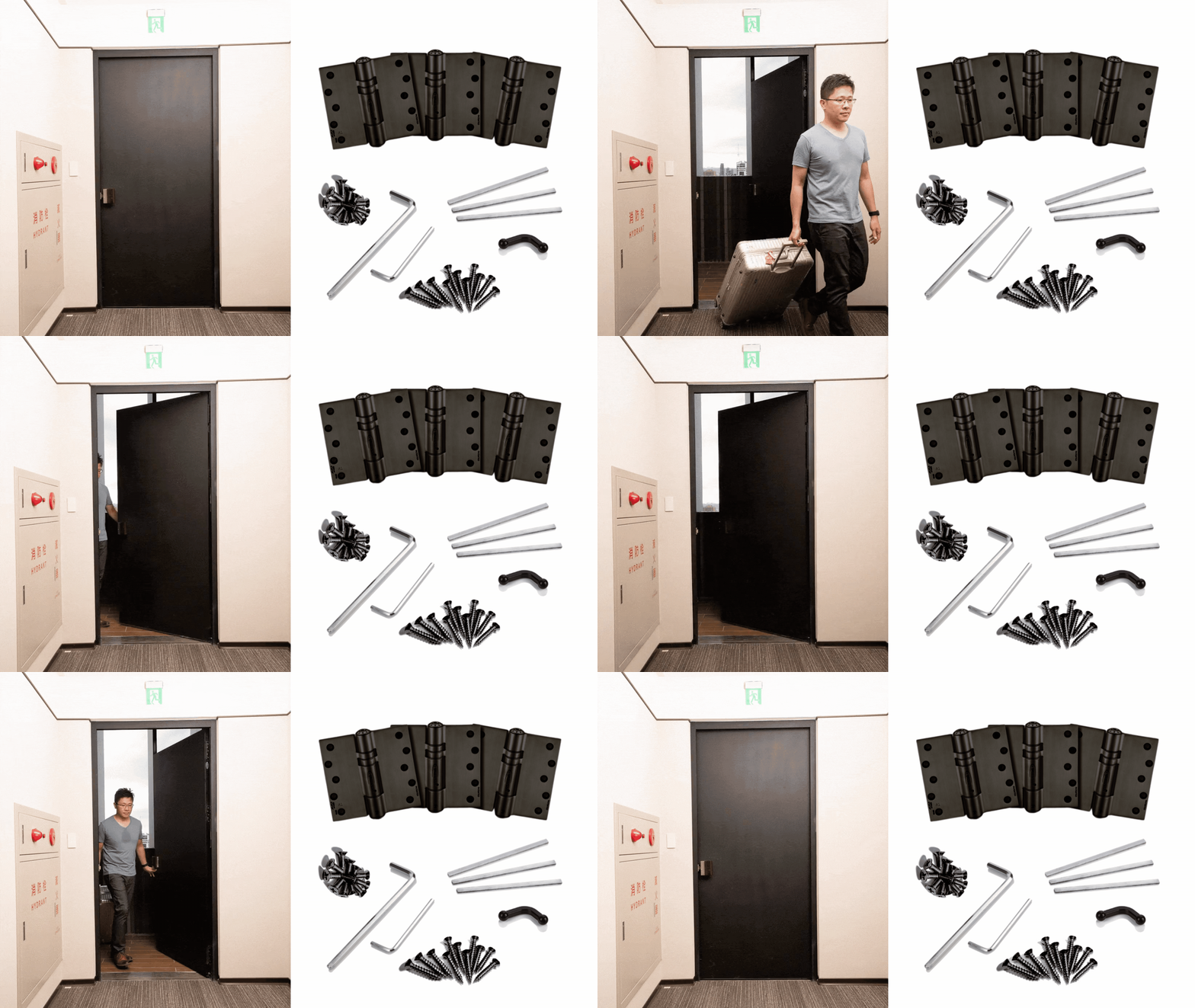
Hardware Is the Last Mile Nobody Can Afford to Trip Over
Walk any project nearing substantial completion, and you’ll hear the punch list chorus: paint touch-ups, ceiling tiles, and – inevitably – doors that don’t self-close, latch, or pass the 5-lb ADA pull test. The irony is that these problems are rarely the result of exotic design; they stem from simple coordination misses.
Project managers already juggle spreadsheets for framing, glazing, and MEP rough-in, but door hardware involves an extra layer of complexity. A single hinge spec affects fire rating, ADA force, acoustics, security, and aesthetics. Misorder one part number, and you multiply rework across every opening tied to that submittal.
In other service trades, tighter sequencing is already standard. Arborist crews, for instance, use tree service software to map routes, confirm material readiness, and log field adjustments before crews leave a site. That level of operational discipline is beginning to migrate into specialty hardware contracting, and for good reason: it protects margins and keeps buildings on the right side of code.
Why 2026 Raises the Stakes
- Code Enforcement Has Accelerated. Several U.S. municipalities have adopted NFPA 80’s annual fire-door inspection verbatim, and inspectors now carry force gauges and digital timers. Under ADA Section 404.2.8, a door closer must allow a minimum of 5 seconds to sweep from 90° to 12° from the latch, meaning a door that slams shut too quickly fails the accessibility test, not one that closes too slowly. NFPA 80 separately requires that fire doors fully close and positively latch from any open position, with no tolerance for a door that stops even a fraction short of the frame. Either failure no longer earns a warning; it triggers a failed inspection.
- Market Momentum Is High. Dodge Construction Network data shows nonresidential starts trending 6.5 percent higher on a trailing 12-month basis into mid-2026, with data centers overwhelmingly driving the commercial sector’s strongest gains. Institutional sectors such as healthcare and higher education have seen starts modestly decline over the same period, making hardware compliance in those existing-building renovation pipelines even more consequential.
- Liability Exposure Grows. Insurance carriers are scrutinizing fire-door records. Industry fire-safety guidance broadly recognizes that improper closure tension is a contributing factor in smoke migration during contained-fire events.
With bigger backlogs and tougher enforcement, any lapse in hardware coordination now ripples through certificate-of-occupancy timelines and insurance underwriting.
Waterson Hinges: A Single Component, Triple Impact
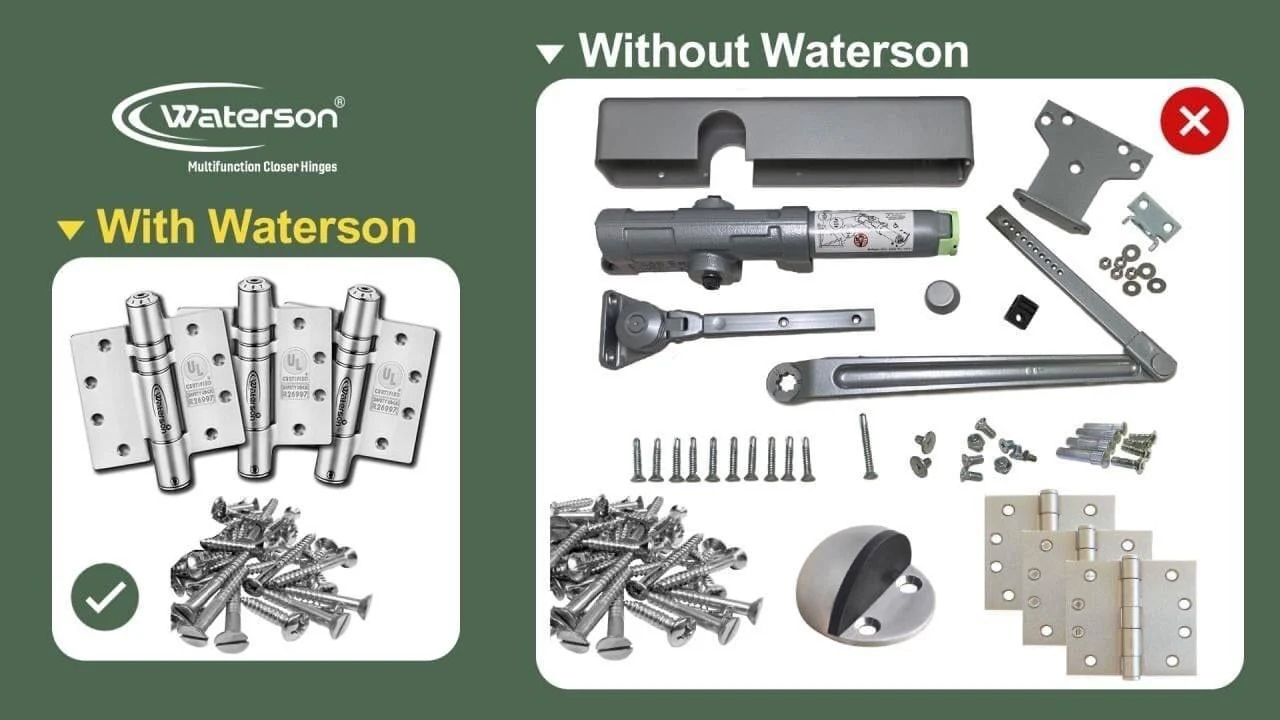
Traditional closer arms, spring hinges, and hold-open devices live in separate silos on the hardware schedule – three SKUs, three potential failure points. Waterson USA changed that equation by integrating them into one stainless-steel closer hinge that mounts like a standard butt hinge. For AEC professionals, this consolidation offers three distinct advantages:
- Less Trade Handoff. The same crew hanging doors can install the closer, reducing subcontractor overlap.
- Cleaner Aesthetics and ADA Clearance. No overhead box or arm to conflict with recessed ceilings or throw off sightlines.
- Reduced Maintenance. Fewer exposed parts means lower vandalism risk in schools and public buildings, and stainless steel shrugs off humidity that destroys traditional closer bodies.
Every 7-foot commercial door typically receives three Waterson hinges. Each hinge bears its own numerical tension dial, enabling field techs to fine-tune closing speed and latching force so the assembly passes both ADA and NFPA criteria in one visit.
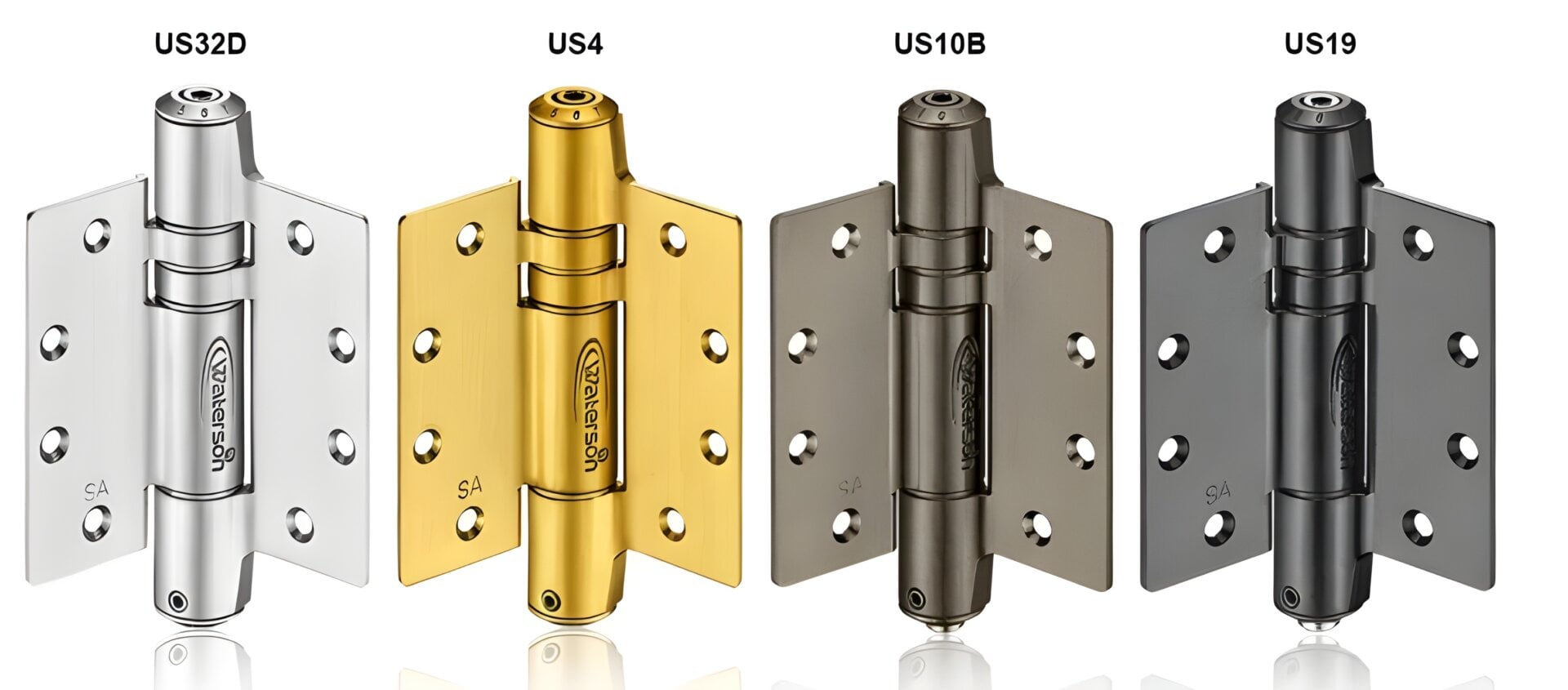
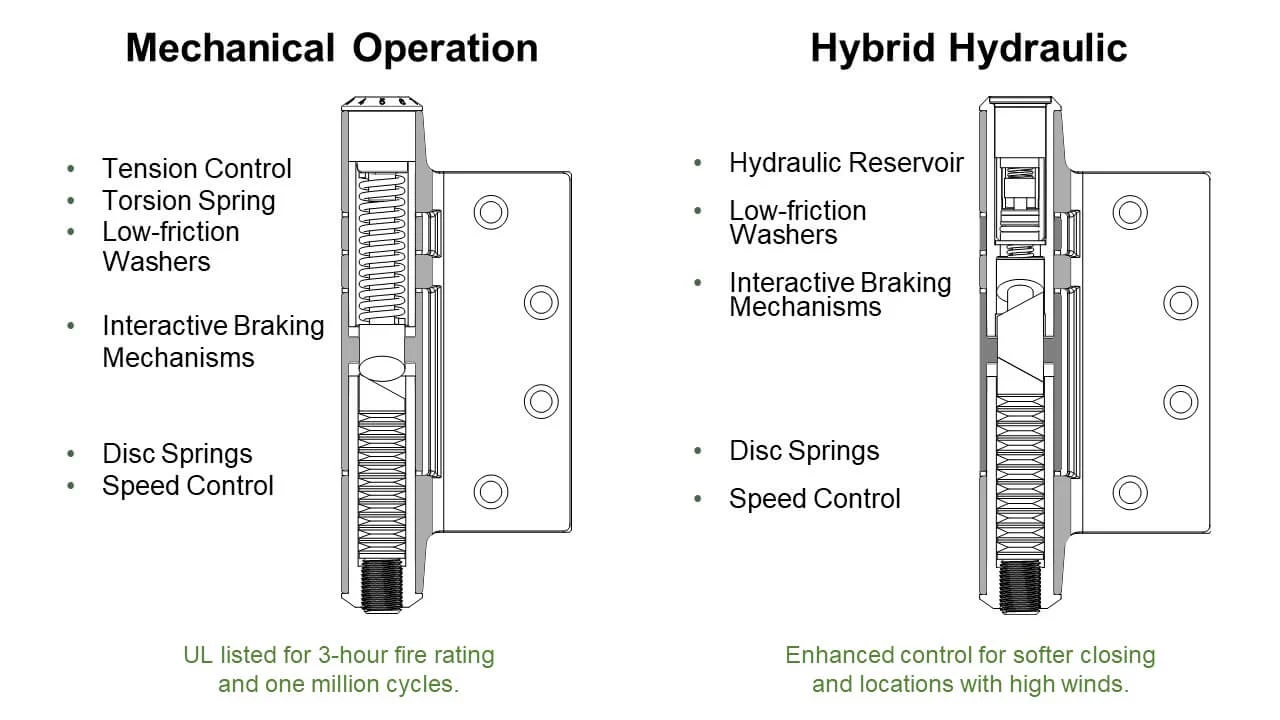
Mechanical-Only vs. Hydraulic Hybrid
Waterson’s catalog splits into M (mechanical spring) and H (mechanical + hydraulic damping). The hybrid model’s fluid chamber cushions the final phase of the closing arc with an adjustable buffer activation angle that field technicians set during installation, preventing the door from slamming against the smoke gasketing. This is a crucial benefit in patient-care wings and hotel corridors where noise reduction is part of the spec. Both models retain full UL 3-hour fire ratings and ANSI/BHMA Grade 1 durability, but choosing the right suffix (M or H) on the purchase order matters. Get it wrong, and your installers will spend the afternoon swapping hinges instead of dialing tension.
The Cost of Coordination Gaps – Real-World Pain Points
Even seasoned contractors underestimate how many players touch a single door opening:
- Framers set the hollow metal frame.
- Millworkers deliver prefinished wood leaves.
- Electricians fish the card-reader wiring through the hinge jamb.
- Hardware specialists show up last, often to find the frame out of plumb or the wrong backset mortised.
Slip anywhere in that relay race and the project eats delay costs. According to a landmark Autodesk and FMI study, poor communication and bad project data account for 48 percent of all rework on commercial jobsites. The vast majority of these overruns are traced to coordination failures rather than labor shortages, a problem squarely in the realm of operations, not manpower.
Waterson’s integrated hinge can’t solve a crooked frame, but it does collapse three potential misorders into one. Still, success depends on locking in the correct SKUs early and conveying adjustment instructions to the field team.
Digital Coordination: Turning Checklists into Live Workflows
Relying on emailed spreadsheets to schedule crews is no longer tenable when a single misclick can delay occupancy.
Specialty contractors who adopt installation scheduling software gain real-time visibility into which doors, frames, and hinges belong together, who is trained on Waterson tensioning, and when inspectors are booked.
The software can embed QR codes on each door tag; techs scan the code, pull up the exact hinge model, watch a 30-second tension-setting video, and log the closing-speed reading on the spot. That record lives in the cloud, ready for the fire marshal and the building owner’s maintenance staff.
Consider a scenario increasingly common on healthcare renovation projects: the GC requires the hardware sub to upload video clips showing each rated door self-closing. The result is zero punch-list items for door operation, and the facility manager has a baseline record before the first annual NFPA 80 inspection, a key point for long-term risk management.
Practical Steps to Tighten Your Hardware Schedule
Improving coordination does not require a cultural revolution; it hinges on four concrete actions.
1. Finalize Hardware Before Frame Release
Waiting until the door package hits the shop floor is a recipe for back-charges. Incorporate Waterson hinge SKUs into the frame approval set so hinge backsets and reinforcement plates align with the actual product, not a generic template.
2. Use Door Numbering That Integrates Adjustment Data
Door 112A on the plan should translate to “(1) hold-open hydraulic + (2) standard mechanical” on the hinge list. Print that combo on the door tag, not in a siloed spreadsheet. Installers should know at a glance which hinge takes the D-suffix hold-open feature.
3. Calibrate Under Real Load, Not on a Workbench
A hinge adjusted on a sawhorse won’t mimic the installed leaf’s weight or gasketing friction. Have techs tension the spring only after the door is hung, latch installed, and closer covers on. Five extra minutes per opening beats a failed inspection later.
4. Log Inspection-Grade Evidence
A smartphone video showing the door self-closing from 70° to latch in slightly over five seconds satisfies most AHJs. Store the clip alongside hinge tension settings in your scheduling platform. The record saves headaches when future tenants prop doors open and claim the closer never worked.
Where Waterson Hinges Fit Best and Why Coordination Varies
Different building types impose unique schedule pressures:
- Healthcare & Education. Rated corridors and smoke compartments dominate, so every hinge must prove UL continuity. Waterson’s 4.5″ swing-clear option eases gurney clearance without extra floor space.
- Hospitality. Dozens of room doors per floor mean volume installations and phased turnovers. Bulk ordering hinges by floor reduces handling, while the hold-open feature simplifies housekeeping.
- Multifamily Residential. Corridor entries need fire ratings; unit interiors do not. Mixing Waterson heavy-duty hydraulics at the entry with standard mechanics inside balances cost and performance.
- Retail Storefronts. Aluminum-framed glass doors benefit from stainless hinges that resist corrosion when the air curtain kicks moisture onto the entry.
Coordinating which Waterson variant lands where prevents the classic mistake of sending an interior-only hinge to an exterior pool gate, a scenario that invites rust and warranty claims.
Waterson vs. Overhead Closers: Coordination in Plain Numbers
Consider a clinic wing with 40 fire-rated doors:
| Scope Item | Traditional Overhead Closer | Waterson Closer Hinge |
|---|---|---|
| Hardware SKUs per Door | 1 closer + 3 hinges + 1 hold-open = 5 | 3 integrated hinges = 3 |
| Separate Installation Crews | 2 (door hanger, closer tech) | 1 (door hanger) |
| Field Adjustments | Closer sweep + latch valves, plus hinge lubrication | Spring tension dial (no fluid valves) |
| Average Install Time | 60+ min/door | 30 min/door |
Multiply the 30-minute-or-more savings by 40 doors, and you reclaim more than two full workdays – time that often falls during occupancy crunch.
Long-Term Payoff: Maintenance and Compliance
A door that closes smoothly on day one but slams shut six months later has not solved the owner’s problem. Stainless-steel hinges with integrated hydraulics maintain performance through temperature swings and cleaning cycles better than powder-coated closer arms. Annual fire-door inspections mandated by NFPA 80 require documentation of each hinge’s condition. Keeping the closer inside the hinge body shields critical components from dust and custodial damage, decreasing maintenance tickets.
UL listings remain valid only if the hinge shows no field modifications. Because Waterson units carry a one-million-cycle ANSI Grade 1 rating, maintenance teams can focus on gasketing and latch wear instead of replacing leaking closer bodies.
Bottom Line: Coordination Is a Product Decision
Better installation coordination in 2026 is not just about smarter calendars; it starts with choosing hardware designed for the realities of modern schedules. Waterson USA’s self-closing, fire-rated hinges condense multiple moving parts into one component that travels through procurement, installation, and inspection with fewer handoffs. Pair that simplicity with digital scheduling tools, clear door numbering, and on-site calibration, and the last mile becomes a showcase instead of a bottleneck.
For AEC professionals, the payback appears in fewer RFIs, smoother AHJ walkthroughs, and a maintenance record that insurance carriers appreciate. For owners and facility managers, it means doors that close quietly every time and, in an emergency, close when they absolutely must.
Recent Post
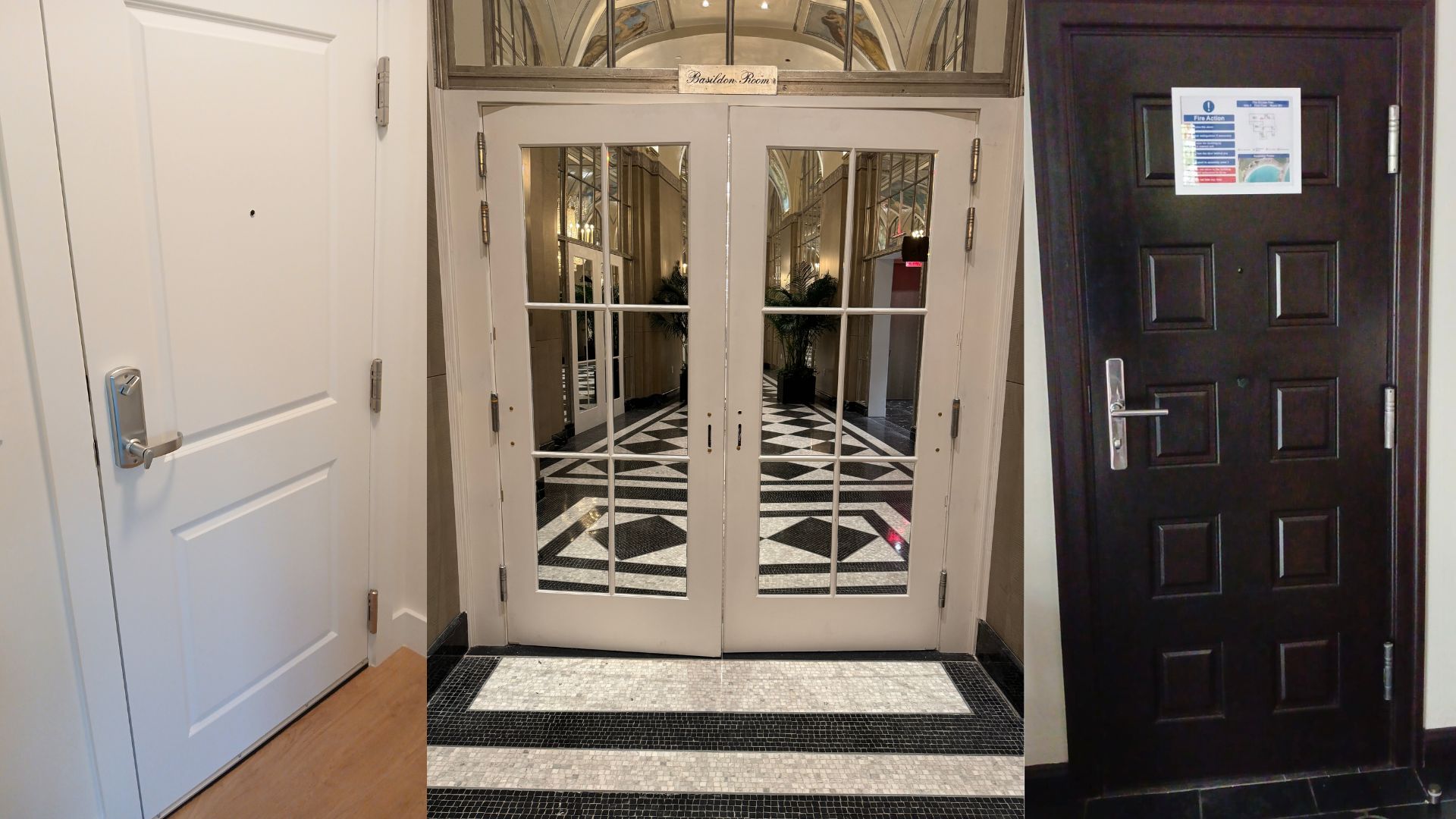
Wind Tunnel Effect Between Buildings: Why Doors Slam and How to Minimize It
Most commercial self-closing hinges still adopt either spring or hydraulic damper for [...]
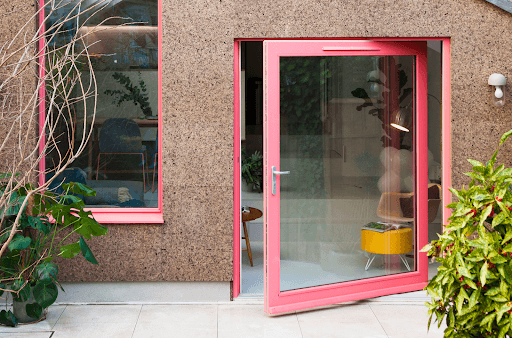
Can Waterson Self Closing Spring Hinges Replace Floor Hinges
"I am contacting you on behalf of H.A. Catholic Church here in San Angelo, TX. We have six 23-year-old interior entrance doors that have closures [...]
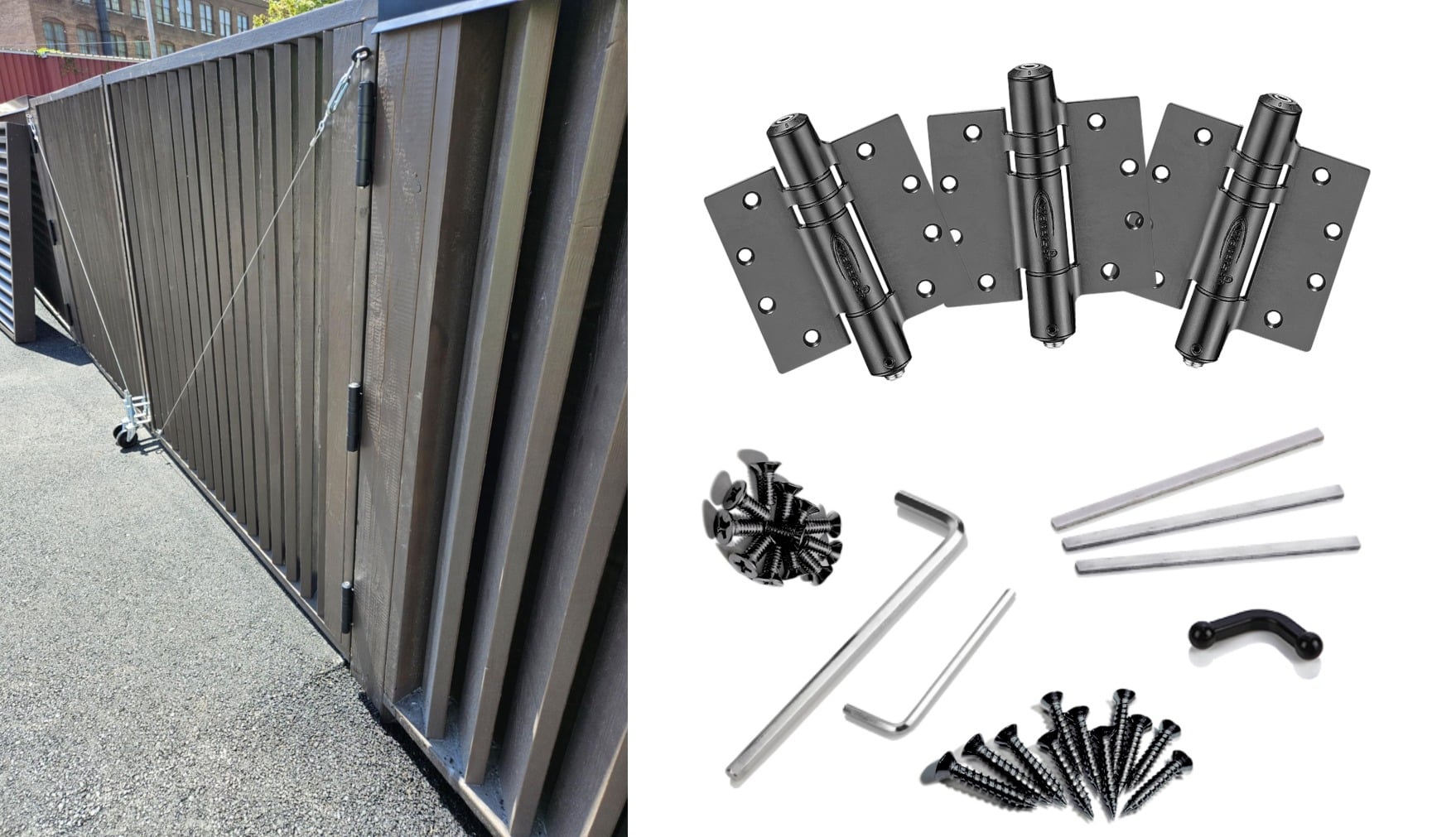
Carriage Door Hinges: Which Hinge Can Hold 450lbs Barn Leaf and Self Close?
"Hello, I am building carriage doors for my barn. They are 5.5' wide by 8' tall and 3" thick solid wood construction. They likely weigh [...]