
Quick Answer
Split the job between two parts of the door. UL-listed self-closing hospital door hinges close the door every time, and positive latching hardware holds it shut. Then adjust opening force and closing speed to ADA limits, and turn on hold-open only on non-rated doors. Doors set up this way close, latch, and stay accessible through thousands of cycles a day without anyone fighting them.
Hospital doors have two jobs that seem to pull in opposite directions. They have to be easy for anyone to open, and they have to close and latch firmly enough to stop fire and smoke. Here’s why both matter, and how to set up each opening, from the hospital door hinges to the latch, so it does both jobs every day.
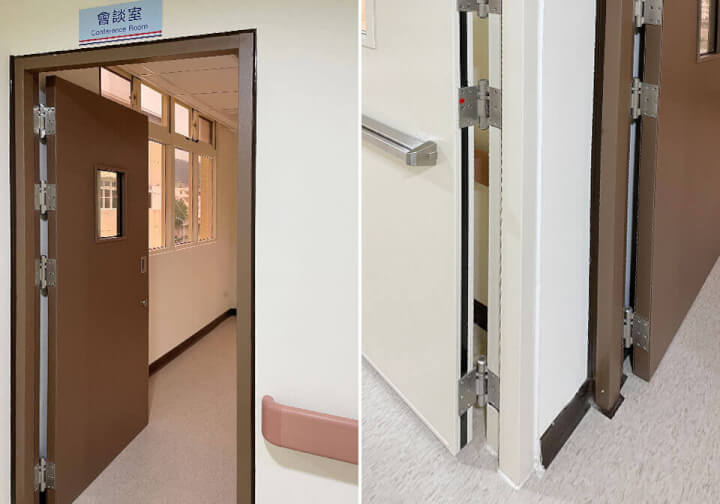
Why Hospital Doors Must Meet Both ADA and Fire Code
Hospitals serve the people who have the least strength to push a heavy door: older adults, children, wheelchair users, patients recovering from surgery, and visitors pushing an IV pole or a stroller. A door that takes too much force, or swings shut too fast, becomes a barrier for them or a safety hazard. ADA limits on opening force and closing speed exist so that everyone can get through the door safely and on their own.
Fire code protects the same people for a different reason. Many patients can’t evacuate quickly, or can’t evacuate at all without help. Fire-rated doors divide the building into protected compartments that slow fire and smoke, so staff can move patients horizontally to a safe zone or shelter them in place instead of evacuating the whole building. That plan only works if every fire door closes and latches when it’s supposed to.
Why High-Traffic Hospital Doors Are So Hard to Get Right
A hospital corridor door needs to open many times a day. It opens for every crash cart, every powered bed, every IV pole, and every nurse with full hands. If the door closes too hard, it can hit a patient and slams all shift long. If it closes too softly, it stops short of the latch, which is a hassle for staff and a failed fire door.
A single overhead closer gets tuned up to latch reliably, and it’s no longer accessible. Then it gets tuned down for accessibility, and it stops latching. The fix is not a better compromise. The fix is to give each requirement its own hardware, starting with the self closing hospital door hinges.
Sort Every Opening by What the Code Asks of It
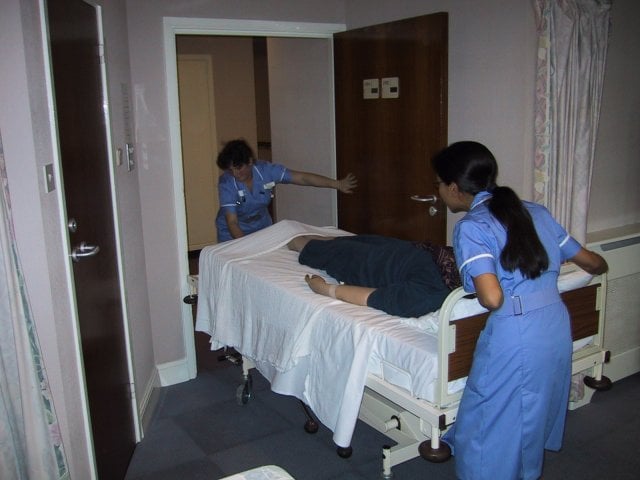
Before you choose hardware, find out what each opening has to do. One example that surprises people: patient room corridor doors in fully sprinklered facilities usually don’t need to be fire-rated, but they still need positive latching hardware.
| Opening type | What the code requires | Recommended setup |
|---|---|---|
| Fire-rated doors (stairs, exits, fire barriers) | Self-closing or automatic-closing, positive latch, listed hardware | UL listed self-closing hinges, active latchbolt, hinge hold-open OFF |
| Patient room corridor doors | Positive latching, smoke resistance, no roller latches | Hydraulic swing clear hinges for bed clearance, positive latch |
| Smoke barrier and cross-corridor doors | Self-closing or automatic-closing, positive latch | Self-closing hinges, positive latch, hinge hold-open OFF |
| Non-rated support rooms (clean supply, staff offices) | ADA force and speed limits | Self-closing hinges, hold-open enabled where staff need it |
Send us your door schedule, and we’ll mark the right hinge and hold-open setting for each opening.
The Four-Part Method That Keeps Doors Closing, Latching, and Moving
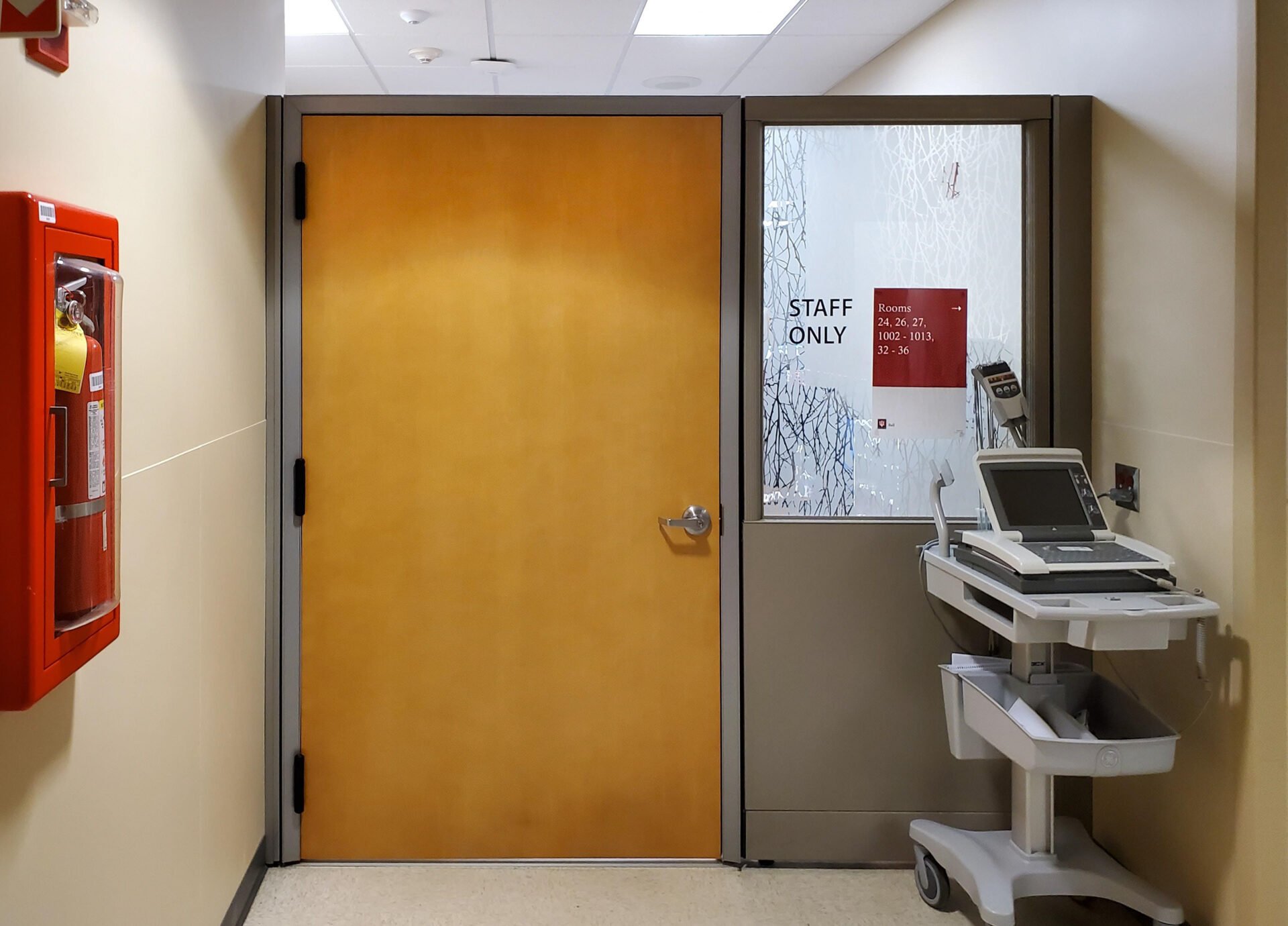
Each step below solves one requirement with one piece of hardware. Put together, they give you a door that meets NFPA 80, NFPA 101, and ADA without any setting fighting another.
1. Let UL Listed Hospital Door Hinges Close the Door
On a fire door, the closing device has to be listed, and a closer is not your only option. The model codes and referenced standards accept listed spring hinges as the closing device. Waterson self-closing hinges are UL certified as swinging fire door closers under ANSI/BHMA A156.17 and CAN/ULC S133 (view the UL certificate). Because the closing force sits inside the hinge barrels, there is no arm hanging off the door frame for a gurney to hit.
2. Let the Latch Keep the Door Shut
The hinge closes the door. The latch locks it in place once it’s closed. When the door reaches the frame, the latchbolt engages the strike, so heat and pressure from a fire can’t push the door back open. NFPA 101 requires this positive latching on health care corridor doors, rated or not. Skip roller latches entirely. They hold the door with friction only, they don’t count as positive latching, and 42 CFR 482.41 prohibits them on corridor doors in all Medicare and Medicaid facilities.
3. Tune Force and Speed for ADA, Then Lock the Settings
ADA caps opening force at 5 lbf for interior doors other than fire doors, and fire doors should use the minimum force the authority having jurisdiction allows. According to ADA 404.2.8, speed matters just as much: door closers need at least 5 seconds to move from 90° to 12° from the latch, and spring hinges need at least 1.5 seconds to close from 70°. Waterson hydraulic hinges adjust swing speed, latch speed, and a 30° hydraulic zone with a hex wrench, so you can slow the sweep for patients and still finish strong at the latch. Once the settings are right, lock the speed screws so daily traffic can’t knock them out of adjustment. For more on balancing these two numbers, see ADA Force vs Fire Door Latching.
4. Use Hold-Open Only Where the Door Is Allowed to Stay Open
Some doors need to stay open during a shift. A clean supply room being restocked, a staff office next to the nurse station, or a linen room during deliveries all run smoother when staff don’t have to prop the door with a cart. Others must never stay open: stairwell and exit doors, fire barrier doors, and smoke barrier doors have to close and latch every time someone walks through.
On Waterson hinges, hold-open is optional and quick to turn on or off with a hex wrench, so you set it per door instead of buying different hardware. Turn it on for non-rated doors where staff need it, and leave it off everywhere else.
Waterson hinge hold-open is a mechanical feature. Once engaged, the door stays open until someone closes it by hand. It does not release automatically when a fire alarm sounds, and Waterson does not supply fire alarm release devices. Never enable hold-open on fire-rated doors, and especially not on stairwell or exit doors.
Why Self-Closing Hinges Hold Up Better Under Hospital Traffic
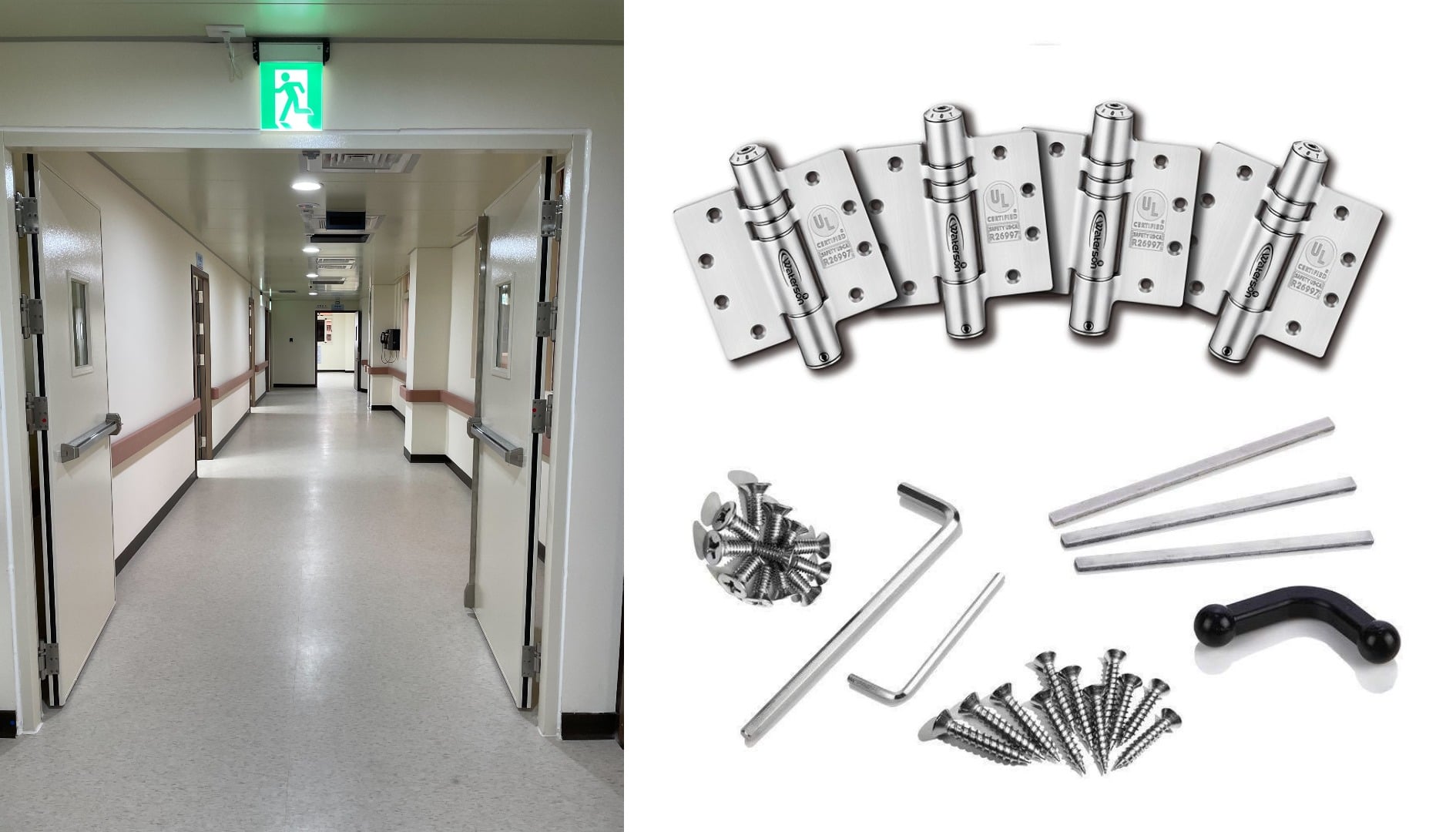
Overhead closers work, but in a hospital they take abuse. The arm sits right where bed rails, carts, and equipment poles hit. It also adds hard-to-clean surfaces at the top of the door. Self-closing hospital door hinges keep the mechanism inside the barrel, out of the way of impacts and with fewer surfaces for environmental services to wipe down.
Material matters too. Hospital doors get cleaned with strong disinfectants every day, so specify 304 stainless steel hinges with a satin finish that won’t pit or corrode. For patient rooms, hydraulic swing clear hinges move the door leaf completely out of the opening, so you get the full clear width for beds and wheelchairs without upsizing the frame. See room-by-room recommendations in our hospital door hinges guide.
Waterson stainless steel mechanical hinges carry a 10-year warranty, and hydraulic models carry 3 years for indoor use. If a door doesn’t need soft closing, a mechanical hinge gives you the longest coverage. See the full warranty terms.
Real-World Example: Chinese Hospital, San Francisco
Chinese Hospital is a community medical center in San Francisco. It needed replacement hospital door hinges for 16 patient room doors that would close softly instead of slamming. The doors are about 4′ x 7′ and weigh roughly 120 to 150 lbs, which is typical for heavy hospital leaves.
The team installed Waterson hydraulic swing clear hinges in 304 stainless steel, with controlled closing speed and adjustable settings. The swap went quickly, and the doors now close quietly and reliably. That makes a real difference on a unit where patients are resting and staff walk through the same doors all day.

High-Traffic Hospital Door Frequently Asked Questions
Positive latching hardware, used with a self-closing device. During a fire, heat and pressure can push a door away from the frame, and friction devices like roller latches can’t resist it. A positive latch engages the strike every time the door closes, so the door stays shut until someone turns the lever.
Yes, as long as the hinges are listed for that use. The model codes accept listed spring hinges as the closing device on fire doors. Waterson hinges are UL certified as swinging fire door closers. See the UL certificate.
Yes, but they don’t get unlimited force. The IBC limits fire doors to 30 lbf to set the door in motion and 15 lbf to swing it fully open. Aim for the lowest force that still latches reliably.
No. A mechanical hold-open keeps the door open even during a fire, which defeats the purpose of a fire door. Codes only allow fire doors to be held open by devices that release automatically when the fire alarm or a smoke detector activates. Use Waterson hold-open only on non-rated doors.
Not in facilities that take Medicare or Medicaid. NFPA 101 still allows roller latches in a few existing-building cases, but CMS and The Joint Commission do not allow them on corridor doors, including doors to patient rooms.
Request For Quote
Please note that Waterson closer hinges start from a size of 4″x4″. If you’re in need of smaller self-closing hinges, we’d recommend checking out some other resources! Also, we only provide single acting closer hinges. Thank you.
Recent Post
Best Way to Secure High-Traffic Hospital Doors While Staying ADA and Fire Code Compliant
Quick Answer Split the job between two parts of the door. UL-listed self-closing hospital door hinges close the door every time, and positive latching hardware [...]
What Leads to Premature Wear in Commercial Door Hinges on Storefronts
Quick Answer Premature wear in storefront door hinges usually comes from four causes working together: a hinge grade too low for the traffic, a door [...]
Which Commercial Door Hinges Are Best For Busy Retail Entrances?
Most commercial self-closing hinges still adopt either spring or hydraulic damper for [...]