
“We manage the entrance doors for a strip of retail tenants, and two of the anchor stores go through hinges and closers almost every year. The doors dragged, and the closer cranked up to force the latch. We failed the code check. What commercial door hinges for busy retail entrances can actually last?
From our customer’s request, we can actually see four questions hiding inside one:
- How many cycles is the opening really taking each day?
- Can the door hold its alignment under that load, or will it sag and drift?
- How many separate devices are you keeping alive on one leaf?
- And does the whole set survive an exterior, code-rated threshold?
Let’s walk through them one at a time, then look at where Waterson fits.
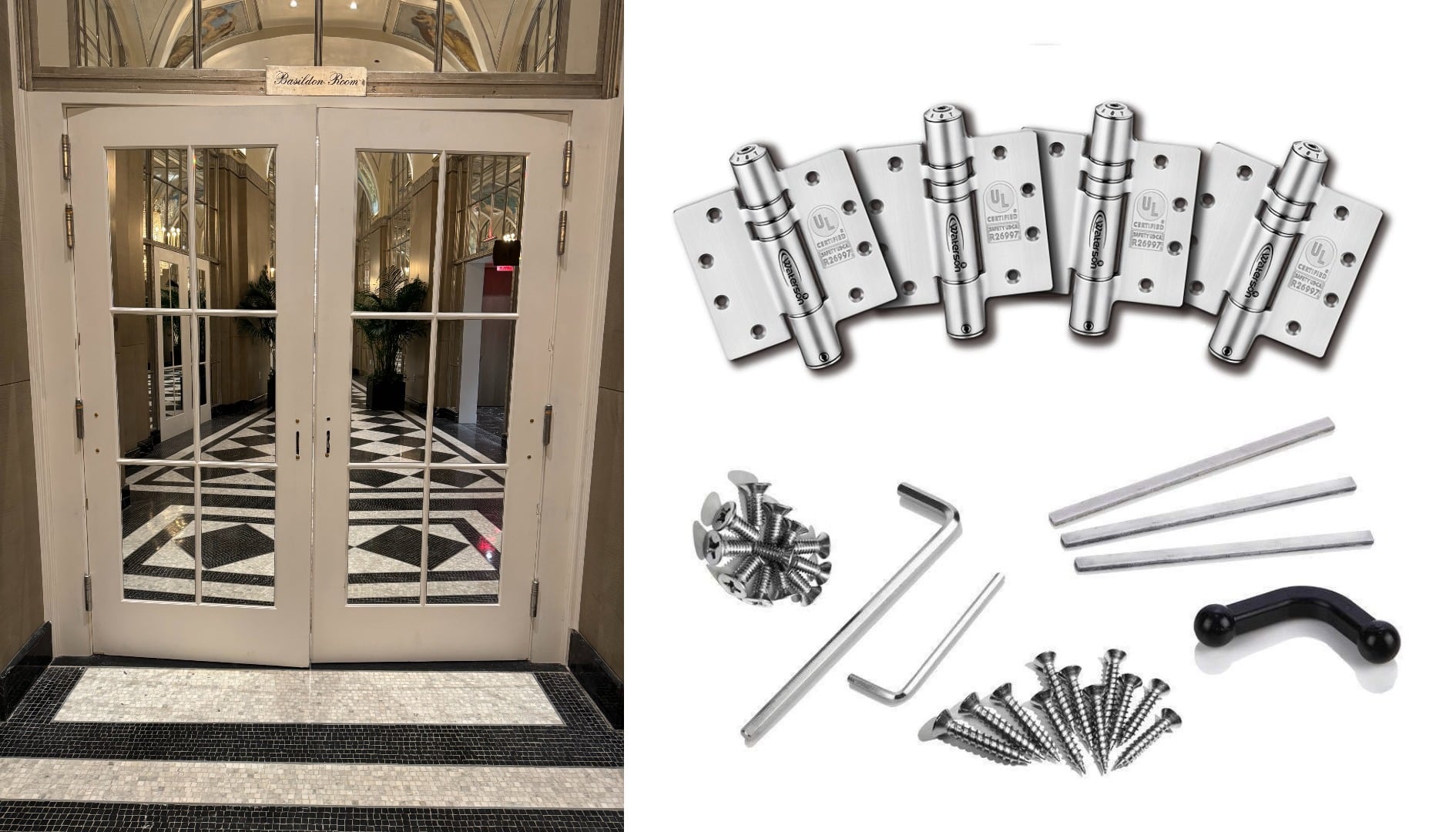
How Many Cycles Does a Busy Retail Entrance Really Put on a Hinge?
Start with the traffic, because it sets everything else. A single grocery, pharmacy, or mall entrance commonly runs 500 to 2,000 open-close cycles a day. At just 1,000 cycles a day, that opening passes roughly 365,000 cycles a year. A hinge built to a light interior spec is mechanically spent inside eighteen months at that rate, which is exactly why the same two doors keep coming back on the service log.
There is only one cycle number worth specifying at a retail door: ANSI/BHMA A156.17 Grade 1, the one-million-cycle line. Anything below that is a countdown, not a rating. Here is how the common formats compare against that reality.
| Hinge type | Where it fits a retail entrance | Why it holds up (or does not) |
|---|---|---|
| Heavy-duty ball-bearing butt hinge | Most storefront and vestibule leaves | Bearings carry constant traffic, load shares across every leaf, drops straight into A156.7 prep. Specify Grade 1. |
| Geared continuous hinge | The most abused big-box and grocery leaves | Supports the leaf along its full height, resists sag, but non-standard prep and a higher install cost. |
| Plain-bearing butt hinge | Not a retail entrance part | Wears fast under frequent cycling. Fine for a light interior door, wrong for the front door. |
| Self-closing NRP hinge) | High-traffic leaves that also need closing, hold-open, and a stop | Consolidates closing and stop into the hinge on standard prep, so the device count drops. |
The takeaway for a spec writer is simple. At a busy entrance the bearing surface and the cycle rating are the whole game. Plain-bearing leaves do not belong on the opening, and whatever you choose has to carry a Grade 1, one-million-cycle number in writing.
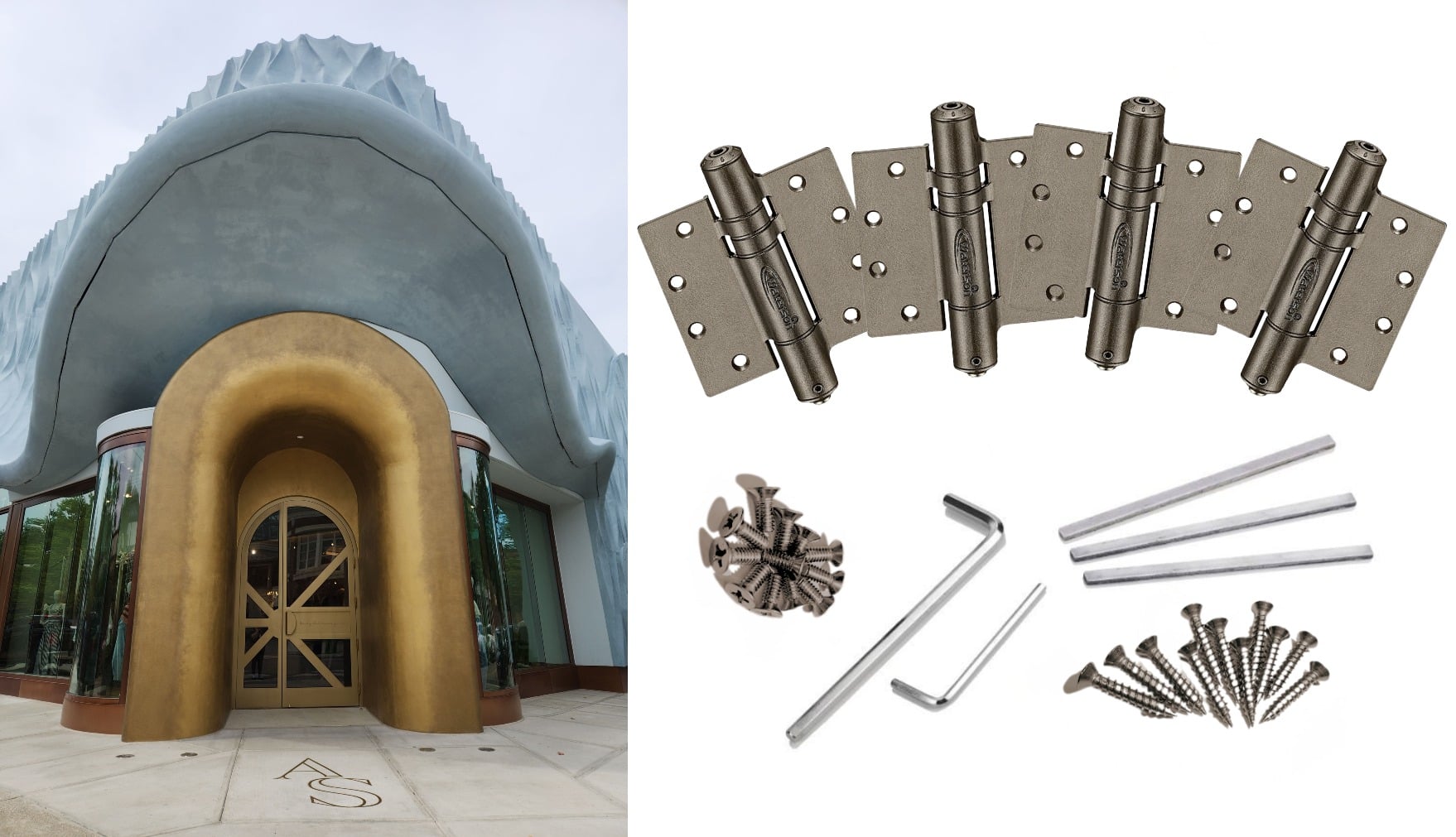
Why Do Retail Entrance Doors Sag, Drag, and Fail the ADA Check by Year Two?
Sag is a load problem before it is a hinge problem. When a heavy leaf rides on too few points, or on worn plain-bearing leaves, the top hinge starts taking more than its share, the gap at the top opens up, and the latch edge drops.
From there it usually runs like this:
- The door drags the strike and binds against the frame.
- It stops latching on its own, so someone cranks the closer spring up to force it shut.
- Opening force climbs past the ADA and ICC A117.1 ceiling.
- The accessible opening that measured under 5 lbf and closed in over 5 seconds on day one now fails both.
Nothing about the building changed. The hinges simply wore out, and turning up the closer only hid that for a while, until an inspection or a customer complaint brought it back into the open.
Every Separate Device on the Opening Is Another Service Call
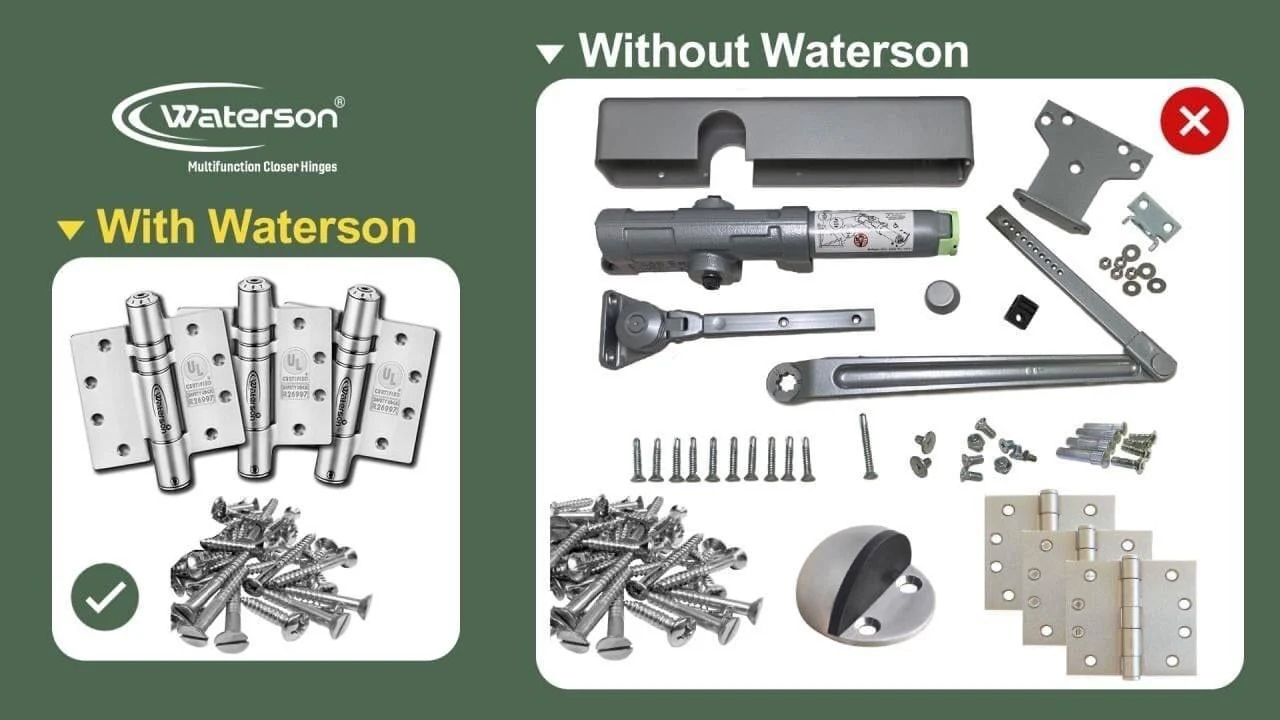
To make a traditional entrance behave, you do not spec one thing, you spec a stack:
- A self-closing closer to pull the door shut
- Standard barrel hinges just to carry the weight
- A door stop to stop the swing
- A separate hold-open device
- Latch tuning so the door does not slam
That is five separate parts on one leaf, and every one is its own failure point. When one goes, that is one more repair call, so on a high-traffic door your maintenance cost multiplies fast.
An integrated self-closing hinge like Waterson makes that whole stack unnecessary. The closing force, the soft close, the hold-open, and the door stop all live inside the hinge, so there is nothing separate to bolt on, adjust, or replace. One part does the job of five, which means fewer things to bump, fewer things to tune, and a far shorter PM list on the doors that punish hardware the hardest.
What Does the Exterior Threshold Add: Weather, Salt, and Security?
A retail front door is an exterior, often all-weather opening, so the material spec is not a detail you can skip. Type 304 stainless covers most storefronts. If the location is coastal, humid, or exposed to deicing salt at the threshold, move to 316, or 316L marine grade, so the finish and the mechanism do not pit and stain in the first winters.
Two more items belong on the exterior spec. Use non-removable pins on outswing leaves so the door cannot be lifted from the hinge side, and confirm the finish is a real architectural finish, not a coating that chalks off under UV and cleaning. The hardware has to survive the weather and the wipe-downs, not just the traffic.
Where Waterson Stainless Steel Commercial Door Hinges Fit the Busy Retail Entrance
Waterson self-closing hinge is a full-mortise, concealed, butt-style stainless hinge that also closes, soft closes, holds open, and stops the door, all on standard ANSI/BHMA A156.7 template prep. For the abused retail entrance in the inquiry above, these are the specifications that matter.
| Feature | Specification | What it does at a retail entrance |
|---|---|---|
| Stainless Steel | Type 304 standard, 316 optional, 316L marine grade | Corrosion resistance for exterior, humid, coastal, and salted thresholds |
| Cycle life | ANSI/BHMA A156.17 Grade 1, 1,000,000 cycles | The durability line for 500 to 2,000 cycles a day |
| Self-closing | Built-in mechanical spring, field adjustable | Meets self-closing with no separate overhead closer to leak or get clipped |
| Soft close | Hydraulic damper on the final degrees of travel | Anti-slam control that protects the frame, latch, and glass |
| Heavy duty | Up to 330 lb, leaves to 4 by 8 ft, add hinges to scale | Carries a heavy entrance leaf without sag on standard prep |
| Door stop | Integrated 90 and 120 degree barrel stops | Removes the separate floor or wall stop from the traffic path |
| Hold-open | Field set near 90 degrees, optional, not on fire doors | One part covers self-closing and hold-open leaves |
| Non-handed | One part fits left and right swing | Fewer SKUs to spec, order, and stock across a tenant strip |
| ADA compliant | Opening force under 5 lbf, closing over 5 seconds, per ICC A117.1 | Holds the accessible opening spec instead of drifting out of it |
| Fire rated | UL certified to 3 hours, meets NFPA 80, tested to 8 ft leaves | Passes rated vestibule and stair-to-retail openings |
| Warranty | 10-year product warranty | Priced for the life of the opening, not the season |
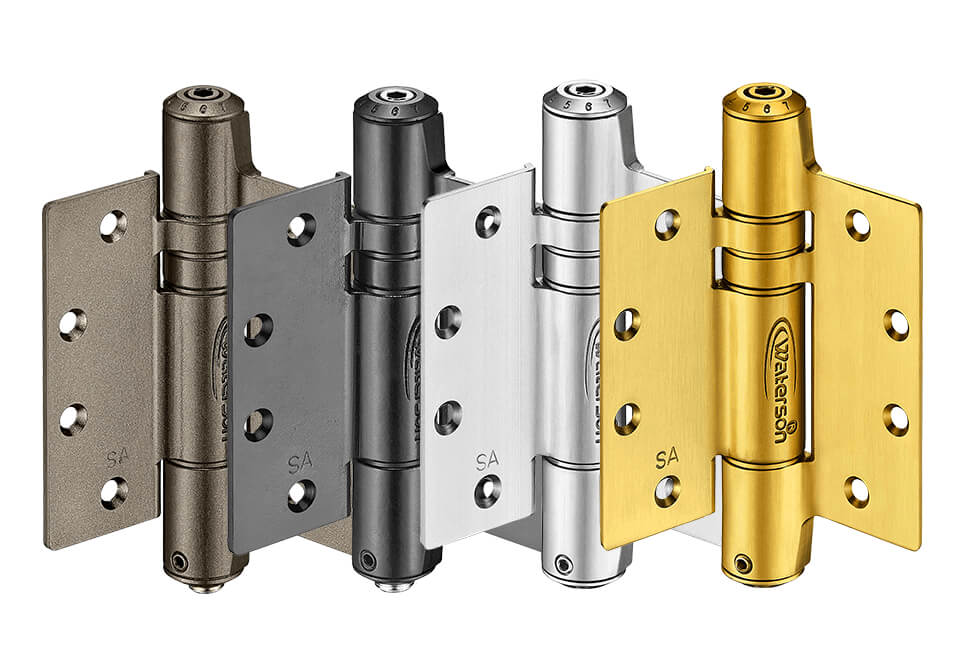
Finishes are Satin Stainless Steel (US32D), Flat Black (US19), Dark Satin Bronze (695), and Satin Brass (US4), so the storefront design match does not cost you the rating. Sizes start at 4 x 4 inches and run 4, 4.5, 5, and 6 inch, and the set ships engineered for the opening.
Waterson Stainless Steel Commercial Door Hinges for Busy Retail Entrances
Waterson self closing door hinges combine the function of an overhead closer and a hinge into a single, sleek component—complete with optional hold-open and door-stop features. Designed for commercial openings, gates, and glass doors, these hinges are easy to install and adjust to meet ADA and ICC A117.1 standards for opening force, while ensuring quiet and secure closure. Crafted from durable stainless steel, they are NFPA 80 compliant, UL 3-hour fire-rated, and built to perform reliably in both interior and all-weather exterior environments. See all our features.
In addition to these performance advantages, Waterson offers custom hinge services. As a direct manufacturer, we can tailor hinge sizes, finishes, and especially hinge leaf designs to meet the specific structural needs of your doors. This makes our hinges an ideal solution for door manufacturers seeking custom options that integrate seamlessly with their existing frames.
Request For Quote
Please note that Waterson closer hinges start from a size of 4″x4″. If you’re in need of smaller self-closing hinges, we’d recommend checking out some other resources! Also, we only provide single acting closer hinges. Thank you.
Recent Post
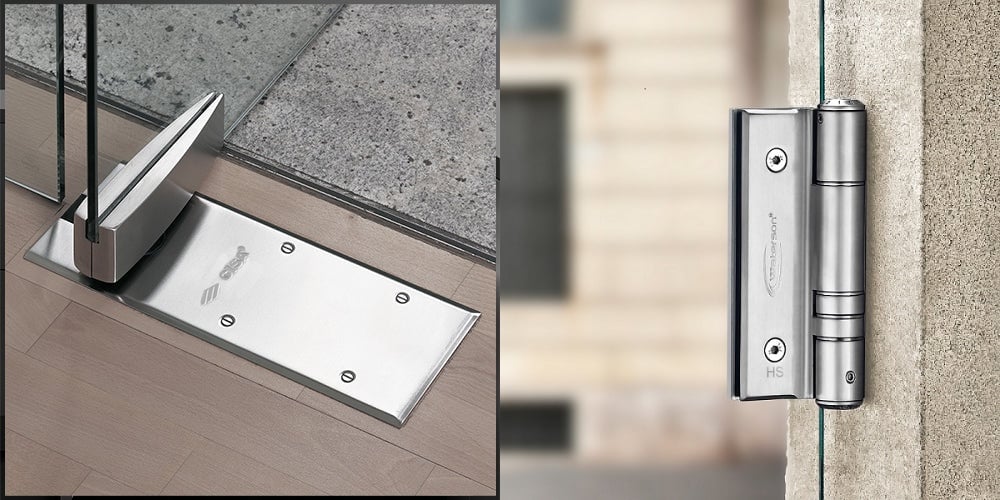
Glass Door Hinges: Floor Spring vs Spring Hinge Compared
Quick Answer Floor hinges (also called floor springs) are hydraulic closers set into the floor slab for center-hung or double-acting glass doors with fully concealed [...]
Stainless Steel Spring Hinges: Self-Closing Hinges for Interior and Exterior Doors
Quick Answer A stainless steel spring hinge is a self-closing hinge with a torsion spring inside the barrel, so it swings the door and closes [...]
Cold Weather Gate Hinges: How Waterson Performs in Winter
When winter comes, temperatures drop, and outdoor fence gates start to behave differently. Wood absorbs moisture and swells, metal contracts slightly, and hardware components shift [...]