
Quick Answer
Yes, a glass door can close on its own without a floor mounted closer by using wall to glass hinges instead. Waterson wall to glass hinges mount directly between the door and wall, supporting glass panels up to 7 feet tall and 260 lbs, with self closing and optional hold open built in. They cost less than a floor spring, install easier, and work outdoors too.
“Can a glass door close on its own without a floor mounted closer?”
Wall-to-glass hinges let a glass door pivot and self close directly from a wall, without the cost and complexity of a floor mounted closer. Waterson wall to glass hinges are built for both commercial and residential entries, supporting glass panels up to 7 feet tall and 260 lbs per set.
If you are considering using Waterson wall to glass hinges, this guide will cover what to prepare, how to install and adjust the hinges correctly, and how many you will need for your specific door.

What to Prepare Before Installing Waterson Wall to Glass Hinges
Before mounting any hardware, lay out everything in the box and gather a few basic tools. A smooth installation depends on having the right fasteners and adjustment wrenches on hand from the start.
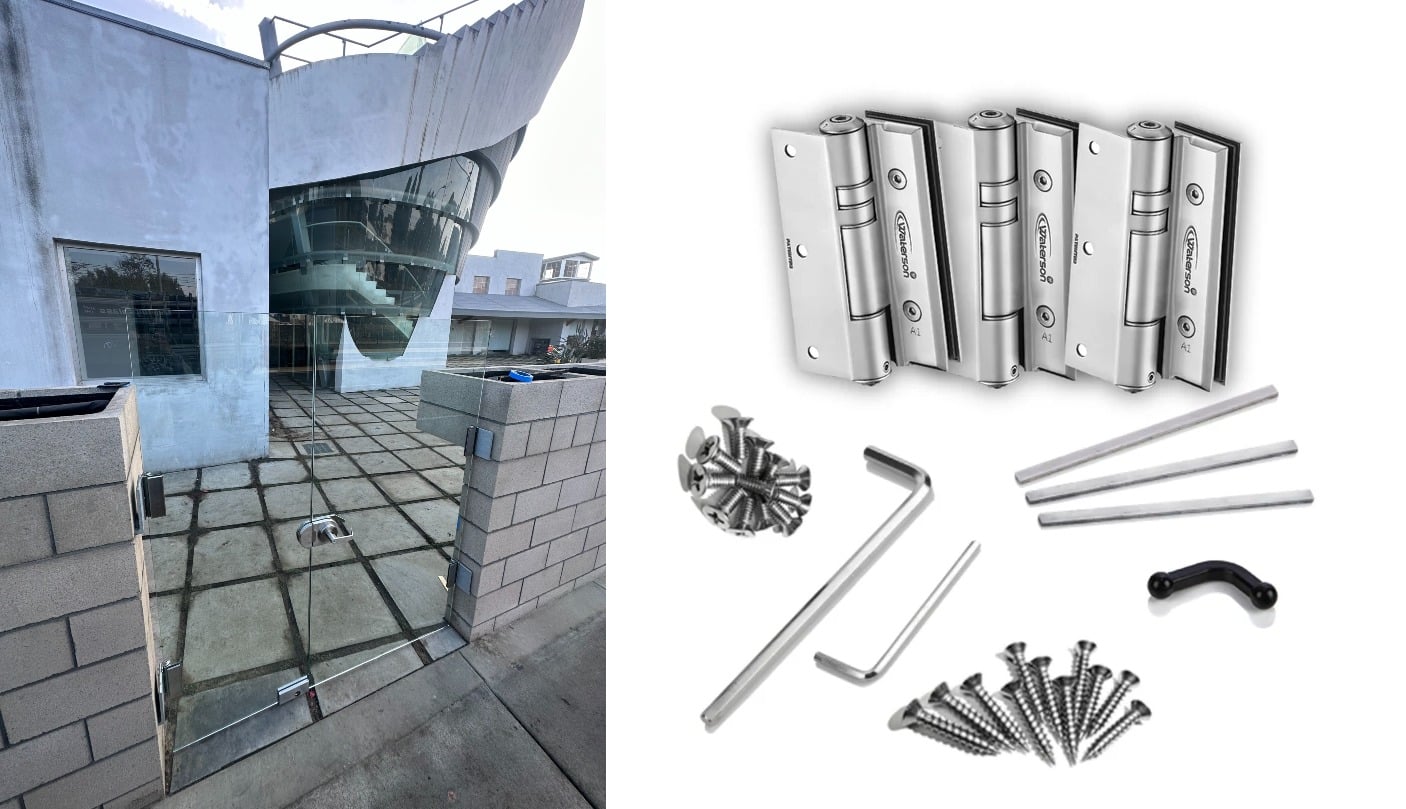
Inside a two-hinge Waterson box, you will find:
- Closer hinges, 2 (one per hinge position)
- Back plates, 2
- Sleeves, 4
- Gasket B, 4
- Gasket C, 4
- Allen key set: 2.5mm, 3mm, 4mm, 5mm
- Flat head machine M6 screws, stainless steel
- Anchors (dowels), 6
The self closing function works with glass from 8mm to 13.52mm (5/16″ to 9/16″) thick. Glass up to 21.52mm (27/32″) still fits the hinge, but only in a fixed, non moving setup without the self closing function.
Tools to have ready beyond what is in the box:
- Tape measure and pencil for marking the wall mounting points
- A drill suited to the wall material, for the anchor holes
- A level to confirm the door will hang plumb once mounted

How to Install Waterson Wall to Glass Hinges
Waterson wall to glass hinges follow a fixed spacing pattern so the door swings evenly and the closer mechanism performs as designed.
- Mark the top hinge 5 inches (127mm, ±1/8 inch) from the upper door edge, and the bottom hinge the same distance from the lower edge. For a third hinge, keep at least 10.95 inches (278mm) between pivot centers.
- Check the glass cutout: hole center 1.57 inches (40mm) from the edge and 5/8 inch (16mm) in diameter. Use the sizing table below to confirm how many hinges your door needs.
- Fit the sleeve and matching Gasket B/C into the glass hole, then secure the door-side leaf of the hinge to the glass with the M6 screw.
- Mount the back plate to the wall at the marked height with the anchors, then attach the wall-side leaf of the hinge.
- Bring the door into position so both halves of the hinge engage, swing it through its full range, then tighten every fastener.

How to Adjust Waterson Wall to Glass Hinges
Once installed, Waterson wall to glass hinges can be fine tuned to match the door size, traffic level, and accessibility needs of the space.
- Before adjusting: install the door so it swings freely and latches on its own, with every hinge still set to the factory N position.
- Tension adjustment: use a 5mm hex wrench to raise tension one number at a time until the door closes and latches from a 20 degree open position. Turn clockwise to increase, moving from N through 0, 1, 2, and on; press down on the hex socket and turn counterclockwise to decrease. Keep all hinges on the same number, and avoid going past 5, since higher settings shorten spring life. Never force the wrench between N and 7, since doing so breaks the hinge and voids the warranty.
- Move the hydraulic zone, if needed: loosen the 3mm locking screw slightly, shift the hydraulic zone with the 5mm wrench, then lock the 3mm screw back down. Turn fully toward plus for light or latchless doors, which is the factory setting, or fully toward minus for doors with a heavier latch.
- Hydraulic damper adjustment: use a 3mm hex wrench. Turn one full rotation toward minus first, then fine tune in quarter turns either direction until the closing speed and damper strength feel right, plus for a faster, softer close and minus for a slower, firmer one.
- Fine adjustment: if the door slams, lower the swing speed, latch speed, or tension. If it does not latch reliably, raise one of those same three settings instead. Make changes gradually, one step at a time, and keep the door within its 0 to 120 degree range, since opening past 120 degrees can damage the hinge and voids the warranty.
How Many Waterson Wall to Glass Hinges Do I Need for My Door?
Waterson’s glass to wall hinge sets are sized by door dimensions, weight, and the features you need: hold open, self closing, or both. The table below outlines the standard configurations for glass to wall doors with a wall width of at least 1-1/2 inch (38mm) and glass thickness between 8mm and 13.52mm (5/16″ to 9/16″).
| Door Size (W x H) | Max Weight | Features | Hinges Needed | Model | Hinge Set |
|---|---|---|---|---|---|
| Up to 6′ x 3′ | ≤150 lbs | Self closing, fluid motion | 2 | K51GWL-B2 | HS.SA |
| Up to 6′ x 3′ | ≤150 lbs | Hold open, self closing, fluid motion | 2 | K51GWL-D2 | HS.SB |
| Up to 7′ x 4′ | ≤260 lbs | Self closing, fluid motion | 3 | K51GWL-B3 | SA.HS.SA1 |
| Up to 7′ x 4′ | ≤260 lbs | Hold open, self closing, fluid motion | 3 | K51GWL-D3 | SA.HS.SB |
Door stop hardware is sold separately: two-hinge sets require one door stop, while three-hinge sets require two. Door stops are available in 90 degree and 110 degree types, and standard glass door operation ranges from 0 to 120 degrees.
Waterson Wall to Glass Hinges vs Floor Spring
Wall to glass hinges and floor springs both let a glass door pivot and close on its own, but they perform very differently in daily use.
| Criteria | Waterson Wall to Glass Hinge | Floor Spring |
|---|---|---|
| Installation position | Installed directly on the door | Buried in the floor |
| User experience | Easy to open | Heavy to open |
| Outdoor use | Yes, with 316 stainless steel | Limited, exposed to water pooling and rust in the floor box |
| Total cost | Low | High |
| Warranty | 5 year warranty | Brand specific |
| Hold open angles | 90° hold open (door stops available at 90° or 110°) | 90°, 135°, 180°, and other angles |

Why Choose Waterson Wall to Glass Hinges
Waterson wall to glass hinges are engineered with advanced features, ideal for high traffic areas, both for indoor and outdoor applications. The difference shows up the moment someone reaches for the door. Waterson hinges can be adjusted to open with 5 lbs of force or less, in line with ADA guidelines, which makes them comfortable for children, seniors, and wheelchair users alike.
- Soft Closing: protects the door from sudden impacts, reducing the risk of pinched fingers and broken glass with controlled closure.
- ANSI/BHMA A156.17 Cycle: engineered to last 1,000,000 open and close cycles without performance loss. See the warranty.
- Load Bearing Capacity: a three-hinge set supports glass doors up to 7 feet tall and 260 lbs.
- Durable Material: made with 304 and 316 stainless steel, corrosion resistant and built for heavy, long term use.
- Adjustability: tension, hydraulic zone, and damper strength each adjust independently to match the requirements of the space.
- Low Force Opening: 5 lbs of opening force or less, improving the experience in high traffic areas.
- Hold Open (optional): stops the door at 85 to 90 degrees without drifting closed.
What Are the Common Applications of Waterson Wall to Glass Hinges?
Because they handle both indoor and outdoor conditions and hold up under frequent use, Waterson wall to glass hinges show up across a wide range of settings. Common applications include retail storefronts and shopping mall entrances, restaurant and cafe glass doors, office and conference room partitions, hotel lobbies and guest area entrances, gyms and fitness studios, and outdoor patio or balcony glass doors where weather resistance matters.
Any space that pairs a glass door with a fixed wall, rather than another glass panel or a metal frame, is a good candidate for this hinge style.
A Self-Closing Glass Door, Minus the Floor Work
A glass door does not need a floor spring to close on its own. With wall to glass hinges, the closing mechanism lives in the hinge itself, so there is no slab to cut, no floor box to collect water, and no second person needed to adjust it. Size the set to your door, two hinges up to 150 lbs or three hinges up to 260 lbs, confirm your glass is between 5/16″ and 9/16″ thick for self-closing, and mount to a wall at least 1-1/2″ wide. Add a door stop, tune tension and damping one step at a time, and the door will close softly every time, indoors or out.
Send your door size, weight, glass thickness, and wall material through a quote request, and our team will confirm the right hinge set and door stop for your opening.
Frequently Asked Questions
Request For Information
Please note that Waterson Closer Hinges start from a size of 4″x4″. If you’re in need of smaller self-closing hinges, we’d recommend checking out some other resources! Also, we only provide single acting closer hinges. Thank you.
Recent Post

Which Self Closing Door Hinges Work Best for LEED Buildings
Quick Answer The best self-closing door hinges for LEED buildings close and latch the door reliably every time, meet ADA opening force and closing speed, [...]
School Door Hinges: What Each Room Needs, from Classroom to Dorm
Quick Answer School door hinges are not one product. Classroom doors need quiet, controlled closing, and they only have to self-close when the corridor wall [...]
Different Types of Gate Hinges Explanation: A Focus on Self Closing Solutions
Quick Answer Heavy duty gate hinges come in three main styles: half surface hinges, best for half doors up to 150 lbs with ADA compliant [...]