
“Our storefront door runs on a floor closer that has been leaking oil for months. Now the door drifts open and slams shut. The installer told us for breaking the concrete to swap the whole unit. Is there a way to replace the floor closer with a door closer that doesn’t live in the floor?
We hear some similar questions like this every month. The good news is that yes, a floor closer can often be replaced with a different type of door closer. The honest news is that the right answer depends on how the door is hung today, and not every opening that runs on a floor closer can take a closer hinge.
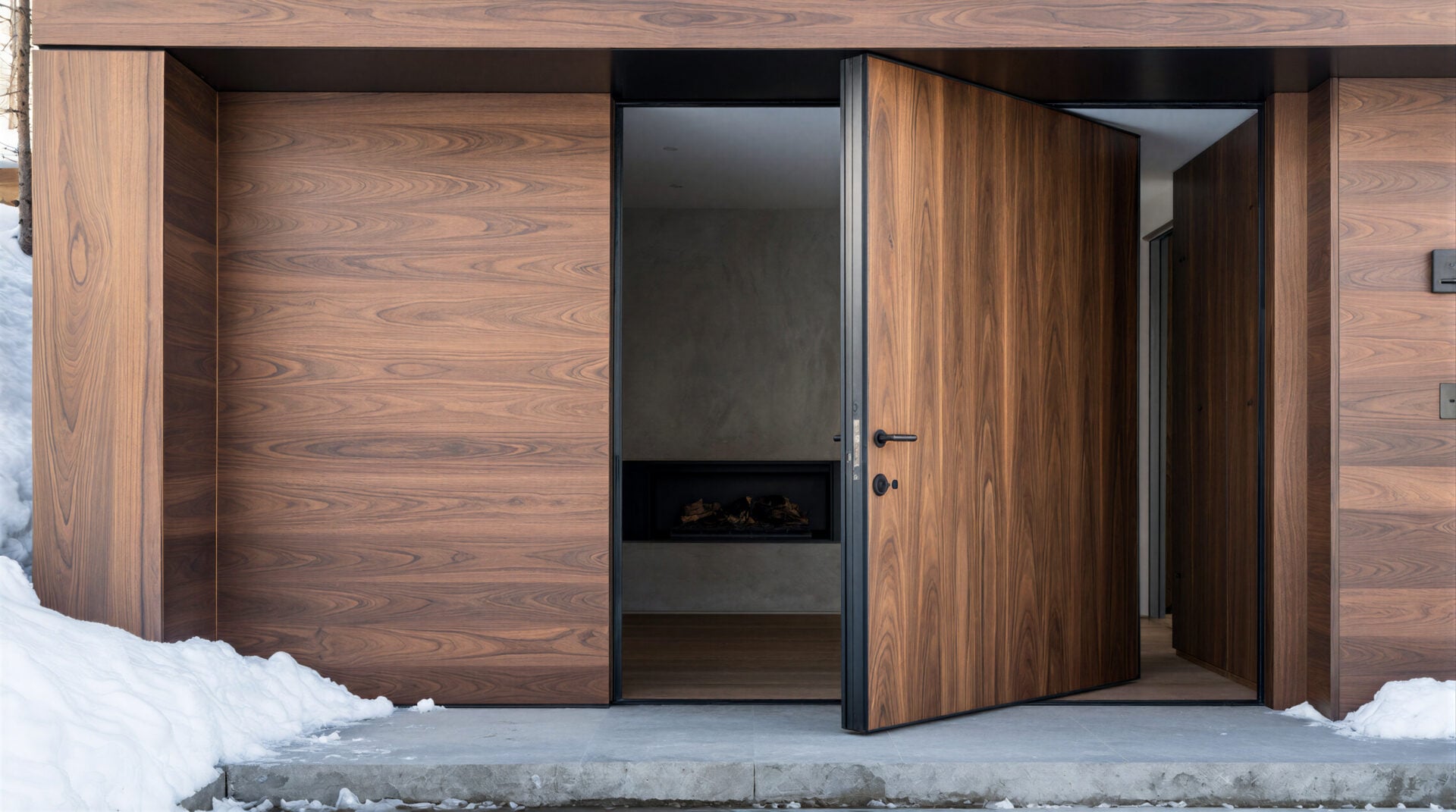
Why Do Floor Closers Fail and Why Are They Hard to Replace?
A floor closer sits in a cement case buried under the threshold. The door either pivots directly on the closer spindle, or on an arm connected to it, with a top pivot at the head of the frame. That design keeps the hardware invisible, but it also puts the whole mechanism in the worst place in the building: the floor.
Common failure points include:
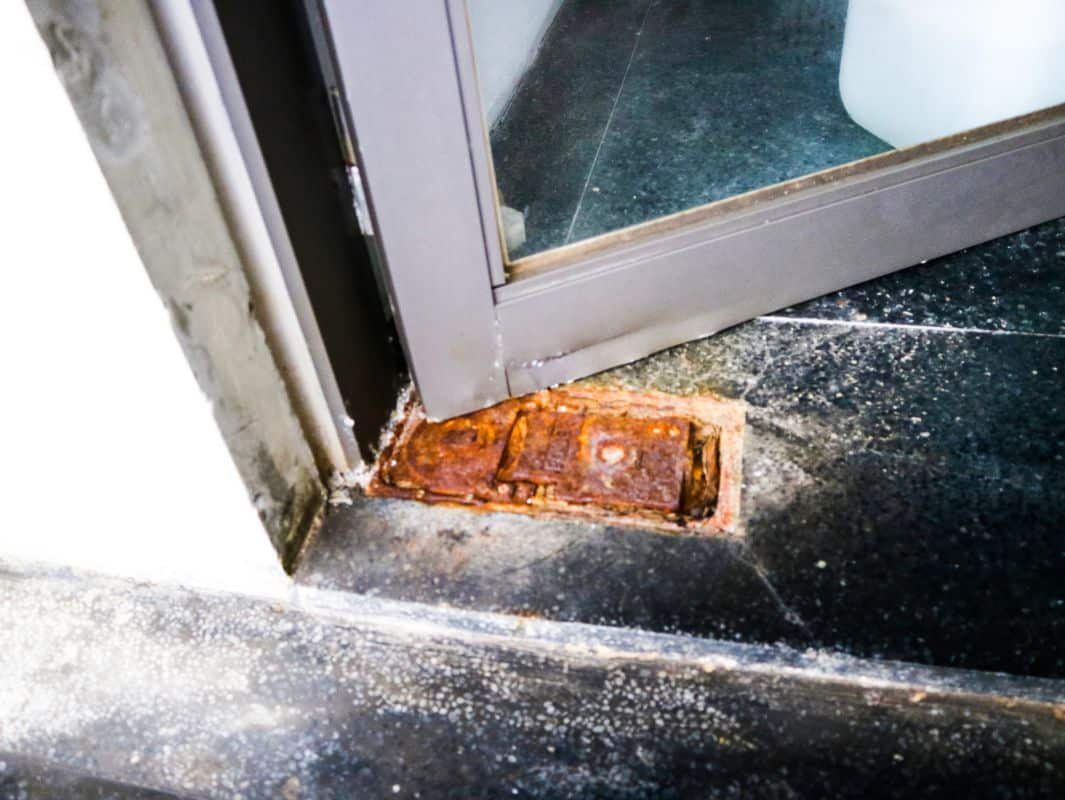
- Water and debris in the pit. Mopping water, rain at exterior doors, and grit settle into the cement case and attack seals.
- Oil leaks. Once a seal fails, the hydraulic fluid escapes and the door loses speed control, so it drifts or slams.
- Replacement cost. If a new unit does not match the existing cement case, the floor has to be cut, the case re set, and the finish floor patched.
- Downtime. At a storefront or a busy corridor, a door out of service for concrete work is a real business cost.
That is why many owners ask whether the next closer should live somewhere other than the floor.
What Are Your Options to Replace a Floor Closer?
When a floor closer fails, you generally have four paths. Each moves the closing mechanism to a different place on the opening.
| Option | Where the mechanism lives | Floor work | Visible hardware | Double acting | Typical retrofit effort |
|---|---|---|---|---|---|
| New floor closer (same type) | In the floor | Yes, unless the case matches | None | Available | Low if the case matches, high if it doesn’t |
| Surface overhead closer | On the door face and frame head | Pit must be filled or capped | Arm and body on the door | Generally no | Moderate |
| Concealed overhead closer | Inside the frame head and door top rail | Pit must be filled or capped | Minimal | Some models | High, needs a deep enough head and top rail |
| Waterson door closer | Inside the hinge barrel | Pit must be filled or capped | Spring door closer only | No, single acting only | Moderate, needs hinge preps on the frame |
Can Waterson Door Closer Replace a Floor Closer?
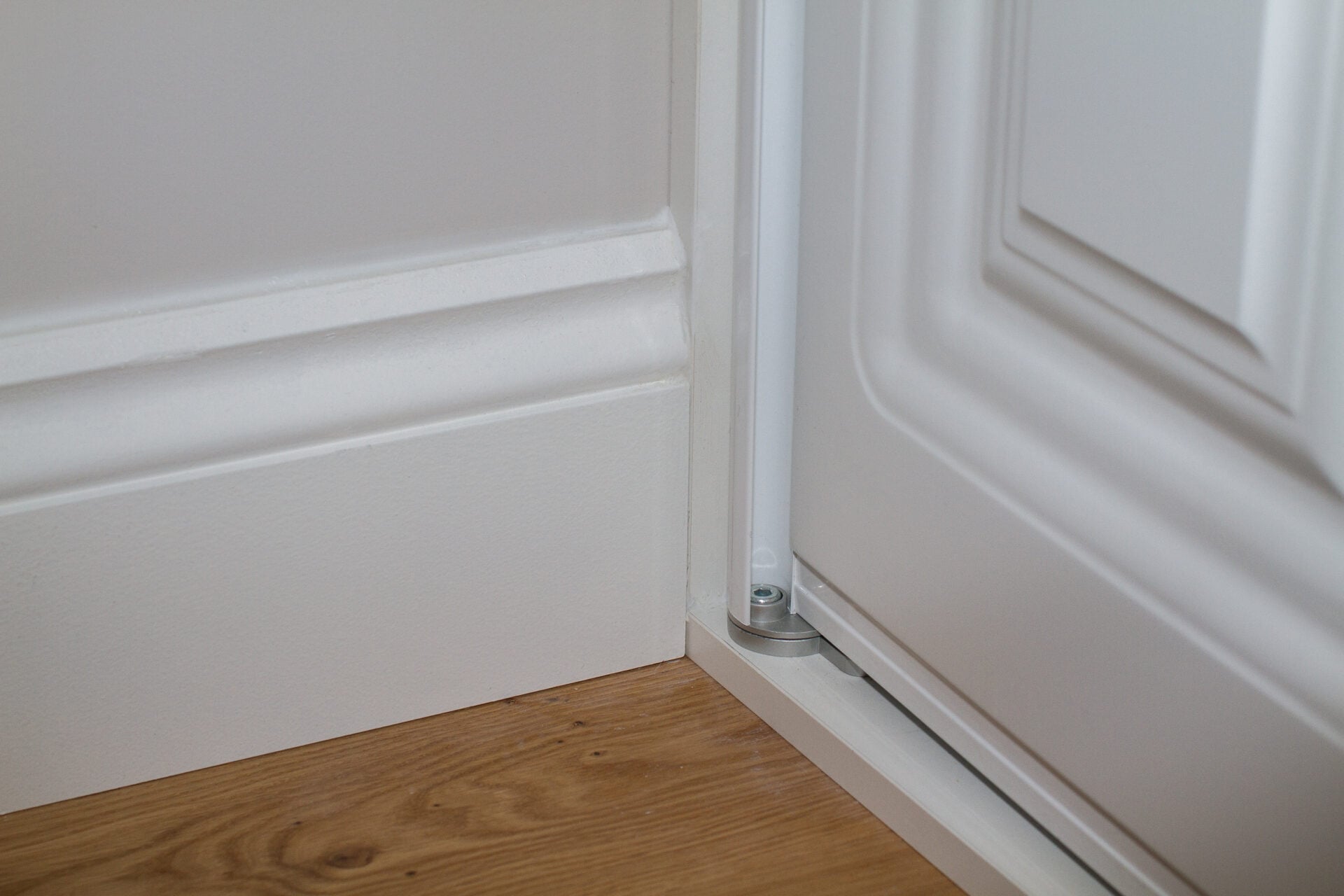
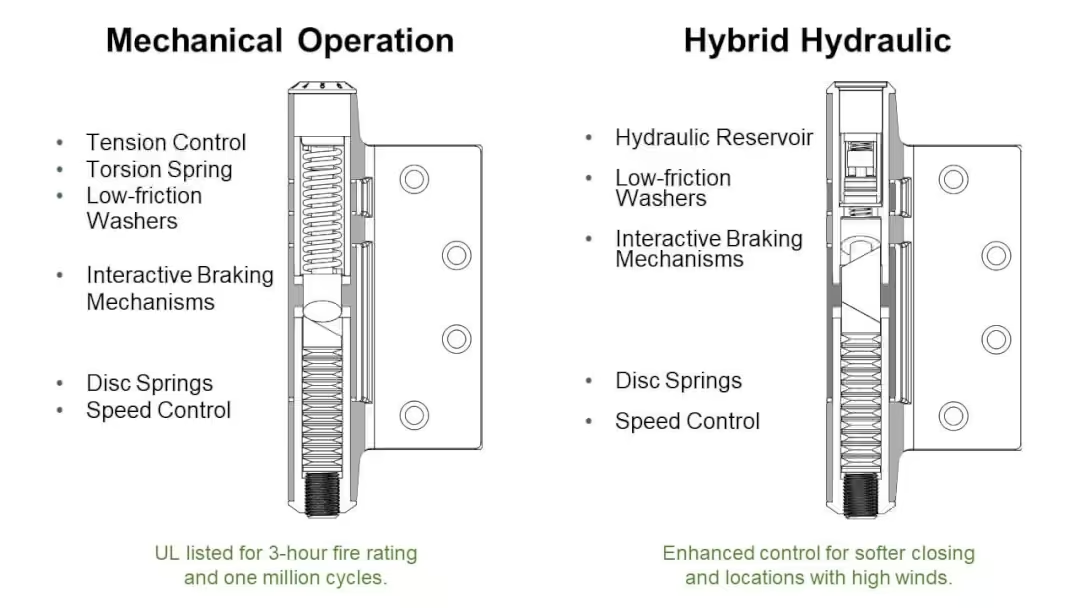
Yes, Waterson can. A Waterson closer hinge packs the spring, the speed control, and optional hold open and door stop functions into the hinge barrel. That means the door gets a self closing function without anything in the floor and without an arm across the face of the door.
However, here are two disclaimers before you buy:
Disclaimer 1: Waterson Spring Door Closer and Floor Closer have Different Pivot Axes.
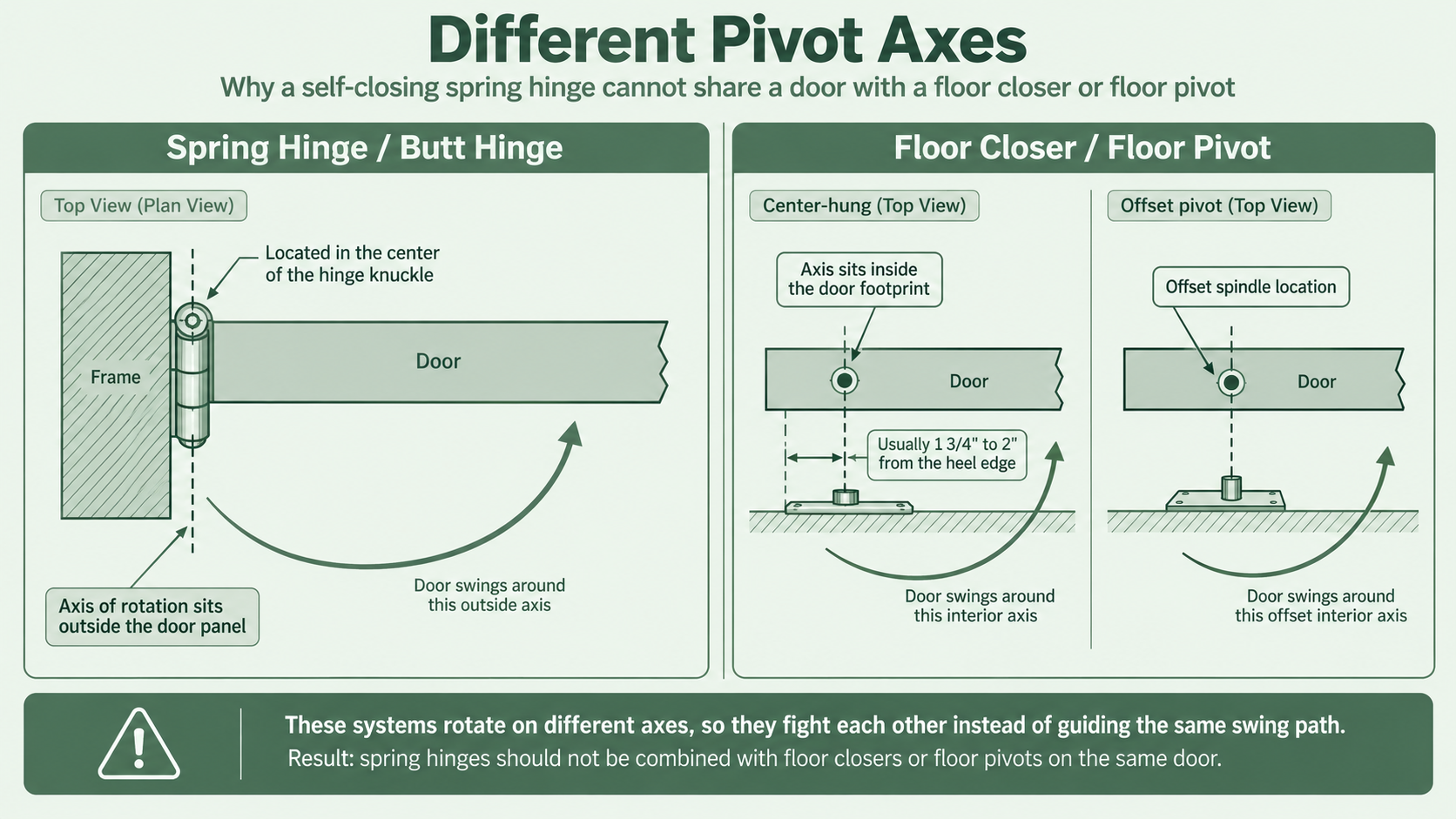
A common shortcut on a failing floor closer door is to leave the floor closer in place and add self closing spring door closer to “help” it. Don’t. The two systems rotate around different points, so they fight each other instead of guiding the same swing path.
- A hinge pivots outside the door. On a butt hinge, a spring hinge, or a Waterson closer hinge, the axis of rotation runs through the center of the hinge knuckle, just outside the door panel and against the frame.
- A floor closer pivots inside the door. On a center hung floor closer, the spindle sits inside the door footprint, typically about 1 3/4″ to 2″ in from the heel edge. On an offset pivot, the spindle is still under the door, just located differently.
When two hardware sets try to swing one door around two different axes, something has to give: the door binds, the door closer strain, the floor closer spindle wears, and the door never closes the way either product was designed to.
Disclaimer 2: Floor Closer Replacement Usually Means Slab Work
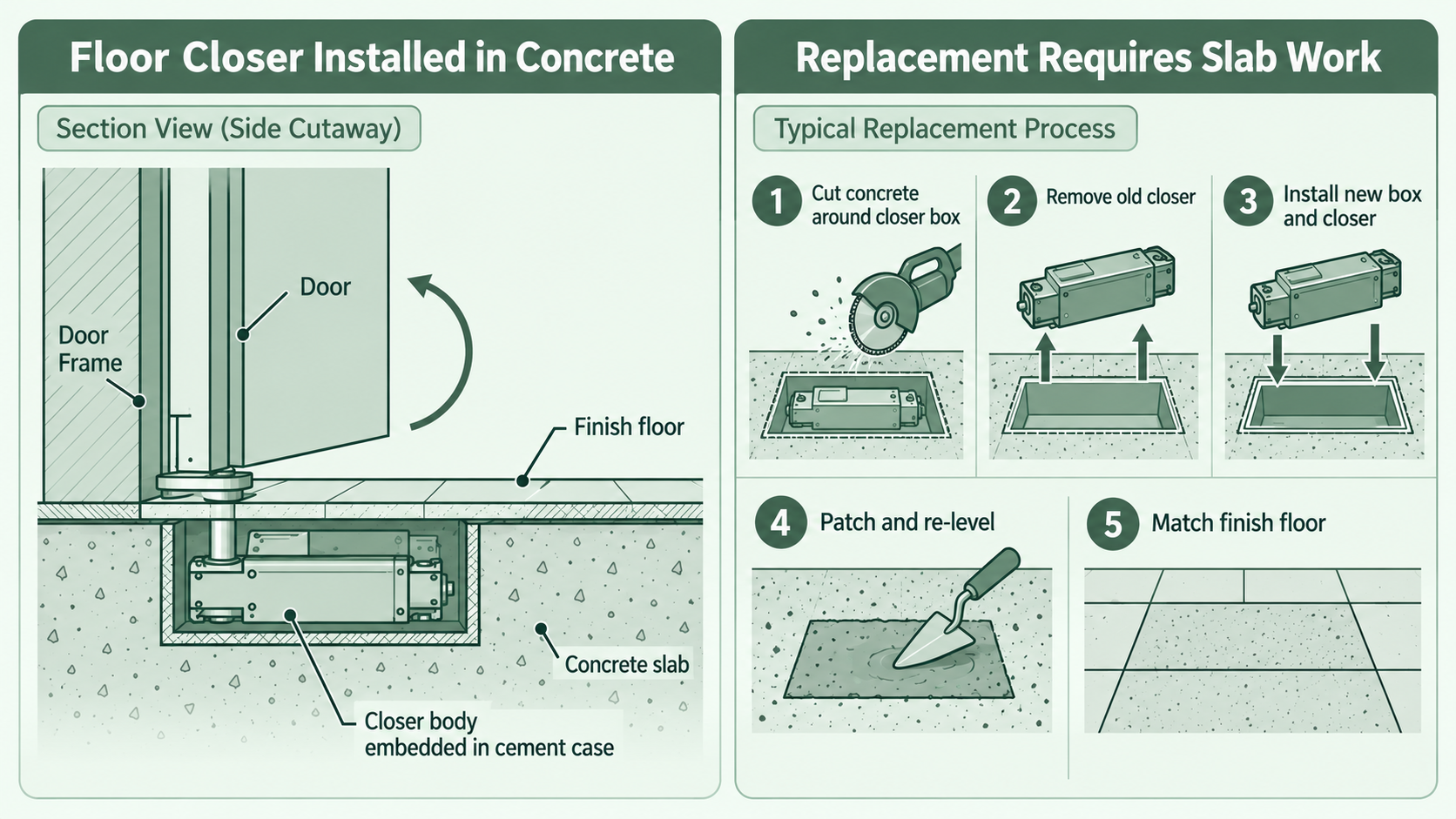
A floor closer is not surface hardware. The closer body sits in a cement case embedded in the concrete slab, under the finish floor, with only the spindle and cover plate showing at the threshold. That is what makes it invisible, and it is also what makes it expensive to replace.
If the new floor closer doesn’t match the existing cement case, a typical replacement looks like this:
- Cut the concrete around the old closer box.
- Remove the old closer and its case.
- Install the new box and closer, set level and aligned with the top pivot.
- Patch and re level the slab.
- Match the finish floor, whether that is tile, stone, or polished concrete.
When Is Waterson NOT the Right Replacement for Your Floor Closer?
We would rather tell you up front than sell you a return.
- Double acting doors. Waterson only makes single acting door closer, so for these openings a new floor closer or a double acting solution is the better answer.
- Center hung pivot doors with no hinge side support. If the door is designed to pivot away from the frame edge, converting it to edge door closer may change the swing path and clearances in ways the opening can’t absorb.
- Zero clearance openings. If the strike side gap is already tight, the barrel diameter described above may rule out a closer hinge entirely.
For single acting exterior doors, gates, and service doors, Waterson provides a solution with no pit to maintain, no oil to leak into the floor, and adjustment done at the closer with a hex key. On windy entrances, the hybrid hydraulic barrel adds the extra speed control those doors need.
Which Waterson Features Matter Most When Replacing a Floor Closer?
Assume the opening passes the checklist above. Here is what a Waterson door closer brings, and which features actually decide this job.
- Integrated closer and hinge: nothing in the floor to flood, and nothing on the door face. This is the main reason to choose it over a surface overhead closer.
- Mechanical or hybrid hydraulic barrel: pick fire rated mechanical operation or softer, wind resistant hybrid hydraulic control based on the opening.
- Stainless steel SS304 with SS316 available: a good fit for exterior and wet openings, which is exactly where floor closers tend to suffer.
- Adjustable spring tension and closing speed: tune the closing force to the door weight and dial the speed to meet ADA timing, without lifting a cover plate off the floor.
- Anti slam and soft close behavior: restores the controlled close that a leaking floor closer lost.
- Optional hold open and door stop: many floor closers provide a hold open position, and some Waterson models can replace that function at the hinge.
- Code coverage: UL 3 hour fire rating, NFPA 80, ANSI and BHMA A156.17 Grade 1, and ICC A117.1.
- Warranty: backed by a 3+ year warranty, depending on the model.

Waterson Commercial & Residential Stainless Steel Self Closing Spring Door Closers
Waterson spring loaded door hinges combine the function of an overhead closer and a hinge into a single, sleek component—complete with optional hold-open and door-stop features. Designed for commercial openings, gates, and glass doors, these hinges are easy to install and adjust to meet ADA and ICC A117.1 standards for opening force, while ensuring quiet and secure closure. Crafted from durable stainless steel, they are NFPA 80 compliant, UL 3-hour fire-rated, and built to perform reliably in both interior and all-weather exterior environments. See all our features.
In addition to these performance advantages, Waterson offers custom hinge services. As a direct manufacturer, we can tailor hinge sizes, finishes, and especially hinge leaf designs to meet the specific structural needs of your doors. This makes our hinges an ideal solution for door manufacturers seeking custom options that integrate seamlessly with their existing frames.
Request For Information
Please note that Waterson Closer Hinges start from a size of 4″x4″. If you’re in need of smaller self-closing hinges, we’d recommend checking out some other resources! Also, we only provide single acting closer hinges. Thank you.
Recent Post
How Many Self Closing Hinges Per Door? The NFPA 80 Rule vs. Waterson Sets for Fire & Arched Doors
Quick Answer Choosing a Waterson self-closing hinge set takes two steps. First, door height sets how many Waterson hinges you need: 2 for a 6 [...]
NFPA 80 Residential Fire Door Requirements: 13 Point Inspection Checklist
Quick Answer NFPA 80 is the standard that defines minimum requirements for fire door installation, inspection, and maintenance in buildings. It requires fire doors to [...]
Unequal Double Door Hinges: How to Self Close Both Leaves with No Overhead Closer
Quick Answer An unequal double door is a pair with one wide active leaf and one narrow inactive leaf, sized so the active leaf alone [...]