
Quick Answer
School door hinges are not one product. Classroom doors need quiet, controlled closing, and they only have to self-close when the corridor wall is fire-rated or built as a smoke partition. Corridor and stairwell fire doors must close and latch every time, with no mechanical hold-open. Dorm doors need a self-closing hinge plus a stop that protects the wall. Preschool doors need a slow close for small fingers. Campus offices need a quiet close and a clean look with no closer arm.
“For the Moreno ES project the issue was that the opening height of the door was below the minimum height allowed by code, only 78”. We were able to get a variance but were not allowed to have the closer arm protrude in the opening. Your hinges were an ideal solution.”
That note came from the team behind Moreno Elementary School in California. It shows how school projects really work: the door has to close on its own, but it also has to fit the building, pass code, and leave the opening clear for students.
So before picking a hinge, ask one question: what does this door need to do? In a school, the answer changes from room to room.
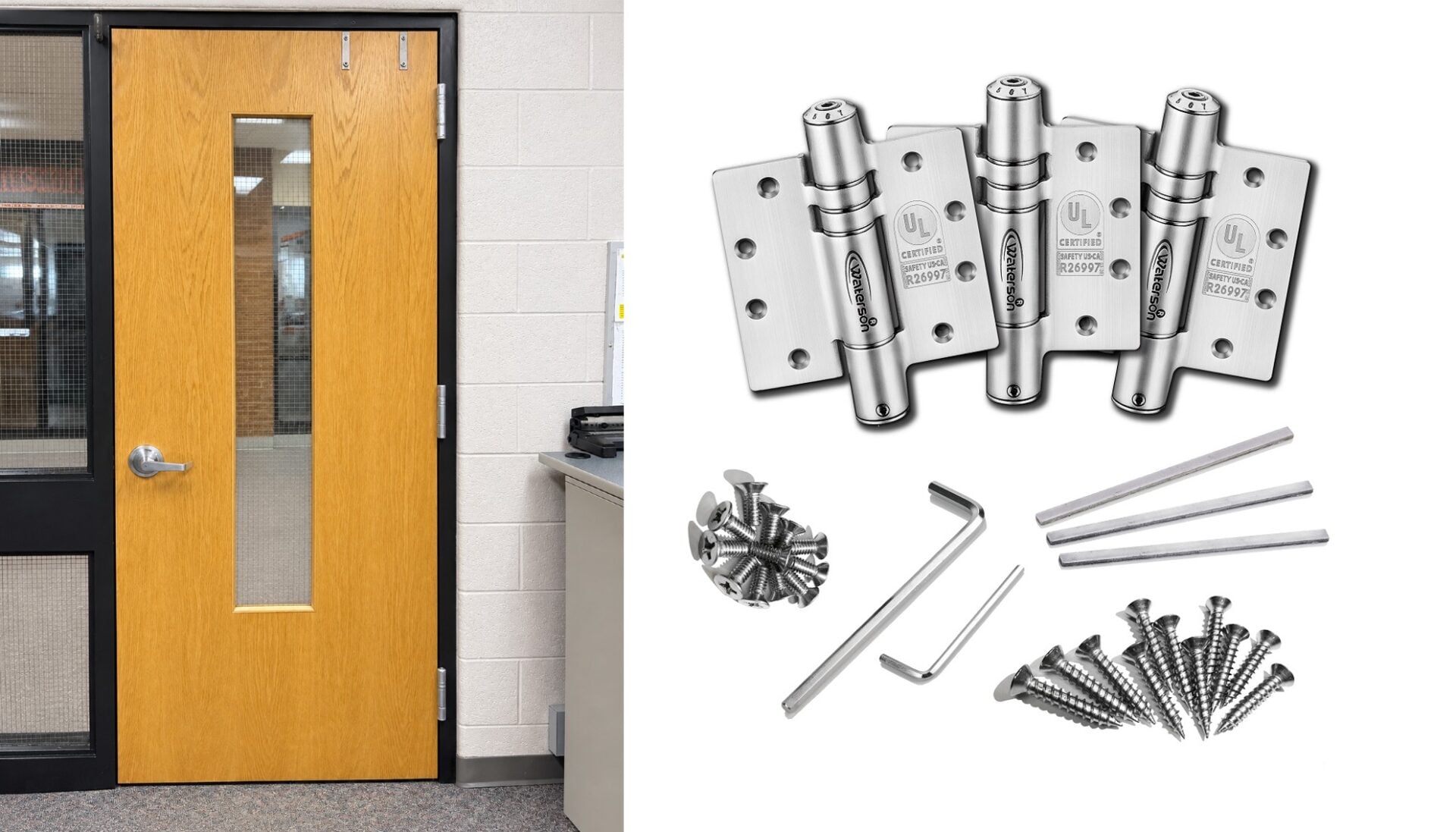
Why School Doors Need More Than a Standard Hinge
A school door works harder than most doors in any other building:
- Busy: Hundreds of students pass through in a few minutes at every class change.
- Small hands: Young children put fingers in the gap without thinking.
- Code-driven: NFPA 101, NFPA 80, the IBC, and the ADA all apply to the same opening.
- Abused: Doors get kicked, slammed, leaned on, and propped open.
- Tight retrofit windows: Districts often replace hardware in summer, so the hinge has to fit existing frames.
Overhead closers can handle some of this, but the arm hangs into the opening, gets swung on, and needs regular adjustment. A self-closing hinge does the same job with nothing hanging over the door.
Which Hinge Does Each Room Need?
| Room | The door should… | Pick this |
|---|---|---|
| Classroom | Close quietly, swing wide for passing periods | Hydraulic hybrid for the quietest close, or mechanical if the door must swing 180° |
| Corridor / stairwell fire door | Close and latch every time | UL listed self-closing hinge, no hold-open |
| Dorm room | Close and lock behind the student, stop at 90° | Self-closing hinge plus door stop |
| Preschool / daycare | Close slowly, protect fingers | Hydraulic hybrid hinge |
| Campus office | Close softly, stay closed for privacy | Hydraulic hybrid hinge, hold-open on non-rated doors |

Classrooms: Quiet Closing, Wide Swing
Under NFPA 101, classroom doors must be self-closing or automatic-closing when the corridor wall is fire-rated or built as a smoke partition. Recent editions exempt normally occupied classrooms from that rule, and the local authority having jurisdiction (AHJ) decides what qualifies. In practice, many schools still want classroom doors to close on their own for security and quiet. Check with your AHJ first, then pick the hinge.
Real project: Moreno Elementary School, Moreno Valley, CA
Moreno Elementary needed self-closing hardware for 30 hollow metal classroom doors. The door opening was only 78″ tall, below the code minimum. The project manager secured a variance, but the closer arm was not allowed to protrude into the opening. A hinge-integrated closer was the only clean answer.
The school installed 30 sets of Waterson hinges:
- K51MP-450-A3-US32D: 4.5″ x 4.5″ butt hinge style, self-closing, 304 stainless steel, satin finish, opening force of 5 lbf or less
- K51P-A3-US32D: full surface style, self-closing, heavy-duty, 304 stainless steel
Nothing hangs into the low opening, and students get the full height.
What about the 180° swing?
The project team also asked for doors that swing 180° to lie flat against the wall during passing periods. Waterson mechanical hinges can open to 180°, but their best range is 0° to 120°. See whether Waterson hinges can open up to 180 degrees.
Caution: If you need 180°, use mechanical hinges only and keep spring tension at level 3 or below. Frequent daily use past 120° wears the spring faster and is not covered under warranty. For most classrooms, a stop at 90° or 120° is the better choice.
How quiet closing works
Waterson hinges control the whole close. You set the swing speed for the long travel back toward the frame, and the hinge drives the door through the final 20° to 0° into the latch. Set it so the door takes at least 5 seconds to move from 90° to 12° from the latch, the ADA rule for door closers (Section 404.2.8.1). Our adjustment guides show each step.
Want more detail on classroom door hinge features? Read classroom door hinges.

Corridor and Stairwell Fire Doors: Close and Latch, Every Time
Cross-corridor doors, stairwell doors, and doors in rated corridor walls are usually fire doors. Under NFPA 80, a fire door must close and latch on its own. A door that stops an inch short fails inspection.
What to look for:
- UL listing: the hinge must be listed for fire-rated doors. Waterson hinges are UL listed for doors up to 3 hours.
- Latch control: enough force through the final 20° to 0° to pull the door into the latch.
- Steady force: the same closing performance after years of class changes.
Caution: Do not use a hold-open hinge on a fire door. Waterson hold-open is mechanical: the door stays open until someone pushes it closed, and it does not release on its own when the alarm sounds. If a school wants corridor doors held open during the day, it needs a hold-open device that releases automatically on a fire or smoke signal. See what NFPA 80 allows for hold-open on fire doors.
The ADA limits how hard a door is to open, while fire doors need enough force to latch. Here is how to balance ADA force and fire door latching.
More on fire doors in schools:
- Fire door hinges for stairwells
- 5 warning signs a fire door spring hinge will fail inspection
- NFPA 80 fire door requirements
Student Housing: Close, Lock, and Protect the Wall
Dorm room doors open onto corridors, so they are often fire-rated and must close and latch. They also have to lock behind the student every time, because a door left ajar is an open invitation.
Real project: Vanderbilt University Housing, Nashville, TN
More than 1,300 students live in Vanderbilt University’s residential housing. To replace aging dorms, the university needed self-closing hinges for 585 wood doors, each a standard 3070 door, 1-3/4″ thick. Himmel’s Architectural Door & Hardware managed the project.
- K51M-450-A3-US32D: 4.5″ x 4.5″ full mortise, self-closing, speed control, UL listed for 3-hour fire doors, 304 stainless steel
- 314 Waterson door stops: hold the door at 90° so it does not hit the wall
Every door now closes and latches behind the student, and the stops protect walls and furniture from move-in day to move-out day.
Why add a stop?
Students fling dorm doors open with boxes, bags, and bikes. A stop on the hinge barrel ends the swing at 90°, with no floor or wall hardware to trip over or break. It also keeps the hinge inside its best range of 0° to 120°. See how a door stop on the hinge works.
Running apartments or off-campus student housing too? See spring loaded residential door hinges for multifamily.

Preschool and Daycare: Slow Close, Safe Fingers
In a preschool, the biggest door risk is a small hand in the gap. The fix is time: a door that takes at least 5 seconds to close gives a child time to pull a hand away. Hydraulic hybrid hinges add a cushion near the end of the close, so the door settles in instead of snapping shut. Adult supervision is still needed with any door.
Real project: Preschool Dutch Doors
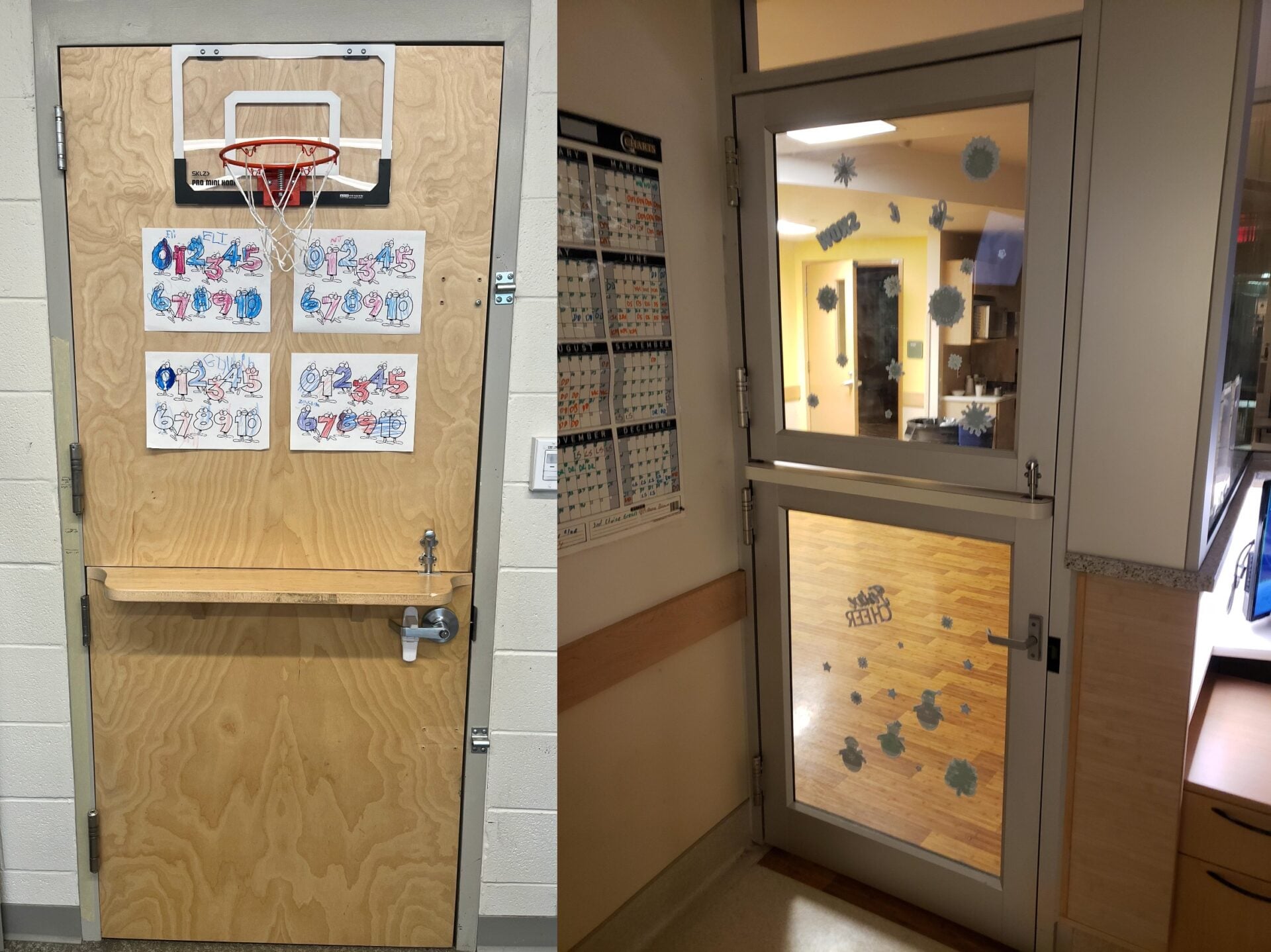
A preschool needed hardware for six toilet Dutch doors. The low bottom leaf gives children privacy and a gentle boundary, while the open top lets teachers see and talk to them.
- 4.5″ x 4.5″ hydraulic hybrid hinges: four per door, two on each leaf
- Placement: on each leaf, one hinge 7″ from the top and one 10″ from the bottom
- Hold-open at 90°: so teachers can keep a door open during supervised times
Both leaves close softly on their own, and the hold-open keeps the door out of the way when staff need it. Hold-open is fine here because these doors are not fire-rated.
More for young children’s spaces:
- Which baby safe door stopper actually holds the door
- Door stop child safety
- Stair gate hinges for child safety
- How to stop door slamming
Campus Offices: Quiet and Professional
Faculty offices, advising rooms, and admin suites often sit right next to lecture halls and study areas. Their doors open dozens of times a day, usually by someone in a hurry who never looks back to close them. The result is slamming in the hallway, doors left ajar, and private conversations about grades, advising, or HR drifting out into the corridor.
For these doors, a hydraulic hybrid hinge gives the quietest close, while a mechanical self-closing hinge suits busy admin doors that must close firmly every time. On a non-rated office door, a hold-open hinge keeps the door open during office hours until someone pushes it closed. Not sure which to pick? Compare mechanical vs hydraulic self closing hinges.
Retrofit tip: A standard 3′0″ x 7′0″ office door usually takes 4.5″ or 5″ hinges. Before you swap, check the existing hinge size, corner radius, and leaf thickness. Here is what to check before a commercial hinge retrofit.
For the full higher-ed office guide, read university office door hinges.
Before You Specify: Quick Checklist
Have these details ready so we can match the right Waterson hinge model to each opening:
- Door size and weight: width, height, thickness, and approximate weight.
- Door and frame: wood, hollow metal, or aluminum; existing hinge size and corner radius for retrofits.
- Fire rating: is the door rated, and for how long?
- Corridor wall: rated, smoke partition, or neither? This decides whether a classroom door must self-close.
- Latch: latched or latchless?
- Opening angle: 90°, 120°, or 180°? Plan a stop if the door can swing past 120°.
- Hold-open: wanted, and is the door non-rated? Hold-open is mechanical and never for fire doors.
- Users: young children, students, or people with disabilities?
- Schedule: new build or summer retrofit, and when the doors must be done.
Not sure how to send it? Follow how to provide your door information to Waterson.
Frequently Asked Questions
Not always. Under NFPA 101, classroom doors must be self-closing or automatic-closing when the corridor wall is fire-rated or a smoke partition, and recent editions exempt normally occupied classrooms. Your local AHJ makes the final call.
No. Waterson hold-open is mechanical and does not release on its own in a fire. Fire doors need to close and latch every time, so hold-open is only for non-rated doors.
In most cases, yes. The hinge closes the door with no arm in the opening, which also helps low openings like Moreno Elementary’s 78″ doors. For very heavy doors, check the weight with us first.
Waterson mechanical hinges can open to 180° occasionally, with spring tension at level 3 or below. Their best range is 0° to 120°, and frequent 180° use is not covered under warranty.
Set to the ADA closing time, the door takes at least 5 seconds to move from 90° to 12° from the latch. That gives a child time to move a hand away. Adult supervision is still recommended.
A 1-3/4″ thick 3′ x 7′ door usually takes three 4.5″ x 4.5″ hinges, the size Vanderbilt used on 585 dorm doors. Taller or heavier doors may need a fourth hinge or a 5″ size. See how many self closing hinges per door.
Find the Right Hinge for Your School Project
A school has hundreds of doors, and each one has a different job. When the hinge matches the room, classrooms stay quiet, fire doors latch, dorm doors lock behind students, and small fingers stay safe.
Planning a new school, a dorm renovation, or a summer retrofit? Send us your door schedule and we’ll recommend the right hinge for each opening. Standardizing one hinge across a whole district? We can help with that too. Architects, contractors, and distributors can request samples or ask for a trade discount for their project.
Request For Quote
Please note that Waterson Closer Hinges start from a size of 4″x4″. If you’re in need of smaller self-closing hinges, we’d recommend checking out some other resources! Also, we only provide single acting closer hinges. Thank you.
Recent Post
School Door Hinges: What Each Room Needs, from Classroom to Dorm
Quick Answer School door hinges are not one product. Classroom doors need quiet, controlled closing, and they only have to self-close when the corridor wall [...]
Healthcare Door Hinges: How to Choose from Patient Rooms to Labs
Quick Answer Healthcare door hinges are not one product. Patient rooms need hydraulic self-closing hinges that close heavy doors softly, often in a swing clear [...]
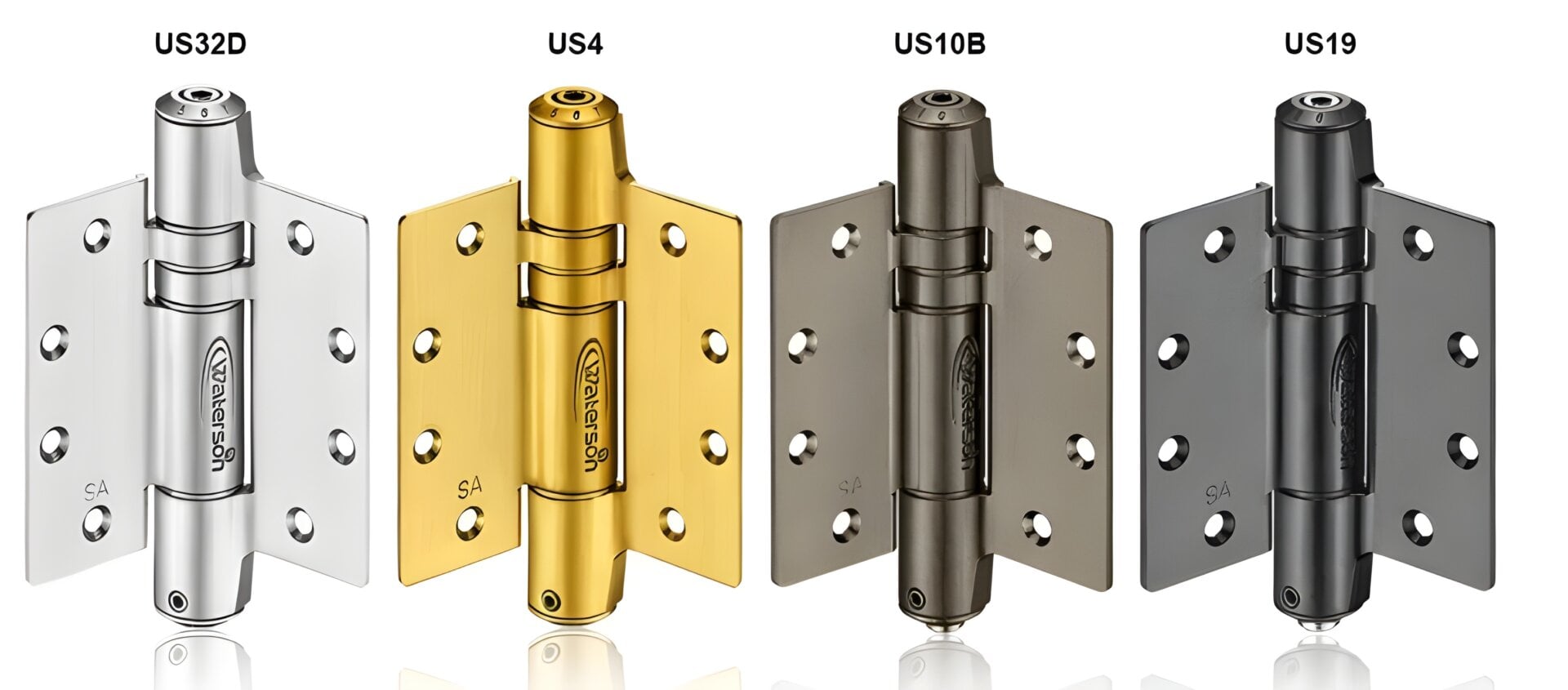
How to Provide Your Door Information to Waterson to Get Product Recommendations
If you're new to Waterson Hinges and not sure how to get started, this page is for you. We get a lot of inquiries every [...]