
Quick Answer
An exterior door that closes fine in summer but won’t latch in winter is usually affected by two things: weather stripping that stiffens in the cold, and hydraulic fluid that thickens and slows the closing speed. The fix is either a fully mechanical self closing hinge (Waterson A3 or C3), which isn’t affected by temperature, or a hydraulic-mechanical hybrid (B3 or D3) with the spring tension raised 1 to 2 settings for winter.
Recently, we have heard this question quite often from homeowners, inspectors, and contractors in colder regions:
“We have a very cold winter and the weather strip are very stiff… I was wondering if there are many different hinges with different pulling forces to close those doors?”
It’s a common and frustrating situation. The same door, on the same hinges, closes and latches perfectly all summer. Then winter arrives, and it stops a few inches short or never quite latches.
This affects any exterior opening that uses self closing hinges, including entry doors, garage entry doors, pool gates, and commercial exterior doors. In most cases, the cause is temperature, and it affects your door in two ways.

Why Does My Door Close in Summer but Not in Winter?
Reason 1: Weather Stripping Gets Stiff
As temperatures drop, weather stripping hardens and creates extra resistance around the door frame. This can stop the door from completing the final few degrees it needs for the latch to engage.
The result: the door may look closed but stops just short of latching, leaving a small gap or slowly drifting open again.
Reason 2: Hydraulic Fluid Reacts to Temperature
Many self closing hinges use hydraulic fluid to control closing speed, and that fluid naturally changes with temperature:
- In cold weather, the fluid thickens and flows more slowly. The door closes slower and loses the momentum it needs to push through the weather stripping and engage the latch.
- In hot weather, the fluid thins out and flows faster, so the door closes more quickly.
This is not a defect. It is a natural property of all hydraulic systems, and it explains why a door adjusted perfectly in summer can underperform in winter.
Doors vs. Gates: Which Reason Applies?
Most exterior doors are affected by both reasons. Gates, such as pool gates and garden gates, usually don’t have weather stripping, so if a hydraulic gate hinge closes slowly or fails to latch in winter, the cause is almost always the hydraulic fluid.
How to Fix a Door That Won’t Close in Winter
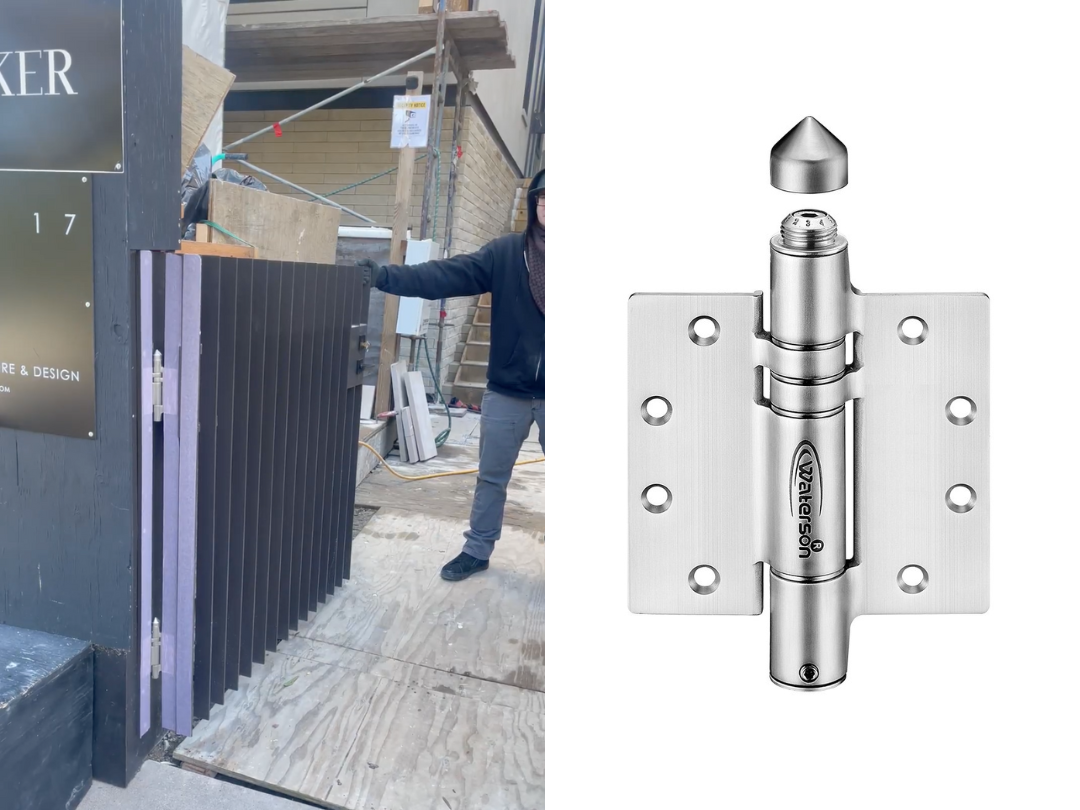
At Waterson, we supply self closing hinges in two closing systems, so you can choose the one that best fits your climate and how you want your door to close. Our mechanical hinge models (A3, C3) close with spring power alone, while our hydraulic hinge models (B3, D3) combine spring power with hydraulic damping for a smoother, more controlled close. Here is how each option handles cold weather.
| Fully Mechanical | Hydraulic-Mechanical Hybrid | |
| Models | A3, C3 | B3, D3 |
| Powered by | Spring only | Spring + hydraulic damping |
| Affected by cold? | No | Yes, closes slower |
| Seasonal adjustment | Not needed | Raise tension 1 to 2 settings in winter |
| Closing feel | Consistent all year | Smoother, softer |
| Best for | Harsh winters, large temperature swings | Users who want controlled closing |
Option 1: If You Choose a Fully Mechanical Hinge (A3, C3), the Performance Stays Consistent Throughout the Season
Waterson’s A3 and C3 models are fully mechanical. They run on spring power only, with no hydraulic fluid inside, so closing performance stays the same in January as it does in July.
This is the simplest choice for regions with harsh winters or large seasonal temperature swings.
Option 2: If You Choose a Choose a Hydraulic Hybrid Hinge (B3, D3), Adjust the Tension Seasonally
If you prefer the smooth, controlled closing of hydraulic damping, Waterson’s B3 and D3 hybrid models are an excellent option. Adjusting them for winter is quick:
- When winter arrives, insert a 5mm hex key into the hinge.
- Raise the spring tension by 1 to 2 settings, using the numbered tension markers on each hinge.
- Test the door to confirm it closes and latches fully.
- When warm weather returns, set it back to your original setting.
Because the markers are numbered, the adjustment takes only a moment and is easy to repeat each season.
For step-by-step instructions, check the Waterson hinge tension adjustment guide.
Whichever hinge you choose, flexible cold-weather weather stripping reduces resistance and helps the door latch reliably all winter.
For openings exposed to snow and de-icing salts, Waterson’s 304/316 stainless steel hinges also resist corrosion.
No. If the door closed properly in summer, the hinge is almost certainly working. Cold weather increases weather stripping resistance and slows hydraulic fluid, and a small tension adjustment usually solves it.
It may close faster than needed, which is why we recommend returning to your original setting when temperatures warm up. With a fully mechanical model (A3, C3), no seasonal change is needed. If your door is already closing too hard, see how to stop a door from slamming.
Typically twice a year, when seasons change and temperatures shift noticeably. Each adjustment is just 1 to 2 settings on the numbered tension markers.
Choose mechanical (A3, C3) if you want zero maintenance through seasonal changes, especially in cold climates. Choose hybrid (B3, D3) if you prefer smoother, softer closing and don’t mind a quick seasonal adjustment.
Waterson hinges are designed to meet ADA and ICC A117.1 limits on closing force and speed, so the final latch force is intentionally not aggressive. This applies to any ADA compliant self closing hinge on the market. Within those limits, raising the tension setting is the right approach.
Yes. Garage entry doors often use self closing hinges and face the same cold-weather issues, especially when the garage isn’t heated. The same two fixes apply.
Since gates usually have no weather stripping, the cause is typically hydraulic fluid. A fully mechanical hinge avoids the issue, or you can raise the tension on a hybrid model. See our gate closer hinges for outdoor options.
Not always, but if your current weather stripping becomes very hard in winter, switching to a flexible cold-weather type makes a noticeable difference.
Request For Quote
Please note that Waterson Closer Hinges start from a size of 4″x4″. If you’re in need of smaller self-closing hinges, we’d recommend checking out some other resources! Also, we only provide single acting closer hinges. Thank you.
Recent Post
Why Won’t My Self Closing Door Hinges Close in Cold Weather
Quick Answer An exterior door that closes fine in summer but won't latch in winter is usually affected by two things: weather stripping that stiffens [...]

Soft Closing Hinges: 9 Most Frequently Asked Questions
Since the AIA in 2018, there has been an increased interest in Waterson hinges for many different projects. We have been inundated with questions by [...]
Residential Soft Close Front Door Hinges: How to Choose, Install & Adjust the Right Hinge for Your Home
Your front door is usually the heaviest door in your home and the one you use the most. Every time it slams, the impact goes [...]