
Quick Answer
An unequal double door is a pair with one wide active leaf and one narrow inactive leaf, sized so the active leaf alone gives the ADA 32 inch minimum clear width. To self-close both leaves without a bulky closer on the narrow leaf, specify closer hinges such as Waterson K51M, which fit standard butt hinge mortises.
Unequal double doors solve a common planning problem: they give an opening the full width needed for equipment, beds, or furniture, while keeping the everyday leaf small enough to handle and wide enough to meet ADA. The difficulty is closing them. The narrow leaf often has no room for an overhead closer, fire-rated pairs must close in sequence, and mixing hardware leaves the opening looking unfinished. This guide covers leaf sizing, code requirements, and how to self-close both leaves with matching closer hinges.
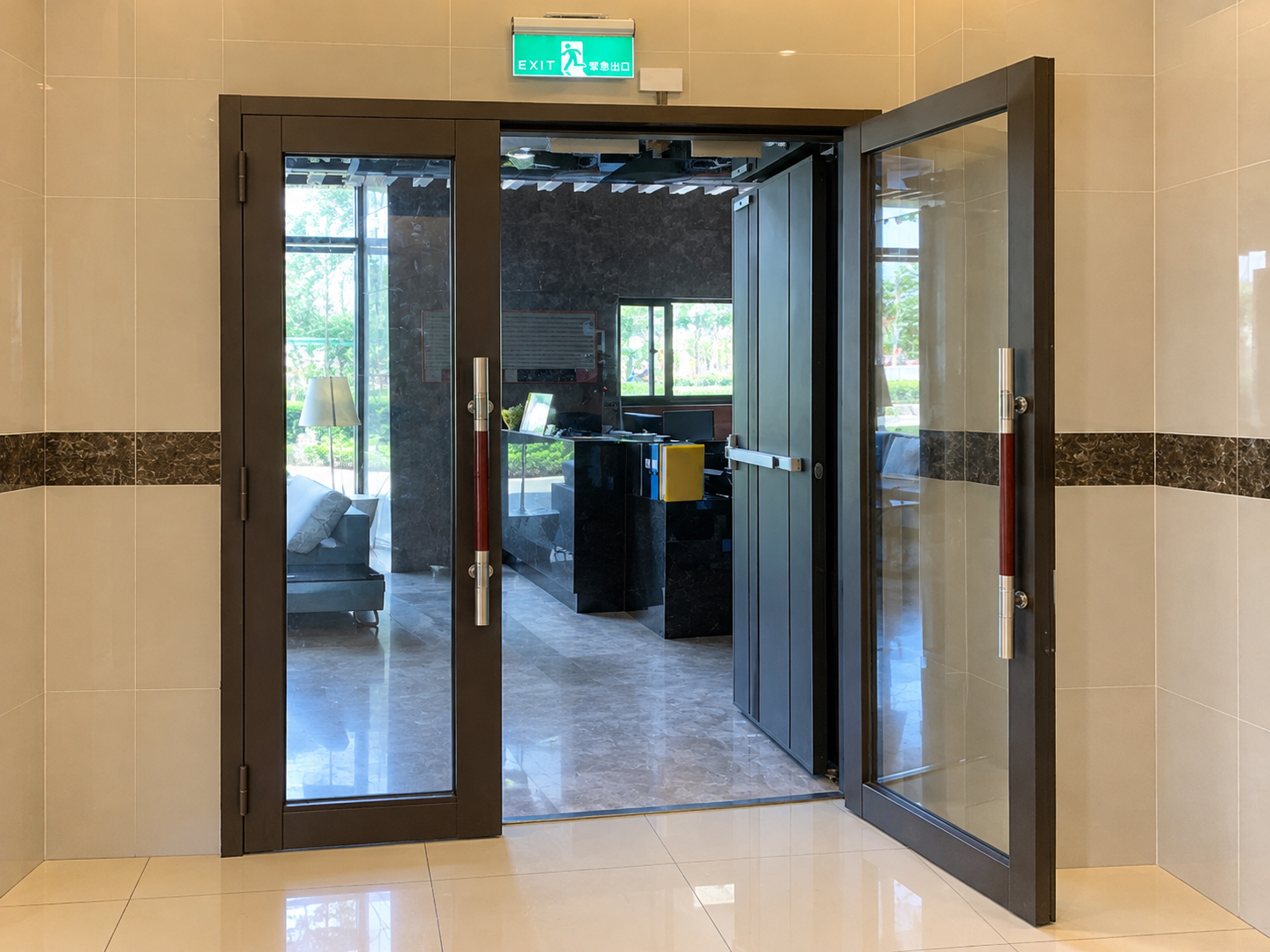
What Is an Unequal Double Door?
An unequal double door (also called an uneven pair, asymmetrical double door, or “one and a half” door) is a pair of leaves with different widths in one frame. The wide leaf is the active, everyday leaf. The narrow leaf usually stays closed with flush bolts and opens only for wide loads, such as equipment, hospital beds, or furniture.
Size the active leaf first, because it must deliver the ADA clear width on its own. The narrow leaf takes the rest of the opening.
| Opening width | Common split (active + inactive) |
| 48 in. | 36 in. + 12 in. |
| 54 in. | 36 in. + 18 in. |
| 60 in. | 36 in. + 24 in. |
| 72 in. | 42 in. + 30 in. or 48 in. + 24 in. |
Typical configurations only. Confirm leaf sizes with the door manufacturer.
How Does ADA Clear Width Work on an Unequal Door Pair?
ADA 2010 Section 404.2.3 requires 32 in. minimum clear width, measured with the door open 90 degrees, from the face of the door to the opposite stop. On a pair, only one active leaf must meet it, which is why a 36 in. active leaf is paired with a narrow inactive leaf.
An overhead closer needs room for its body and arm, and on a 12 to 24 in. leaf that room is limited. Specifiers often end up with a different closer model on each leaf, which creates mismatched closing behavior and a pair that looks unbalanced. Closer hinges move the closing mechanism into the hinge barrel, so both leaves use the same hardware and the head stays clear.
Closer Hinge vs Overhead Closer vs Floor Spring on a Narrow Leaf
| Closer hinge (K51M) | Overhead closer | Concealed floor spring | |
| Space on narrow leaf | None beyond the hinges | Needs arm and body clearance | Floor cutout |
| Matches active leaf | Yes, same hinge on both leaves | Often mismatched models | Yes |
| Retrofit into existing hinge prep | Yes, check barrel clearance | New prep and reinforcement | Major floor work |
| Closing sequence on a pair | Set by tension on each leaf, no head hardware | Needs a separate coordinator | Depends on product |
How Do You Close an Unequal Pair in the Right Order?
Fire-rated pairs with an overlapping astragal must close in sequence: the inactive leaf seats first, then the active leaf closes over the astragal and latches. NFPA 80 requires each leaf of a fire-rated pair to be self-closing, and the usual hardware for the sequence is an overhead door coordinator mounted at the head.
Waterson closer hinges are not coordinators, but setting each leaf’s hinges to a different tension level produces the same closing order with no hardware at the head. Mechanical A sets add separate latch speed control on the active leaf. Test the sequence on site and confirm the approach with the authority having jurisdiction. See how hinge-based sequencing works.
Which Waterson Closer Hinge Fits an Unequal Double Door?
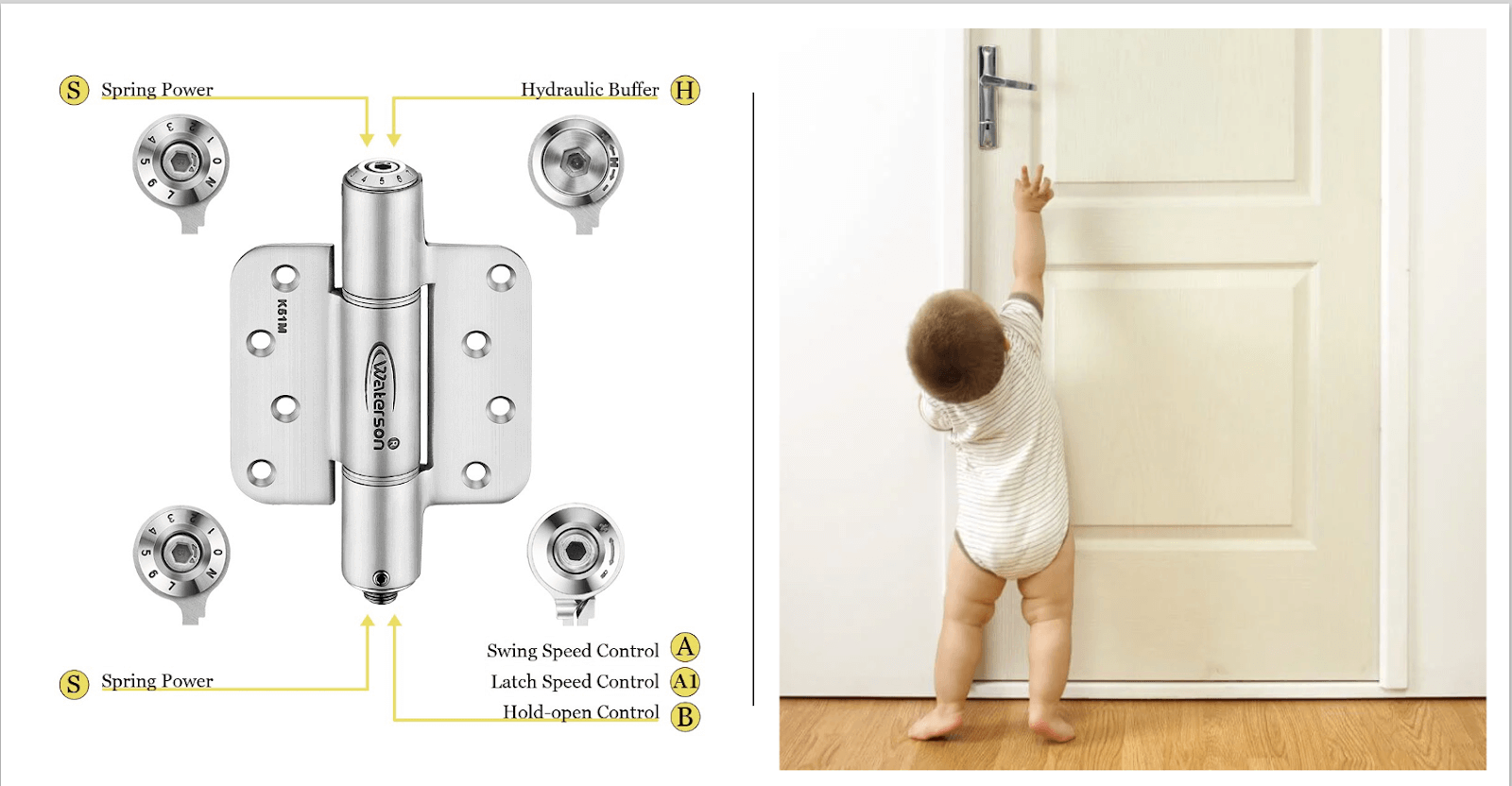
The Waterson K51M full mortise closer hinge combines a hinge, closer, optional hold-open and door stop in one stainless steel unit. The same model goes on both leaves, so the pair matches in finish and behavior.
- Standard mortise template: Fits standard butt hinge templates and conforms to ANSI/BHMA A156.7, so no overhead arm or floor cutout is needed on the narrow leaf.
- Adjustable closing force and speed: Numerical spring tension, swing speed, and (on mechanical sets) separate latch speed adjustment.
- Fire rated: UL listed (R26997) to UL 10C for fire doors up to 3 hours on A (mechanical) and B (hybrid) sets. ANSI/BHMA A156.17 Grade 1, tested to 1,000,000 cycles.
- ADA adjustable: Adjustable to the 5 lbf opening force limit for interior doors.
- Matching inactive leaf: An NF (no function) hinge matches the closer hinges visually on a non-rated inactive leaf. On fire-rated pairs, both leaves still need closing devices.
- Finishes: 630 (US32D) satin stainless standard; 731 (US4) satin brass and 612 (US10) satin bronze in PVD; 631 (US19) flat black and 695 dark satin bronze in powder coat.
- Materials and warranty: Type 304 stainless steel standard, 316 marine grade optional. Mechanical sets carry a 10-year limited warranty; hydraulic hybrid sets carry 5 years indoors and 3 years outdoors.
- Single acting only: Waterson closer hinges are not for double swing (double acting) doors.
Waterson Specifications
| Model | Size (in.) | Gauge (in.) | Door thickness | Max door and weight |
| K51M-400 (Square, 58R, 14R) | 4 x 4 | 0.130 | 1-3/8″ or 1-3/4″ (residential) | 48 x 96 in., 330 lb (4 hinges) |
| K51M-450 | 4-1/2 x 4-1/2 | 0.134 | 1-3/4″ (commercial) | 48 x 96 in., 330 lb (4 hinges) |
| K51L-SWRH-450 (Swing Clear) | 4-1/2 x 4-1/2 | 0.134 | 1-3/4″ (commercial) | 48 x 96 in., 330 lb (4 hinges) |
| K51M-500 / 500D | 5 x 5 | 0.146 / 0.190 | 1-3/4″ to 2-1/4″ | 48 x 96 in., 330 lb (4 hinges) |
| K51M-600 | 6 x 6 | 0.160 | 2-1/4″ and up | 48 x 96 in., 330 lb (4 hinges) |
Ratings per the Waterson K51 product selection table. 3-hinge sets are rated to 260 lb on 48 x 84 in. doors. All models are non-handed. A 4-1/2 x 5 in. size (K51M-455) is also available.
What Could Be the Limitation in Waterson K51M 4 Inch Hinge Barrel Size?
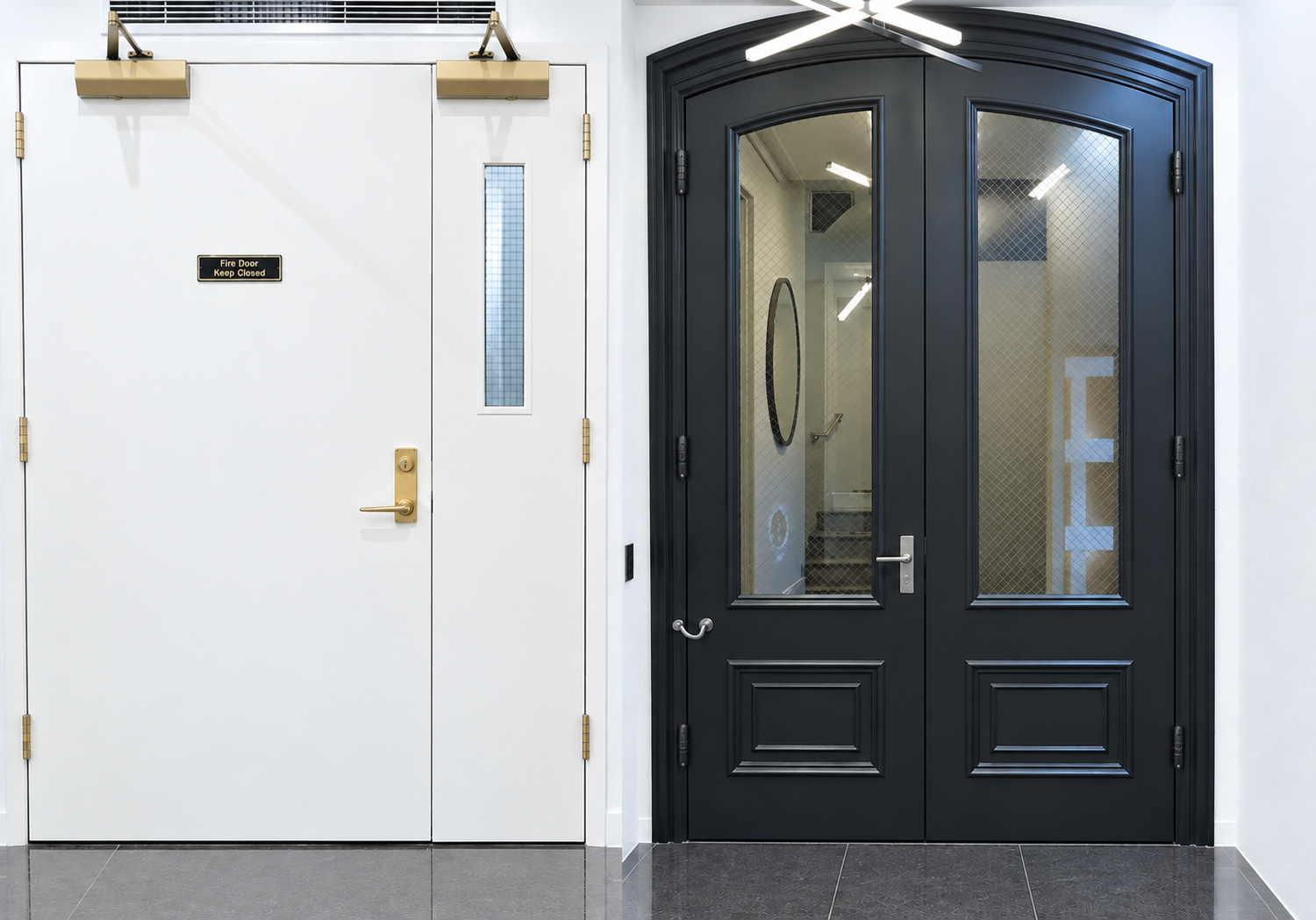
On a retrofit, the Waterson 4×4 uses the same mortise template as a standard 4×4 butt hinge, so the leaves drop into the cutout you already have. The difference is the barrel. It is built bigger (1.122 in. vs. about 0.55 in. on a standard butt hinge) to keep the closing mechanism inside, and that thicker barrel moves the pivot further off the door and frame, shifting the door roughly a quarter inch toward the strike jamb. This clearance issue is limited to the 4 in. K51M-400 on residential retrofits. We have not seen it with the 4-1/2, 5, or 6 in. models, which are typically installed on commercial doors and frames.
For most doors, that shift is absorbed by the normal strike side gap, and we have not seen this issue on garage entry doors. It mainly shows up on tight custom doors, such as interior French doors, where the strike edge can end up touching the frame, and deepening the mortise only helps if there is room on the strike side to take it. For residential doors with rounded hinge mortises, the K51M-400 is available with 1/4 in. (14R) or 5/8 in. (58R) radius corners. If you are retrofitting, check your clearance first, because with this hinge, the barrel diameter, not the leaf size, decides whether it fits. Read the full hinge barrel clearance guide.
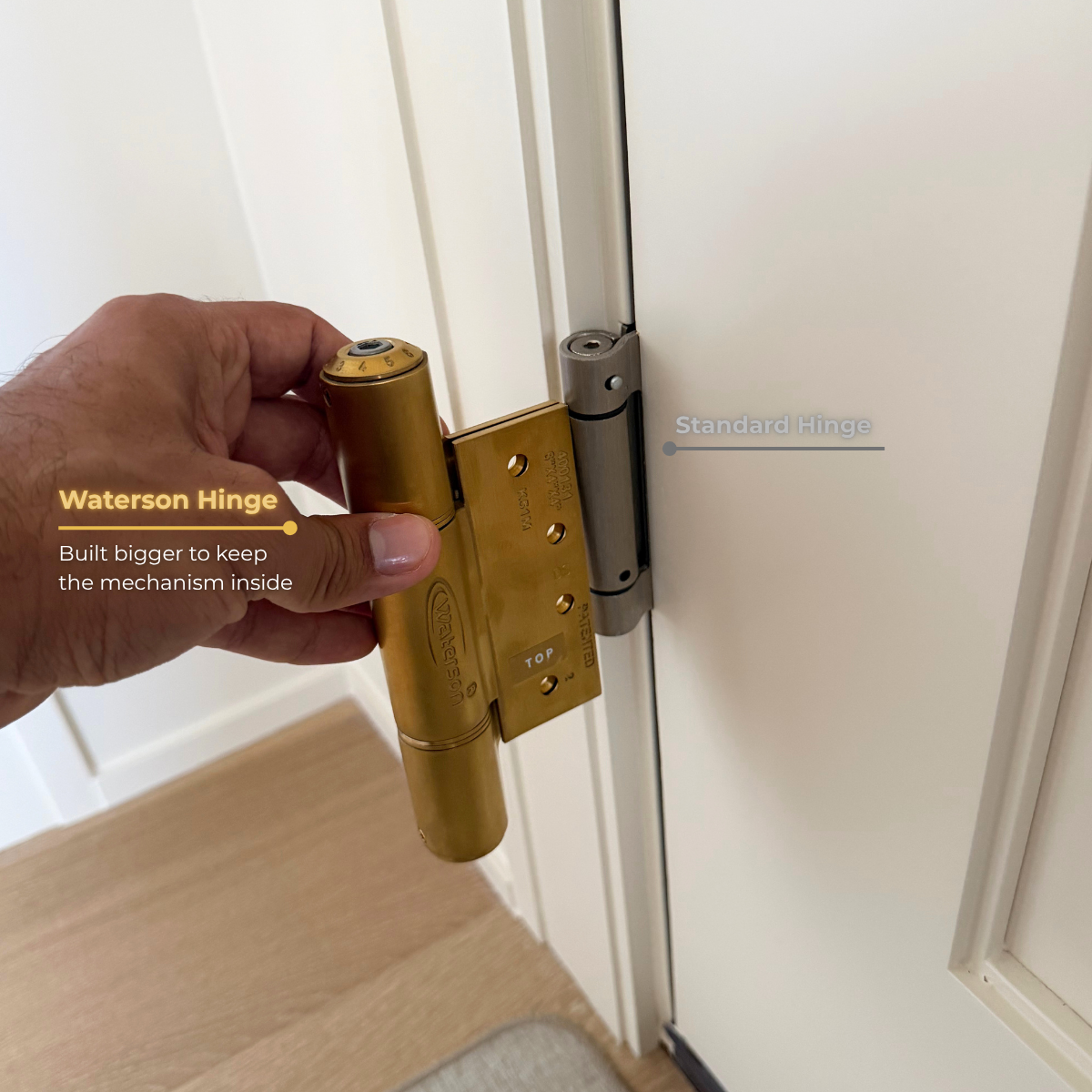
On an unequal pair, the narrow leaf is where most closer problems start. Size the active leaf for 32 in. clear width, specify A or B sets on fire-rated pairs, set each leaf’s tension so the inactive leaf closes first, and check strike side clearance before retrofitting.
Specifying an unequal pair? Download K51M CAD, DWG and spec sheets, or request a project quote with your opening width, leaf sizes, door thickness, door weight, and fire rating. Our product specialists will recommend the right set for each leaf.
Size the active leaf so it alone gives at least 32 in. of clear width under ADA 2010 Section 404.2.3, which usually means a 36 in. leaf. The inactive leaf takes the remaining width, for example 24 in. on a 60 in. opening or 12 in. on a 48 in. opening. Confirm final sizes with the door manufacturer.
Yes. NFPA 80 requires each leaf of a fire-rated pair to be self-closing, and pairs with an overlapping astragal must close in sequence. Waterson closer hinges are not coordinators, but setting each leaf to a different tension level closes the inactive leaf first. Test the sequence on site and confirm with the authority having jurisdiction.
Usually yes, because the K51M-400 uses the standard 4×4 butt hinge template. However, its barrel is 1.122 in. in diameter versus about 0.55 in. on a standard hinge, which can shift the door about 1/4 in. toward the strike jamb. Measure the strike side gap before retrofitting tight interior or custom doors.
No. In the Waterson K51 product selection table, only the A (mechanical) and B (hybrid) sets are marked for fire-rated doors. The hold-open C and D sets are intended for non-rated openings, such as interior office pairs. For fire-rated unequal pairs, specify A or B sets on both leaves.
No. Waterson closer hinges are single acting only, so they suit doors that swing in one direction. For double acting doors, such as kitchen or corridor swing doors, specify a double acting spring hinge or floor closer instead. Waterson closer hinges also start at 4×4 in. size.
Request For Information
Please note that Waterson Closer Hinges start from a size of 4″x4″. If you’re in need of smaller self-closing hinges, we’d recommend checking out some other resources! Also, we only provide single acting closer hinges. Thank you.
Recent Post
4 Inch Self Closing Door Hinges for Residential & Commercial Doors
Quick Answer Waterson 4-inch self-closing hinges (K51M-400) fit standard 4" x 4" templates on 1-3/8" or 1-3/4" residential doors, in mechanical or hydraulic versions with [...]
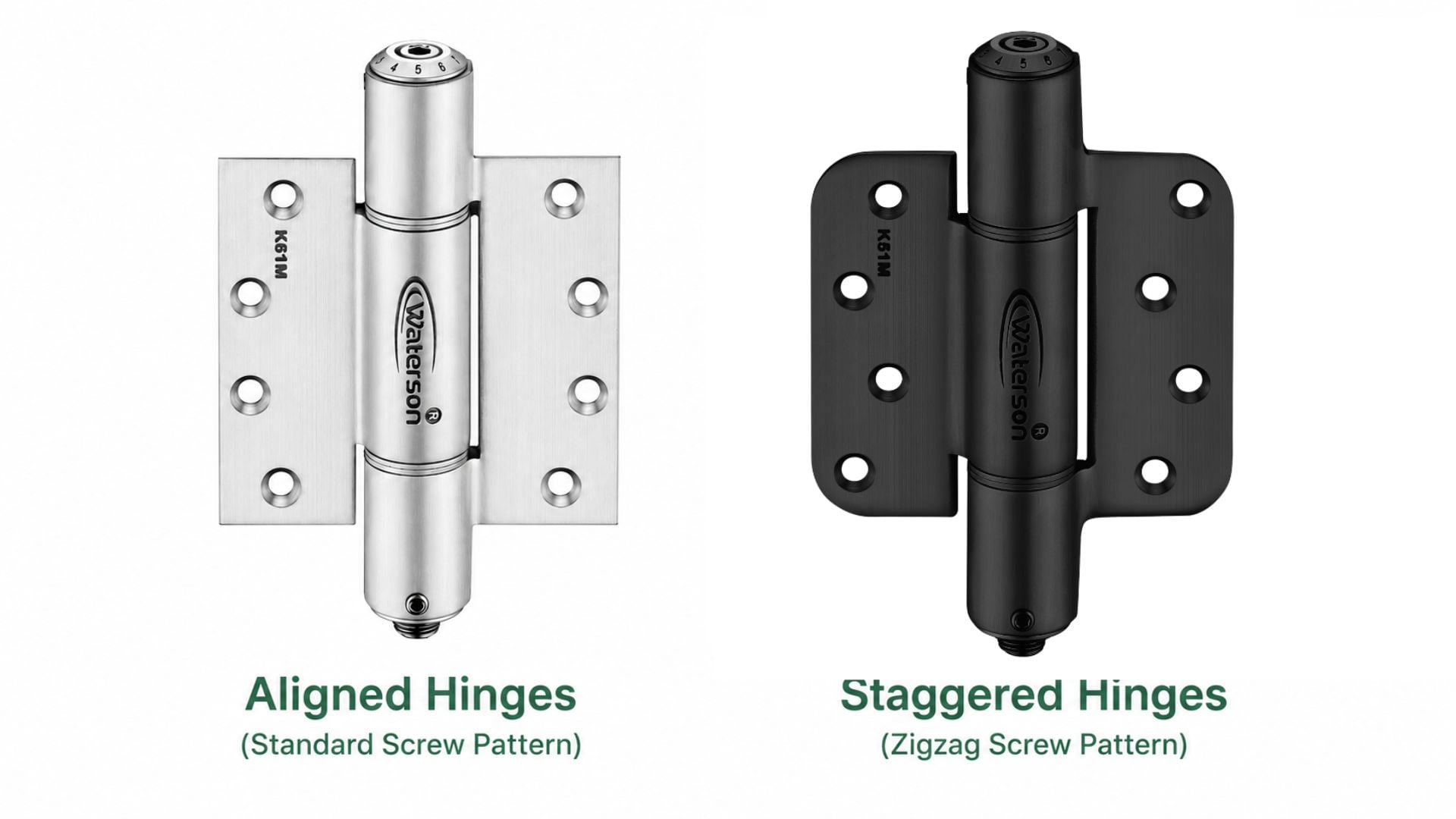
Aligned Hinges vs Staggered Hinges: A Comparison of Screw Hole Patterns
When sourcing replacement hinges, most buyers check size, radius, and finish, then assume the screw holes will simply line up. In practice, the screw hole [...]
Residential Soft Close Front Door Hinges: How to Choose, Install & Adjust the Right Hinge for Your Home
Your front door is usually the heaviest door in your home and the one you use the most. Every time it slams, the impact goes [...]