
Quick Answer
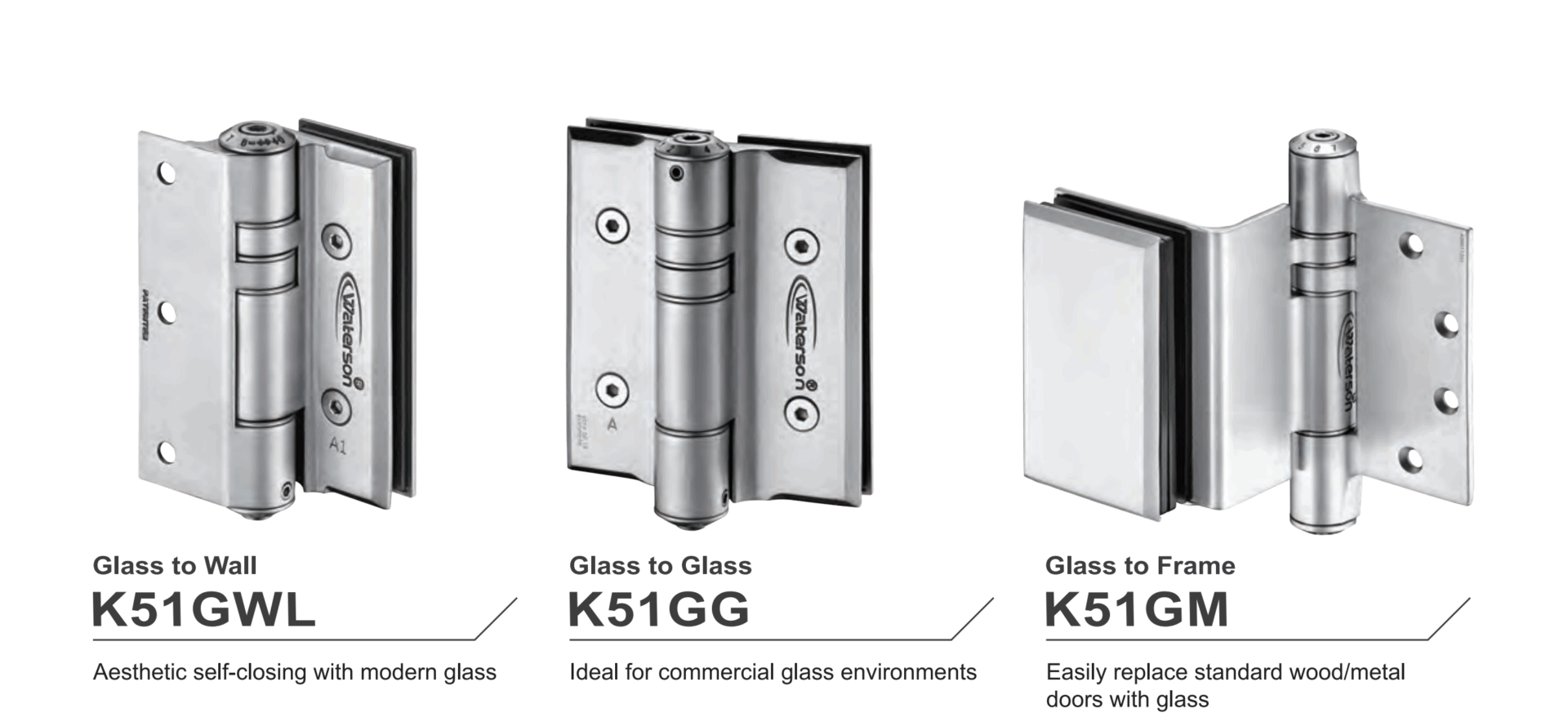
The best self-closing hinge for a glass door depends on your setup. If your door swings from another glass panel, use a glass-to-glass hinge (K51GG). If it mounts to a wall or post, use a glass-to-wall hinge (K51GWL). And for an existing wood or metal frame is in place, use a glass-to-frame hinge (K51GM). All three are self-closing, require no floor drilling, and support doors up to 330 lbs.
Most people searching for a glass door hinge already know they need self-closing functionality. What they don’t know is that picking the wrong hinge type can crack the glass panel, misalign the frame, or leave them with a door that slams instead of closing quietly.
The truth is, there is no single “best” self-closing glass door hinge. The right hinge depends entirely on your door configuration, your mounting surface, and how much weight the glass carries. This guide breaks it down by application so you can match the correct hinge to your exact setup.
What are the 3 Main Types of Self Closing Glass Door Hinges
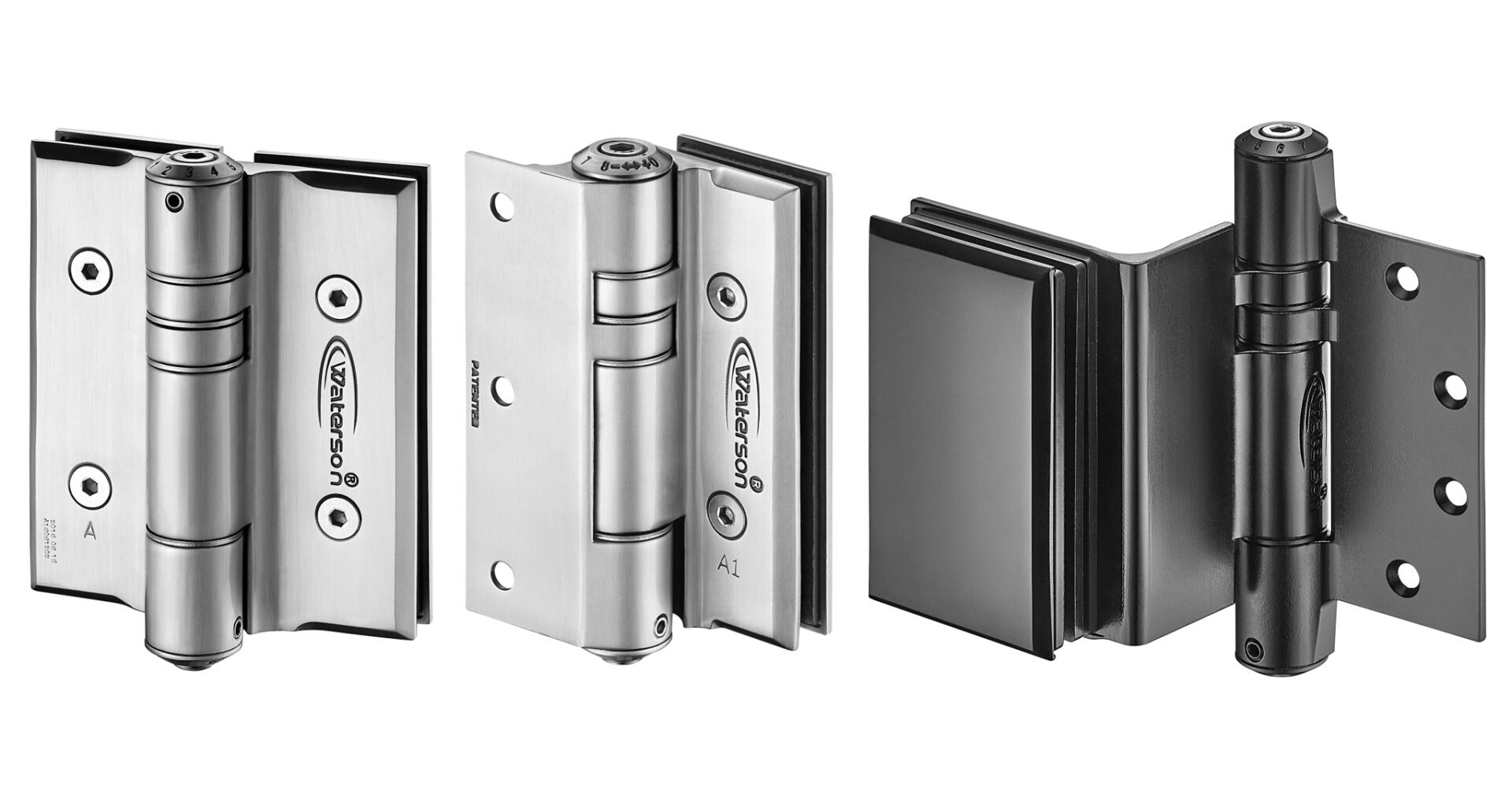
Waterson’s K51G glass door hinge series covers the three primary mounting configurations used across commercial and residential glass door applications.
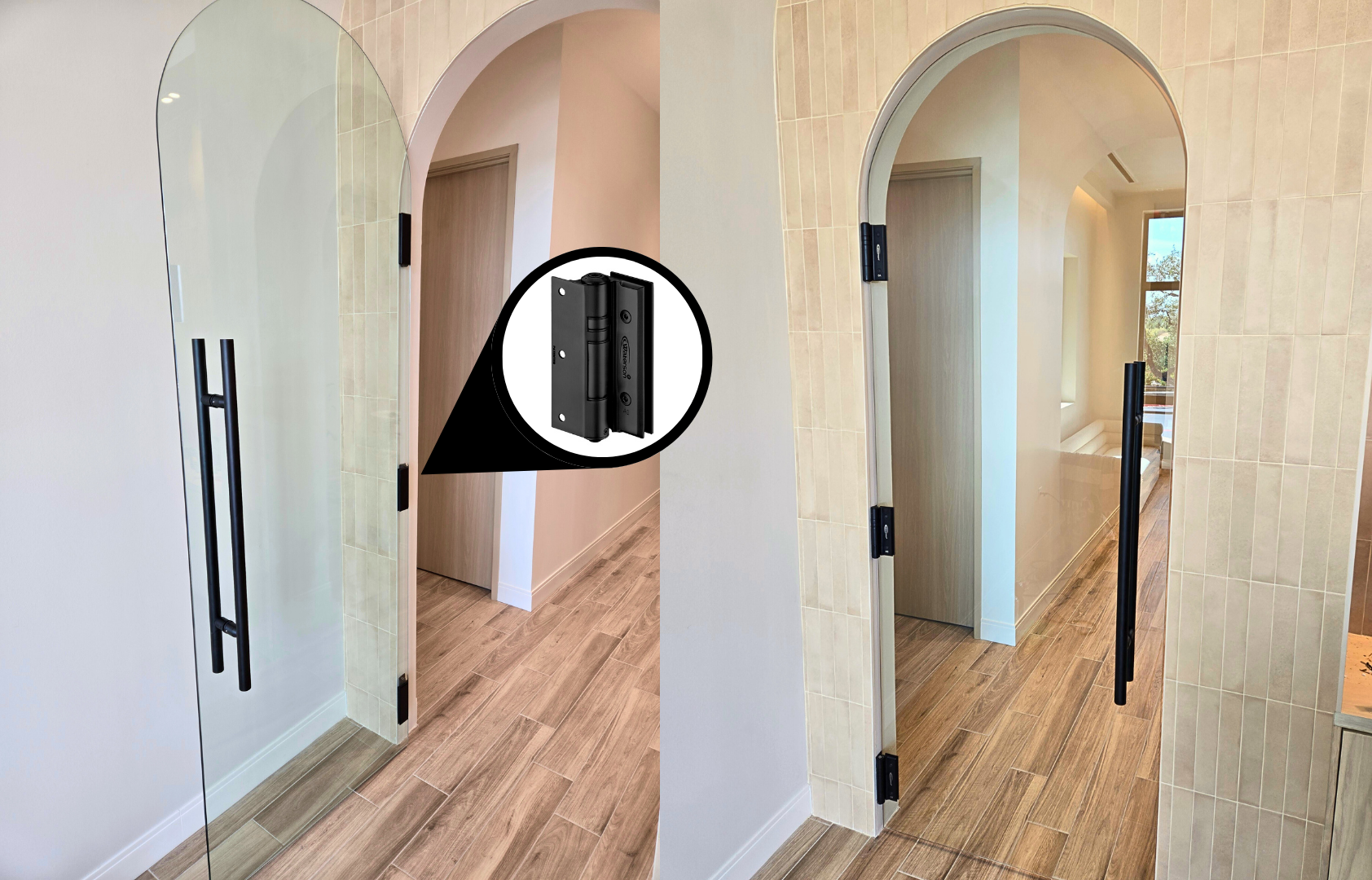
1. Glass to Glass – K51GG (Shower Doors and Office Partitions)
The glass to glass K51GG connects two adjacent glass panels directly, with no wall or frame involved. One leaf clamps onto the fixed glass panel; the other clamps onto the swinging door panel. Both sides grip glass, which is why this model is built using investment casting to deliver superior clamping strength.
Best for:
- Frameless shower enclosures (the most common K51GG application in residential settings)
- Commercial glass partitions and office entrances
- Showrooms and hospitality spaces where visual continuity matters
The K51GG eliminates the need to drill into the floor or attach a metal frame. For shower doors specifically, this means you get self-closing function from the hinge alone, without adding a floor spring underneath.
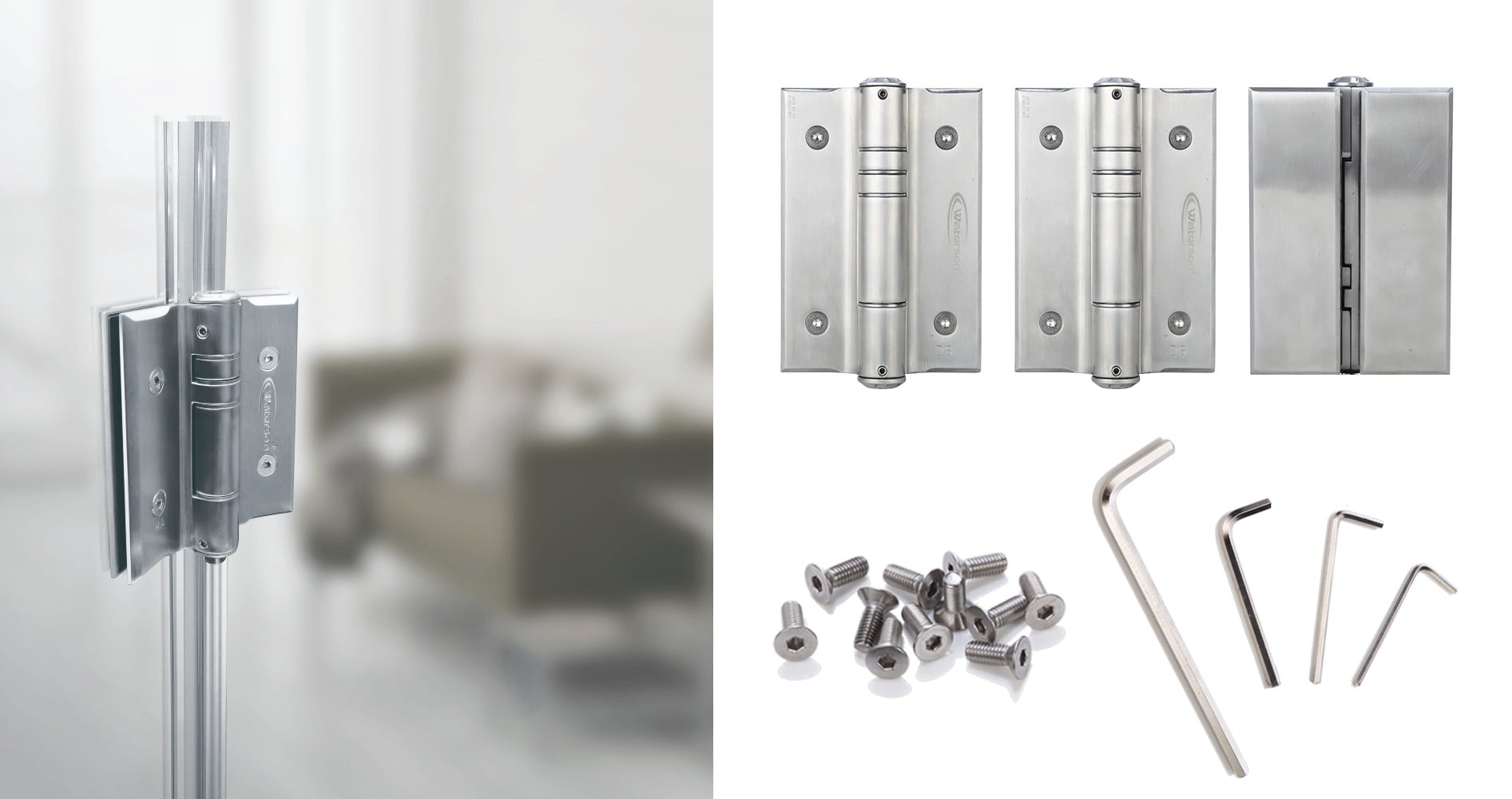
2. Glass to Wall / Partition – K51GWL (Pool Gates and Bathroom Entries)
The Glass to Wall K51GWL has one leaf that clamps directly to the frameless glass panel, while the other leaf mounts to a solid wall, concrete post, or metal fence post. The wall thickness must be at least 1.5 inches (38mm) for a secure installation.
Best for:
- Pool gates and outdoor glass enclosures (the most common K51GWL application in exterior settings)
- Glass bathroom entries and corridor doors
- Any frameless glass door that swings directly from a solid structure
For pool gates in particular, the K51GWL handles outdoor exposure well. Paired with 316 stainless steel finish, it resists corrosion from pool chemicals and weather without losing closing performance over time.
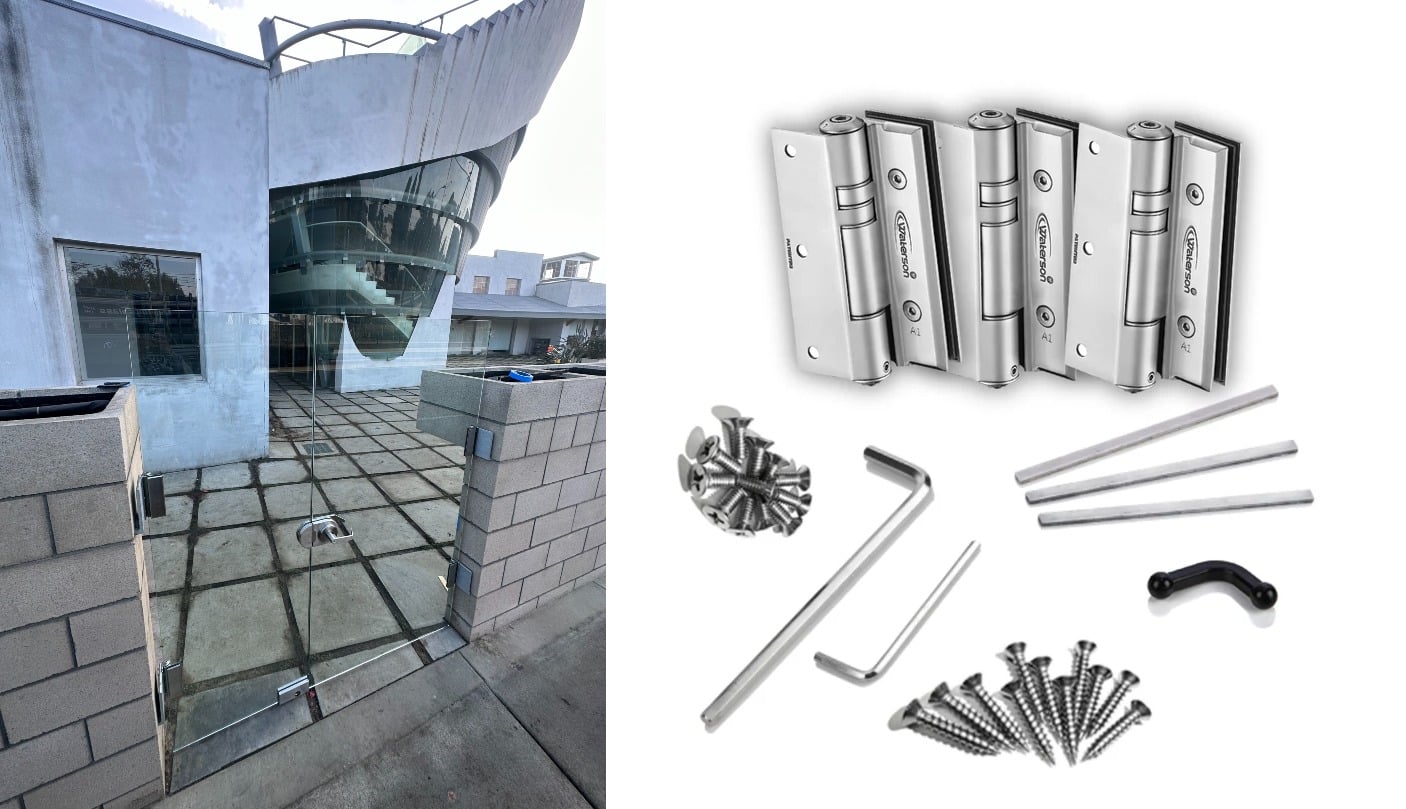
3. – K51GM (Interior and Retrofit Framed Doors)
Lastly, the Glass to Frame K51GM is designed for situations where a standard wood or aluminum frame already exists. One side attaches to the glass panel; the other side installs directly to the 4.5 x 4.5 standard template frame. This makes it the go-to solution for glass door retrofit projects, where you’re replacing an existing solid door with glass without modifying the frame.
Best for:
- Office buildings retrofitting framed doors with glass panels
- Commercial spaces needing code-compliant self-closing glass systems
- Residential or light commercial projects with existing aluminum or wood frames
How to Match Hinge to Glass Thickness and Door Weight
Choosing the right hinge type is step one. Step two is making sure the hinge set can handle your specific glass size and weight. Here’s how the K51 series maps to door dimensions:
| Door Size (W x H) | Max Weight | # of Hinges Required |
|---|---|---|
| Under 6′ x 4′ | Up to 150 lbs | 2 hinges |
| Under 7′ x 4′ | Up to 260 lbs | 3 hinges |
| Under 8′ x 4′ (K51GM only) | Up to 260-330 lbs | 4 hinges |
The hinge set also operates in two modes depending on glass thickness: 5/16″ to 9/16″ glass thickness activates self-closing mode, while 9/16″ to 27/32″ thickness switches to heavy-duty non-self-closing mode.
A Comparison on Self Closing Glass Hinges vs. Traditional Floor Spring
Many glass door installations still default to floor springs, partly out of habit and partly because they’ve been the standard for decades. But the comparison is increasingly one-sided.
| Criteria | Waterson Self Closing Glass Hinge | Floor Spring |
|---|---|---|
| Installation Position | Directly on door | Buried in floor |
| User Experience | Easy to open | Heavy to open |
| Outdoor Use | Yes | No |
| Total Cost | Low | High |
| Adjustment | Easy to adjust the speed and latch with the numeric panel from 1 to 7 | Requires two people: one to hold the door open, one to open the floor cover and adjust the screws inside |
| Product Lifetime | 3-Year Warranty | Brand specific |
| Hold Open | 90° hold open | 90°/135°/180° and other angles |
Floor springs require cutting and drilling into the finished floor, which adds labor cost and risk to the slab. They’re also susceptible to rust in outdoor or high-moisture environments. Waterson closer hinges install like standard hinges, no floor work required, and the 316 stainless steel option handles outdoor exposure without degradation.
Ideal Glass Door Hinge Across Applications
Waterson glass door hinges combine precision mechanics with architectural flexibility, ensuring safe and efficient glass-door operation without the maintenance burden of traditional closers.
Key Performance Features:
- Soft Closing: Smooth, controlled motion that prevents abrupt impact and protects panels.
- Heavy-Weight Capability: Three hinges support up to 260 lbs; four hinges up to 330 lbs.
- Stainless Steel: 304 or 316 grade for long-term corrosion resistance indoors or outdoors.
- Aesthetic Integration: Eliminates floor drilling and keeps glass design uninterrupted.
- Adjustable Closing Speed: Three-stage numerical tension system for precise control.
- Low Opening Force: ADA-friendly performance for high-traffic commercial use.
- Hold-Open Option: 90° configurations available.
- No Floor Cutting Required: Reduces labor, downtime, and risk to finished floors.
- 3-Year Warranty: Backed by reliable coverage and service support.
How Do You Install Waterson Self-Closing Glass Door Hinges?
What Comes in the Box
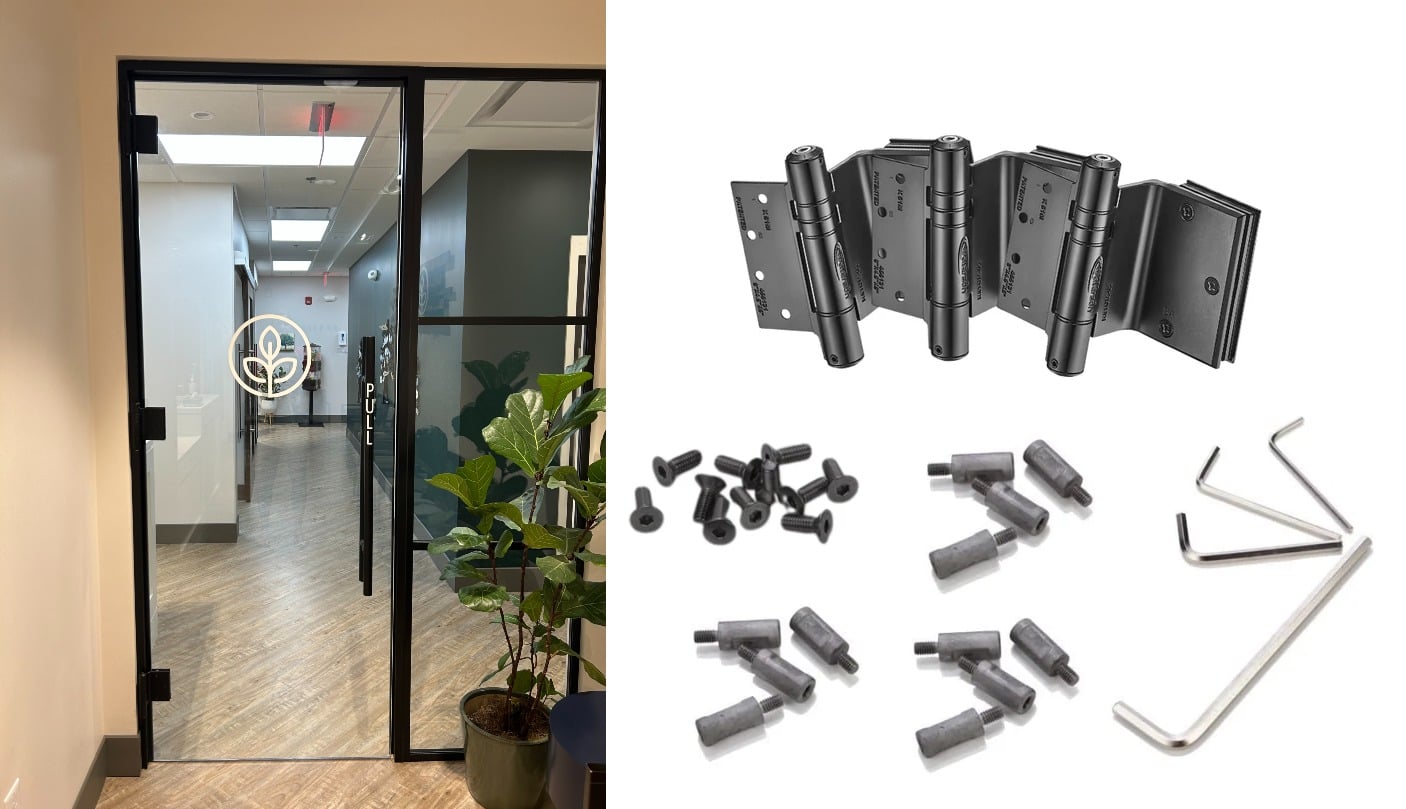
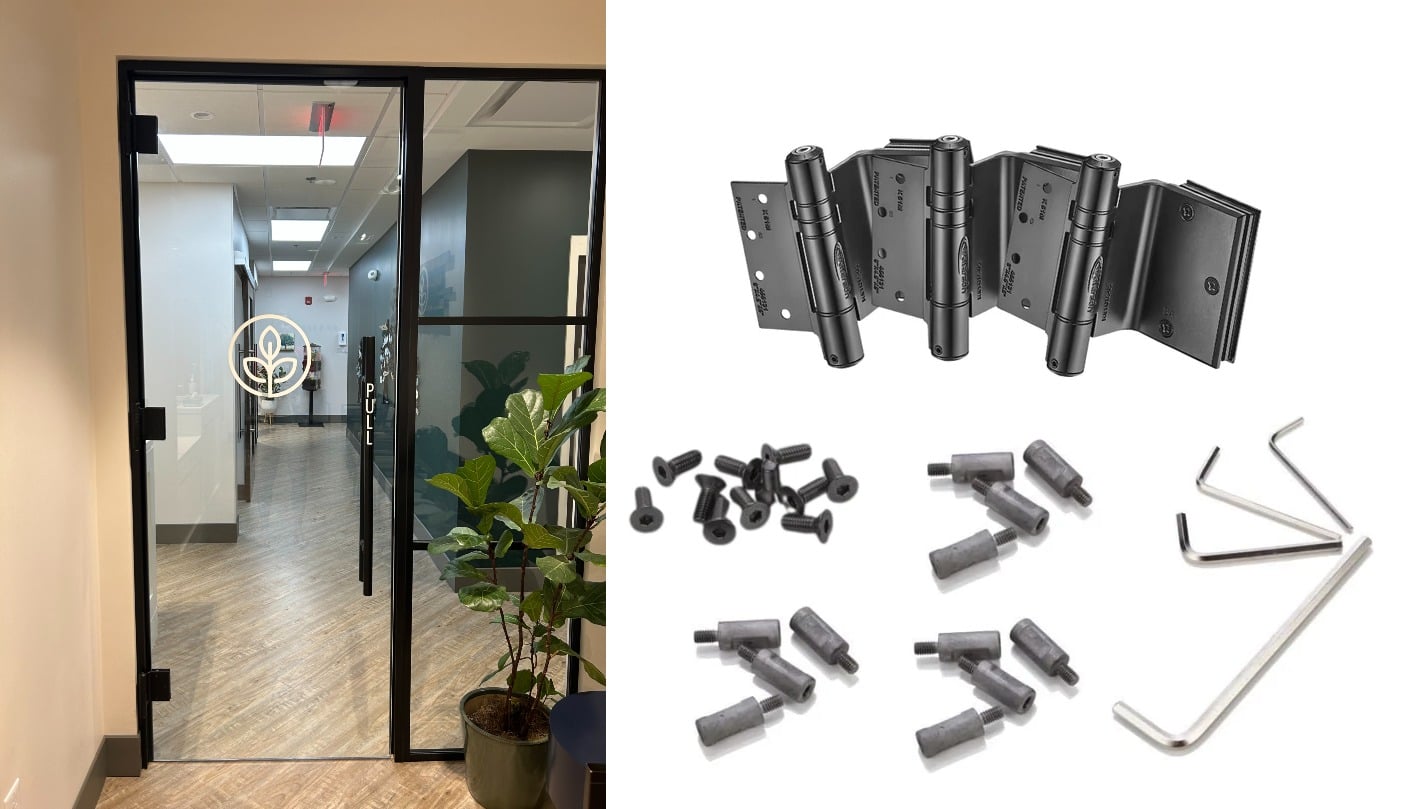
Each Waterson package includes everything needed for installation:
- Waterson Closer Hinges (Set B2 includes 2 hinges, Set B3 includes 3 hinges)
- Standard hex wrench 3mm and 5mm
- Cross head self-tapping screws (#12 x 1-1/4″ / 31.75mm)
- Flat head machine screws (#12-24 UNC, 1/2″)
- Spreader Bar (props the hinge leaves open for easier install)
- Fire-rated stainless steel shims
Step-by-Step Installation
Step 1: Check factory settings before installing. Hinges should be at N position (disengaged). Confirm the door swings freely and latches before touching any adjustment.
Step 2: Mount the hinges using the provided screws. Use the spreader bar to hold the leaves open while positioning.
Step 3: Set starting tension. Increase tension one number at a time until the door closes and latches from 20 degrees. Start low and work up gradually, one number at a time. Note that tension settings are cumulative across all hinges, so keep all hinges at the same number.
Step 4: Adjust swing and latch speed. Adjust swing speed first using Hex Nut A on the SA hinge, then latch speed using Hex Nut A1 on the SA1 hinge. Always in that order to avoid slamming. Turn (+) for faster, turn (-) for slower.
Step 5: Enable hydraulic damper if needed. Check H1 to see if hydraulic zone adjustment is needed, then refer to H2 for damper strength on the HS hinge.
Step 6: Lock in place. Tighten the barrel-side speed lock-in screws on SA, SA1, and HA hinges using a 3mm wrench. Each hinge has two screws, tighten at least one.
How Do You Adjust Waterson Self-Closing Glass Door Hinges?
Waterson hinges use 3mm and 5mm hex wrenches for all adjustments. There are five adjustment points:
S – Tension Adjustment Use a 5mm hex wrench on the numerical panel. Turn up to increase tension, depress and turn to decrease. Setting tension beyond 5 may decrease spring longevity. Never force the panel from N to 7 or 7 to N as this will break the hinge and void the warranty.
A – Swing Speed Adjustment Use a 5mm hex wrench on the SA or HA hinge bottom. Turn (+) for faster swing speed, turn (-) for slower. Lock the speed lock-in screws with a 3mm wrench after adjusting.
A1 – Latch Speed Adjustment Use a 5mm hex wrench on the SA1 hinge bottom only. Turn (+) for faster latch speed, turn (-) for slower. Lock the speed lock-in screws with a 3mm wrench after adjusting.
B – Hold Open Adjustment Adjusted only on the SB hinge bottom. Turn hex nut (+) to disable hold open, turn hex nut (-) to enable. Lock in place with the 3mm wrench after adjusting.
H1/H2 – Hydraulic Zone and Damper Adjustment H1 adjusts the hydraulic zone using a 5mm wrench. For light or latchless doors, turn fully (+). For heavy latch doors, turn fully (-). H2 adjusts the hydraulic damper strength using a 3mm wrench on the HA or HS hinge only. Turn one full round (-) first, then adjust in 1/4 turns. Hydraulic mechanism operates best from 0 to 120 degrees. Opening beyond 120 degrees may damage the hinge and void warranty.
Troubleshooting quick reference:
- Door slams: Decrease swing speed (A), latch speed (A1), or tension (S)
- Door does not latch: Increase swing speed, latch speed, or tension
- Settings keep drifting: Lock-in screws are not tight enough, go back and tighten
In Summary, What Is the Best Self Closing Door Hinge for Glass Doors
The best self-closing hinge for a glass door is the one that matches your specific configuration: K51GG for shower doors and glass-to-glass setups, K51GWL for pool gates and wall-mounted frameless doors, and K51GM for framed openings and retrofit projects. From there, verify that the hinge set supports your glass dimensions and weight, and choose 316 stainless steel if the installation is outdoors or in a high-moisture environment.
If you’re still unsure which model fits your project, contact Waterson directly or request a quote with your door specs, and they’ll match you to the right configuration.
Waterson Self Closing Door Hinge for Glass Doors
Waterson self closing glass door hinges combine the function of an overhead closer and a hinge into a single, sleek component—complete with optional hold-open and door-stop features. Designed for commercial openings, gates, and glass doors, these hinges are easy to install and adjust to meet ADA and ICC A117.1 standards for opening force, while ensuring quiet and secure closure. Crafted from durable stainless steel, they are NFPA 80 compliant, UL 3-hour fire-rated, and built to perform reliably in both interior and all-weather exterior environments. See all our features.
In addition to these performance advantages, Waterson offers flexible customization services. As a direct custom hinge manufacturer, we can tailor hinge sizes, finishes, and especially hinge leaf designs to meet the specific structural needs of your doors. This makes our hinges an ideal solution for door manufacturers seeking custom options that integrate seamlessly with their existing frames.
Request For Information
Please note that Waterson Closer Hinges start from a size of 4″x4″. If you’re in need of smaller self-closing hinges, we’d recommend checking out some other resources! Also, we only provide single acting closer hinges. Thank you.
Recent Post
How to Choose All Glass Door Hinges for Self Closing and Hold Open on Aluminum Framing
"I need 36x96 all-glass doors attached to aluminum framing. Self closing with hold open on 2 doors. Black finish." An all-glass door has no top [...]
Door Closer Replace Floor Closer: What is Your Retrofit Options When Floor Closer Fails
"Our storefront door runs on a floor closer that has been leaking oil for months. Now the door drifts open and slams shut. The installer [...]
Can Waterson Self Closing Gate Hinges Work on a Chain Link Fence
"Hi, we're closing out a commercial lot and the spec calls for self closing hinges on the entry gates. These are customized metal gates: a [...]