
Quick Answer
An ADA transfer shower must be exactly 36″ x 36″ with a 36-inch entry. A standard roll-in shower must be at least 30″ x 60″ and open across the full 60-inch front. The door into the shower room needs a 32-inch clear opening, must open with 5 pounds of force or less, and should close slowly if it has a closer.

ADA shower requirements cover two different things that often get mixed up: the shower compartment itself (size, entry, controls, seat) and the door into the shower room (clear width, opening force, closing speed). This guide covers both, with the ADA 2010 section numbers so you can check each one.
What Size Does an ADA Shower Need to Be?
The ADA Standards (Section 608) allow three accessible shower types. Dimensions are measured at the center points of opposing walls, so prefabricated units with rounded corners can still comply.
| Shower type | Inside size | Entry width | Clear floor space outside |
|---|---|---|---|
| Transfer | 36 x 36 in (absolute, not minimum) | 36 in min | 36 in wide x 48 in long min, extending 12 in past the seat wall |
| Standard roll-in | 30 in deep x 60 in wide min | 60 in min (full width) | 30 in x 60 in min, along the open face |
| Alternate roll-in | 36 in deep x 60 in wide min | 36 in min, at one end | Accessible route to the entry |
Transfer showers must have a seat (17 to 19 in high). Thresholds are limited to 1/2 in, and at roll-in showers anything over 1/4 in must be beveled.
Where Do ADA Shower Controls and Valves Go?
- Transfer showers: on the side wall opposite the seat, 38 to 48 in above the shower floor and no more than 15 in from the seat centerline toward the entry.
- Roll-in showers: above the grab bar and no higher than 48 in. With a folding seat in a standard roll-in, controls go on the back wall, no more than 27 in from the seat wall.
- All accessible showers: a hand-held spray unit usable in a fixed position, with a hose at least 59 in long and water temperature limited to 120°F. Controls must work with one hand and no more than 5 lbf.
Can an ADA Shower Have a Glass Door?
Sometimes, but it is harder than it looks. Section 608.8 says shower enclosures, including doors, cannot block the controls, the spray unit, or the transfer from a wheelchair to the seat. According to the U.S. Access Board, swing doors on transfer showers and standard roll-in showers will usually fail this test. A door can work on an alternate roll-in shower if the opening still gives at least 36 in of clear width with the door open 90°.
What Are the ADA Requirements for the Shower Room Door?
The door into the shower room is covered by ADA Section 404, the same as any other accessible door.
Clear Width (Section 404.2.3)
The door must give at least 32 in of clear opening, measured between the face of the door and the opposite stop with the door open 90°. In practice, a 36 in door leaf is the usual choice, because the door thickness and hinges take space out of a narrower leaf. Where the opening is tight, swing clear closer hinges move the door fully out of the opening.

Opening Force (Section 404.2.9)
Interior hinged doors must open with no more than 5 lbf. Fire doors are exempt and follow the minimum force allowed by the authority having jurisdiction.
Closing Speed (Sections 404.2.8.1 and 404.2.8.2)
If the door has a closer, it must take at least 5 seconds to move from 90° open to 12° from the latch. Doors on spring hinges must take at least 1.5 seconds to close from 70°.
Door Swing
The shower room door cannot swing into the clear floor space at any fixture. In a single-user room, it can, but only if there is an unobstructed 30 x 48 in space inside the room beyond the door swing.
For a full breakdown, see our guide to ADA door requirements for hinges and closers.
Can You Retrofit Closer Hinges on an Existing Shower Room Door?
Yes. Waterson closer hinges follow ANSI/BHMA A156.7 template dimensions, so they fit existing hinge preps and use the same mortise and screws. No special tools are required, and our closer hinge installation guide walks through each step.
Match the hinge to the door: K51M-400 (4 x 4 in) for 1-3/8 in doors and K51M-450 (4.5 x 4.5 in) for 1-3/4 in doors. A 3-hinge set covers doors up to 4 x 7 ft and 260 lb, and a 4-hinge set covers doors up to 4 x 8 ft and 330 lb.
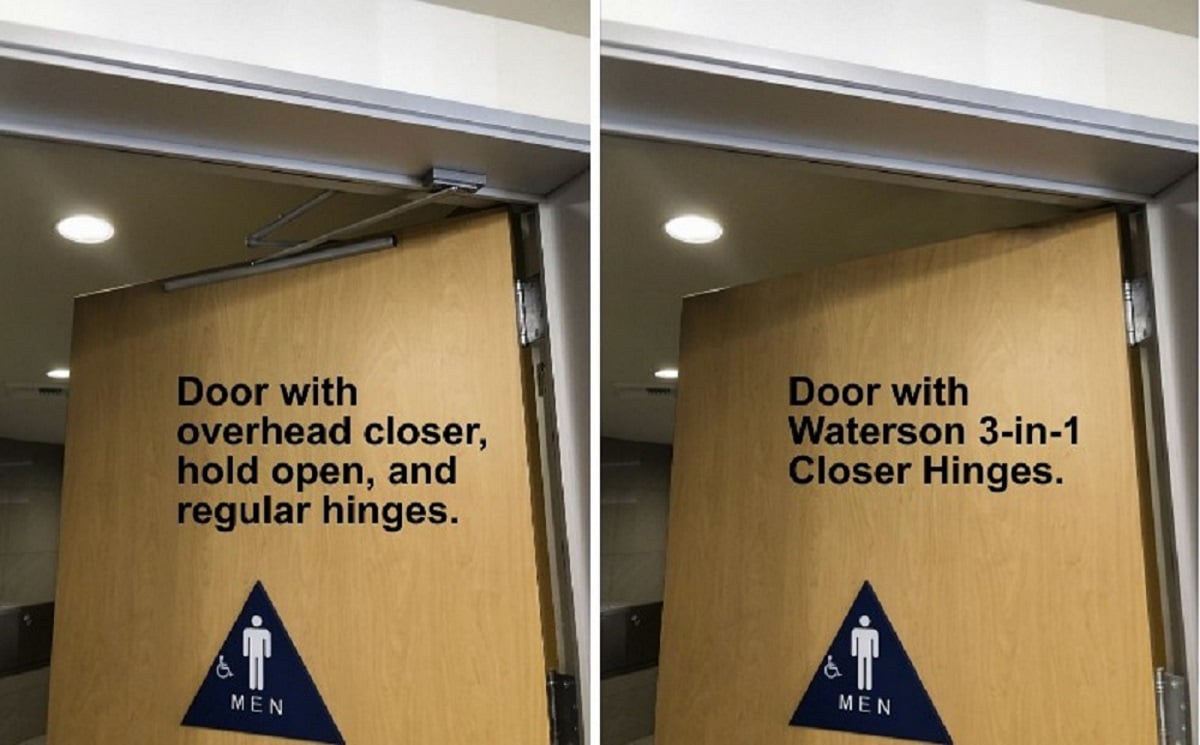
On narrow shower room doors, also check how the hinge barrel affects your strike side clearance.
What Could Be the Limitation in Waterson K51M 4inch Hinge Barrel Size
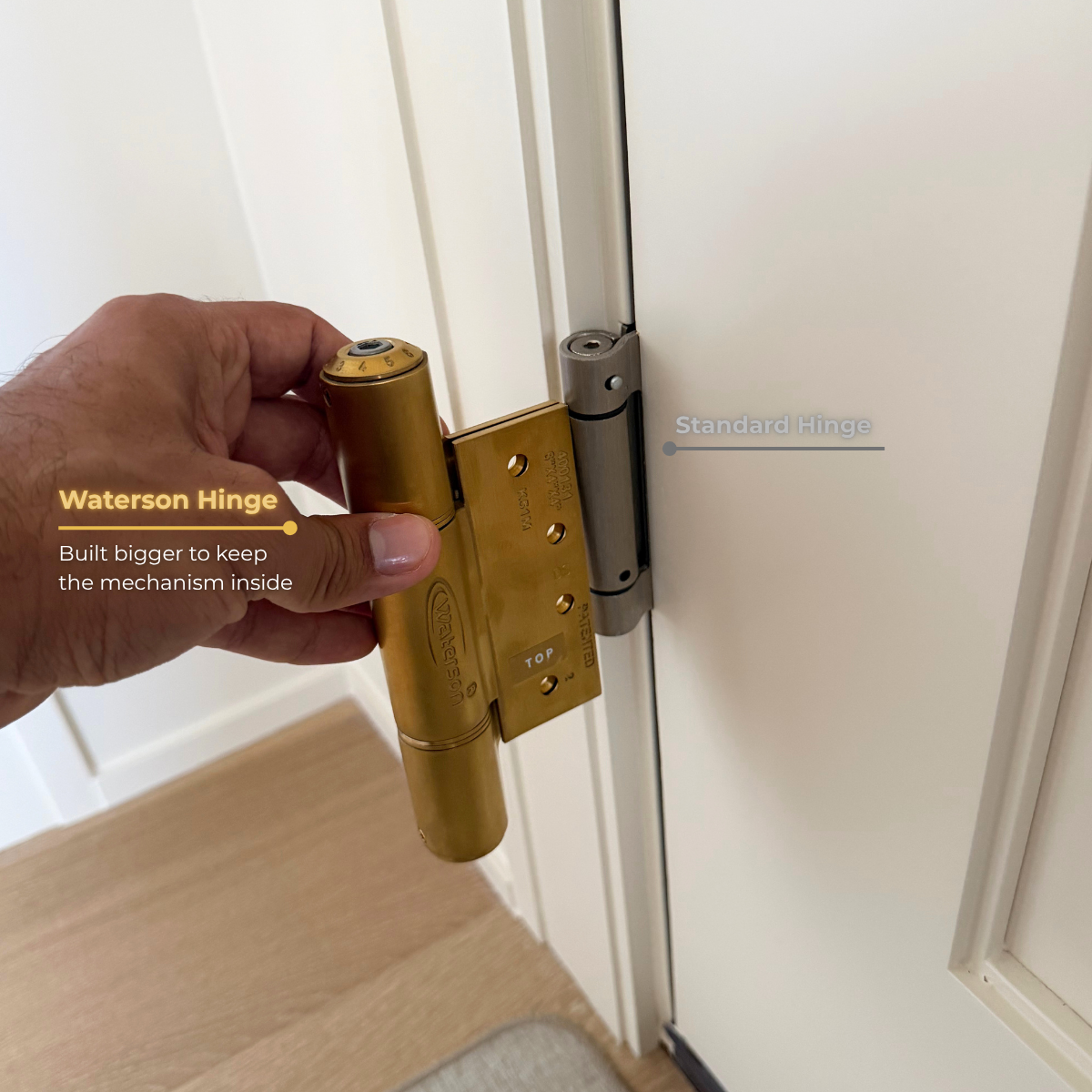
On a retrofit, the Waterson 4×4 uses the same mortise template as a standard 4×4 butt hinge, so the leaves drop into the cutout you already have. The difference is the barrel. It is built bigger to keep the hydraulic mechanism inside, and that thicker barrel moves the pivot further off the door and frame, shifting the door roughly a quarter inch toward the strike jamb.
For most doors, that shift is absorbed by the normal strike side gap, and we have not seen this issue on garage entry doors. It mainly shows up on tight custom doors, where the strike edge can end up touching the frame, and deepening the mortise only helps if there is room on the strike side to take it. If you are retrofitting, check your clearance first, because with this hinge, the barrel diameter, not the leaf size, decides whether it fits.
In short, the issue only comes up when retrofitting an interior door with an uneven or tight gap on the strike side. On new installations, or on any door with an even gap between the door and the frame, the Waterson 4-inch hinge fits and works just like a standard hinge.
What to Specify for an ADA Shower Room Door
Waterson K51M closer hinges combine the hinge and the closer in one part, so there is no overhead arm in the doorway:
- Self-closing: Built-in springs close the door after every use, which keeps the shower room private.
- ADA adjustable: Opening force and closing speed are field adjustable to meet the 5 lbf and 5-second limits.
- Separate adjustments: Spring power, swing speed and latch speed each adjust with the hex keys included in the carton.
- ANSI/BHMA A156.17 Grade 1: All-mechanical models are tested to 1,000,000 cycles.
- Stainless steel: Type 304 is standard and Type 316 is optional. At wet locations, specify the screw-on weather-resistant cap. Limited warranty of 3 to 5 years.
- Soft close option: Hybrid sets add a quieter close. Use all-mechanical sets where the temperature swings more than 20°F, such as steam rooms or pool showers.
- Finishes: Satin Stainless (BHMA 630), Flat Black (631), Dark Satin Bronze (695) and Satin Brass (731).
Most ADA shower problems come from mixing up the shower compartment rules with the door rules. Size the compartment by type (transfer, standard roll-in or alternate roll-in), keep enclosures out of the way of controls and transfer, and give the shower room door 32 in of clear width with a controlled, easy-opening close. For wet rooms, add the weather-resistant cap and consider Type 316 stainless.
Download K51M spec sheets and CAD files, see the closer hinge adjustment manuals, or request a quotation and a product specialist will help you build the right set for each door.
Frequently Asked Questions
ADA doesn’t set a door size. It sets a clear width: at least 32 in, measured from the face of the door to the opposite stop with the door open 90°. Most projects use a 36 in door to get there, because the door’s thickness and hinges take a few inches out of the opening. If a narrower door is unavoidable, swing clear hinges can help recover that space.
It depends on the type. A transfer shower is exactly 36 x 36 in, not larger, so the seat, grab bars and controls stay within reach. A standard roll-in shower is at least 30 in deep and 60 in wide, open across the full front. An alternate roll-in is at least 36 x 60 in with a 36 in entry at one end.
Only if the door stays out of the way. Section 608.8 says shower doors and other enclosures cannot block the controls, the spray unit, or the transfer to the seat. On transfer and standard roll-in showers, a swing door usually fails that test, which is why curtains are common. An alternate roll-in shower can take a door if the opening still has 36 in clear with the door open 90°.
In a transfer shower, put the controls on the wall opposite the seat, between 38 and 48 in above the floor and within 15 in of the seat centerline, so they can be reached from the seat and from outside. In a roll-in shower, the controls go above the grab bar and no higher than 48 in. Every accessible shower also needs a hand-held spray unit.
Yes, as long as it’s adjusted correctly. ADA doesn’t require a closer on a shower room door, but if you add one, it can’t take more than 5 lbf to open, and it has to take at least 5 seconds to close from 90° to 12°. Closer hinges let you set both on site with a hex key, without an arm hanging over the doorway.
Request For Quote
Please note that Waterson closer hinges start from a size of 4″x4″. If you’re in need of smaller self-closing hinges, we’d recommend checking out some other resources! Also, we only provide single acting closer hinges. Thank you.
Recent Post

Which Self Closing Door Hinges Work Best for LEED Buildings
Quick Answer The best self-closing door hinges for LEED buildings close and latch the door reliably every time, meet ADA opening force and closing speed, [...]
School Door Hinges: What Each Room Needs, from Classroom to Dorm
Quick Answer School door hinges are not one product. Classroom doors need quiet, controlled closing, and they only have to self-close when the corridor wall [...]

Door Closer vs Spring Hinges: How to Save Time and Money in Large Project
Quick Answer Traditional door stops pose a child safety risk because their rubber covers can be pulled off and become a choking hazard, and wall [...]
Request For Quote
Please note that Waterson closer hinges start from a size of 4″x4″. If you’re in need of smaller self-closing hinges, we’d recommend checking out some other resources! Also, we only provide single acting closer hinges. Thank you.
Recent Post
Which Self Closing Door Hinges Work Best for LEED Buildings
Quick Answer The best self-closing door hinges for LEED buildings close and latch the door reliably every time, meet ADA opening force and closing speed, [...]
School Door Hinges: What Each Room Needs, from Classroom to Dorm
Quick Answer School door hinges are not one product. Classroom doors need quiet, controlled closing, and they only have to self-close when the corridor wall [...]
Door Closer vs Spring Hinges: How to Save Time and Money in Large Project
Quick Answer Traditional door stops pose a child safety risk because their rubber covers can be pulled off and become a choking hazard, and wall [...]