
“We keep getting callbacks on our exterior gates. The closers sag, the gate stops latching, and the pool inspector fails us on self-closing.”
In Canada, the answer is driven less by preference and more by three things stacked on top of each other: the code, the climate, and the application. Work through them in that order and the hinge almost specifies itself.

So What Do Canadian Specifiers Actually Reach For?
For exterior gates the pattern is consistent: commercial heavy-duty gate hinges that are self-closing, adjustable, and corrosion-resistant, with the style following the gate material:
- Aluminum picket and railing gates: spring-assisted self-closing hinges with adjustable tension and stainless internals for weather resistance
- Ornamental and welded steel gates: heavy-duty stainless self-closing hinges, sized to the leaf
- Frameless glass, pool, and amenity gates: stainless self-closing or soft-close hinges with controlled closing speed
The common thread is that the closing function is expected to live in adjustable, weather-rated hardware, not in a plain butt hinge plus the hope that someone pulls the gate shut. Ontario building officials describe the same thing from the code side: pool gate self-closing is typically achieved with a spring hinge or a hydraulic closer.
Which Codes Govern an Exterior Gate in Canada?
There is no single national rulebook to point an inspector to. Exterior gate requirements come from a stack:
- National Building Code of Canada (NBC): the model code, including the barrier-free provisions in Section 3.8
- Provincial and territorial codes: the NBC as adopted and amended
- Municipal bylaws: pool enclosure bylaws and local amendments that frequently run stricter than the province
- CSA B651 Accessible design for the built environment: the accessibility standard referenced by the NBC and many jurisdictions
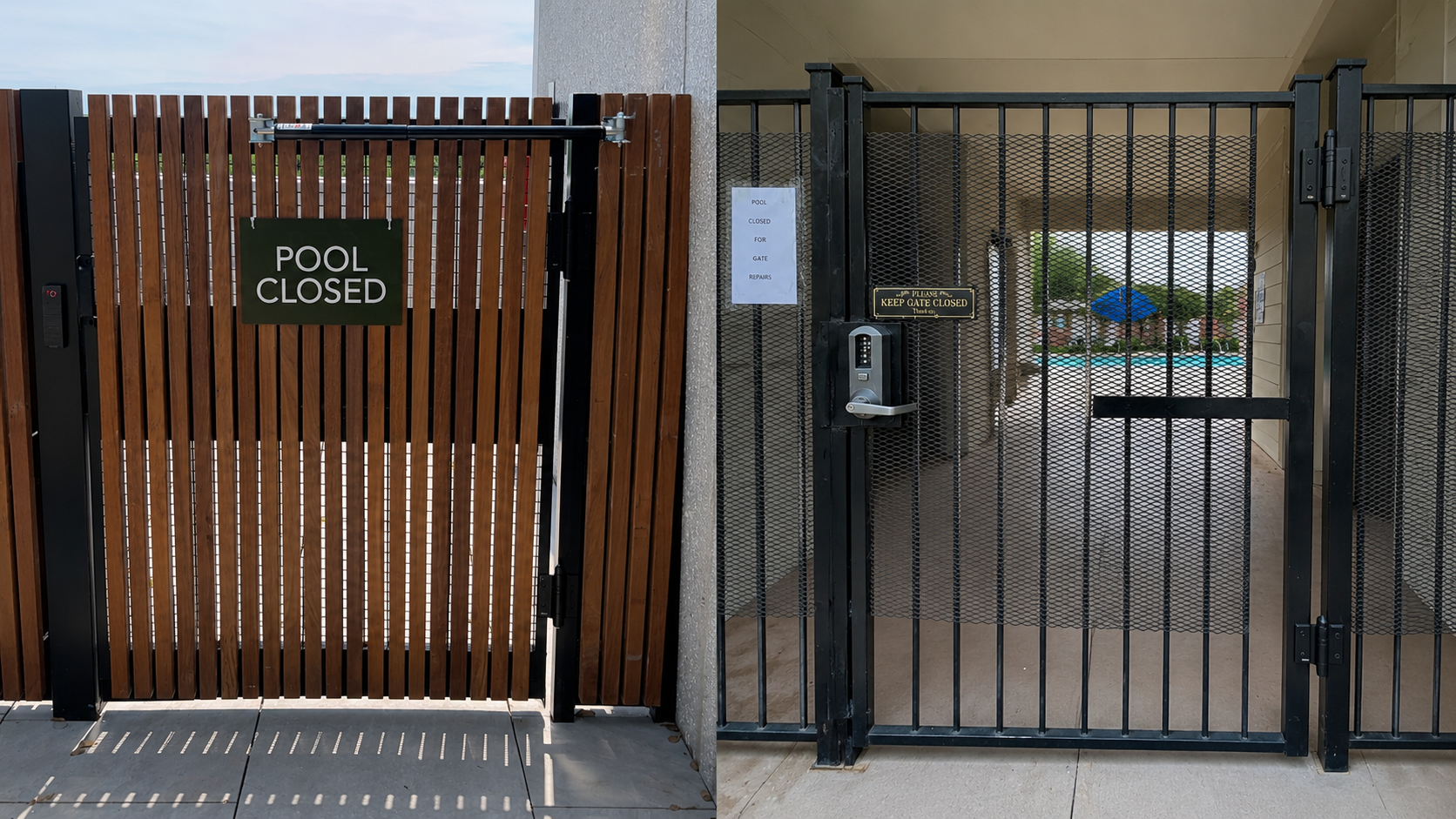
Will the Gate Pass a Self-Closing, Self-Latching Pool Inspection?
Pool and spa enclosures are where most exterior gate failures surface, and the hardware is usually the culprit. Canadian pool bylaws vary by municipality, but the gate requirements rhyme:
- Self-closing from any open position with no manual assist (some bylaws set a maximum return time, for example within 30 seconds)
- Self-latching, engaging on its own each time the gate swings shut
- Gate swinging outward, away from the pool
A self-closing hinge delivers the first two requirements, plus self-latching, from within the gate itself, so there is no exposed overhead closer to seize, sag, or fail the re-inspection.
Can You Meet the 38 N Barrier-Free Opening Force and Still Latch?
On a barrier-free path of travel the NBC caps the force needed to open a door, and specifiers apply the same target to gates serving those routes. Section 3.8 sets the limit at no more than 38 N for exterior doors and 22 N for interior doors, measured at the latch or handle, with an exception where higher force is needed to close against air-pressure differences. That is the number to design to on a Canadian project.
A spring stiff enough to close and latch an exterior gate can push past 38 N. An adjustable spring hinge resolves it, letting you set the opening force toward the barrier-free limit while the mechanical brake still controls the closing speed into the latch.
Is 304 Stainless Enough for Canadian Winters and Coastlines?
Corrosion is a material decision made before the gate ships. Canadian exposure is harsher than average: freeze-thaw cycling, winter de-icing salt near entries and parkades, and salt air on the BC and Atlantic coasts. Match the alloy to the site:
| Site condition | Specify |
|---|---|
| Sheltered or dry exterior, inland | 304 stainless |
| Open exterior, rain, snow, de-icing salt | 304 stainless, weather cap on side-mount styles |
| Cold weather, marine or chlorinated pool air | Upgrade to 316 stainless |
316 adds molybdenum for moisture, marine, and chloride resistance, which is the difference that matters. It is also why aluminum is so common for the gate frames themselves, with the hinge as the place you buy back the strength and adjustability aluminum hardware can lack.
Where Do Waterson Gate Hinges Fit These Requirements?
Waterson is one manufacturer whose closer hinges line up with the Canadian checklist above, which makes it a useful worked example. It consolidates the closer, spring, stop, and optional hold-open into one stainless hinge:
| Canadian gate requirement | Waterson feature | How it solves the painpoint |
|---|---|---|
| Self-closing and self-latching (pool bylaws) | Mechanical self-closing spring, closing built into the hinge | Gate returns and latches on its own, with no exposed overhead closer to seize or fail the re-inspection |
| 38 N barrier-free opening force (NBC Section 3.8) | Adjustable spring tension, set with two hex wrenches | Opening force dialed toward the 38 N limit while the gate still latches |
| Controlled close, no slam (barrier-free closing period, safety) | Mechanical brake governs latch speed | Complete seating into the keeper on every cycle |
| Freeze-thaw, de-icing salt, coastal salt air | Stainless construction, with an SS316 upgrade | Corrosion resistance for cold weather, marine, chlorinated pool air |
| Heavy or tall leaf, up to 260 lb (118 kg) and 7 ft (2.1 m) | Heavy-duty capacity, third hinge added by weight and height | Leaf holds alignment, so the gate keeps latching by season’s end |
| No separate stop or hold-open hardware | Integrated door stop with hold open | Stop and hold without a floor or wall device to trip over or damage |
| Match the architectural hardware schedule | Stock satin stainless and flat black, plus custom finish available | Gate hardware matches the schedule without a special-order surprise |
How Do You Spec the Right Set for Your Gate?
For a Waterson set, four inputs return a part number: gate width and height, gate weight, post width, and environment.
| Gate (W x H) | Max weight | Hinges per gate | Example set |
|---|---|---|---|
| 3 x 6 ft | 150 lb (68 kg) | 2 | K51P-500-A2 |
| 4 x 7 ft | 260 lb (118 kg) | 3 | K51P-500-A3 |
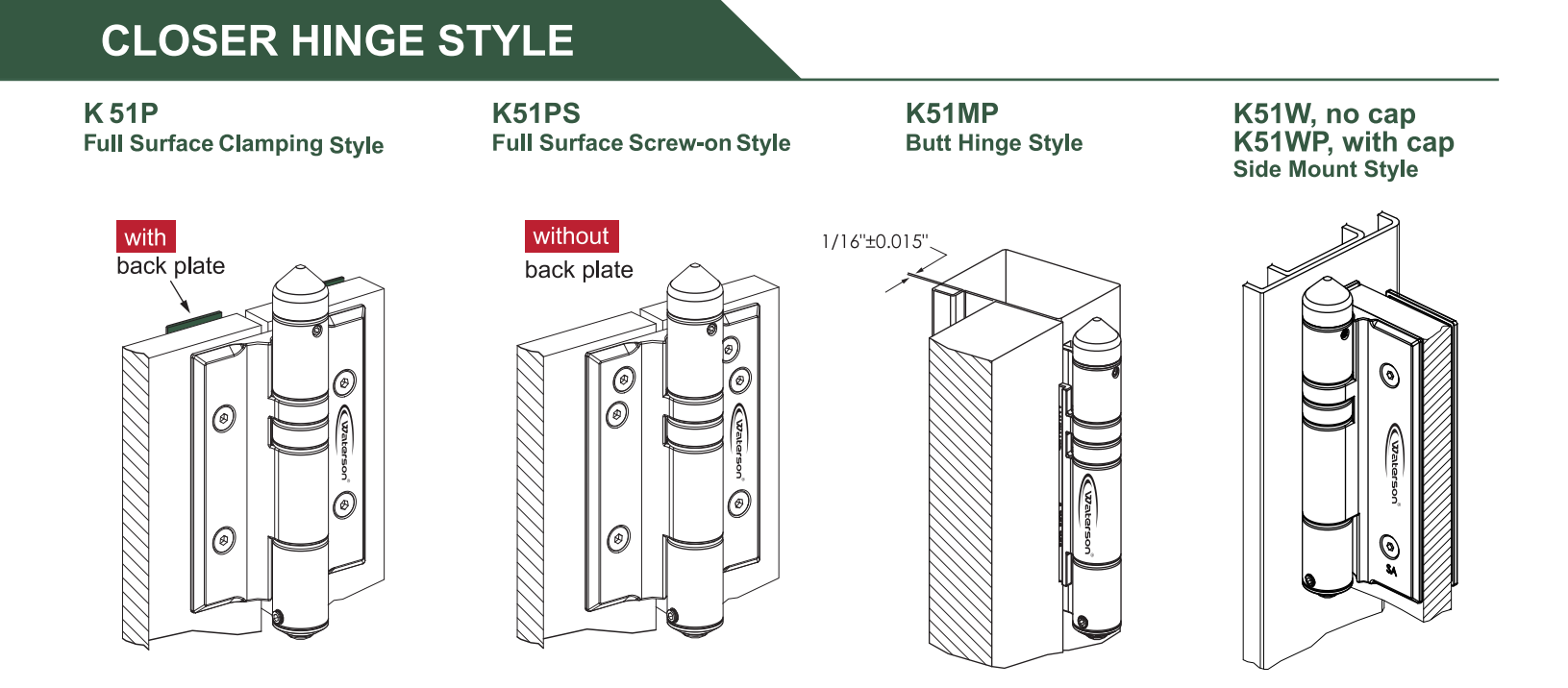
Waterson commercial heavy-duty gate hinges are mounted in the style of the gate and post. You can go further with the Waterson Gate Hinges Catalog here:
| Series | Mounting style | Back plate/cap | Leaf template | Best for |
|---|---|---|---|---|
| K51P | Full surface clamping | With back plate | 5 x 4 in | Retrofit, no welding |
| K51PS | Full surface screw-on | Without back plate | 5 x 4 in | Surface mount |
| K51MP | Butt hinge | Weather cap | 4.5 x 4.5 in | Framed or flush leaf |
| K51W | Side mount | No cap | 6 x 1.5 in | Side-mounted leaf |
| K51WP | Side mount | With weather cap | 6 x 1.5 in | Exterior side mount |
Pass the Inspection the First Time, and Every Season After
Callbacks on exterior gates in Canada usually trace back to the same three gaps: a closer that cannot handle the weather, a leaf that sags out of alignment, and a gate that no longer self-closes and self-latches when the inspector tests it. Work through code, climate, and application in that order, and the specification becomes clear: a stainless self-closing hinge with adjustable tension, sized to the leaf, and upgraded to 316 wherever salt or chlorine is in the air. With the closing function built into the hinge, there is no exposed closer to fail, and the opening force can be tuned toward the 38 N barrier-free limit while the gate still latches on every cycle.
Send your gate width and height, weight, post width, and site conditions through a quote request, or browse the Waterson Gate Hinges Catalog, and our team will confirm the right set before your next inspection.
Frequently Asked Questions
Request For Quote
Please note that Waterson closer hinges start from a size of 4″x4″. If you’re in need of smaller self-closing hinges, we’d recommend checking out some other resources! Also, we only provide single acting closer hinges. Thank you.
Recent Post
Best Way to Secure High-Traffic Hospital Doors While Staying ADA and Fire Code Compliant
Quick Answer Split the job between two parts of the door. UL-listed self-closing hospital door hinges close the door every time, and positive latching hardware [...]
What Leads to Premature Wear in Commercial Door Hinges on Storefronts
Quick Answer Premature wear in storefront door hinges usually comes from four causes working together: a hinge grade too low for the traffic, a door [...]
Which Commercial Door Hinges Are Best For Busy Retail Entrances?
Most commercial self-closing hinges still adopt either spring or hydraulic damper for [...]