
Waterson closer hinges do not include a back check valve. Instead, their optional integrated door stop physically limits the door’s opening angle to prevent wall contact and over-swing. Different mechanism, same result: your wall stays protected.
Every time a door swings open too fast, something takes the hit. It might be the wall, the frame, the hinges, or worse, a person standing nearby. In commercial and high-traffic environments, that kind of repeated impact adds up quickly, leading to damaged hardware, costly repairs, and real safety risks.
That is where the door back check comes in. Built into most hydraulic door closers, the back check acts as a hidden shock absorber, slowing the door’s swing before it can cause damage. It is a small mechanism, but one that quietly protects a lot of things at once.

What is a Backcheck on a Door Closer?
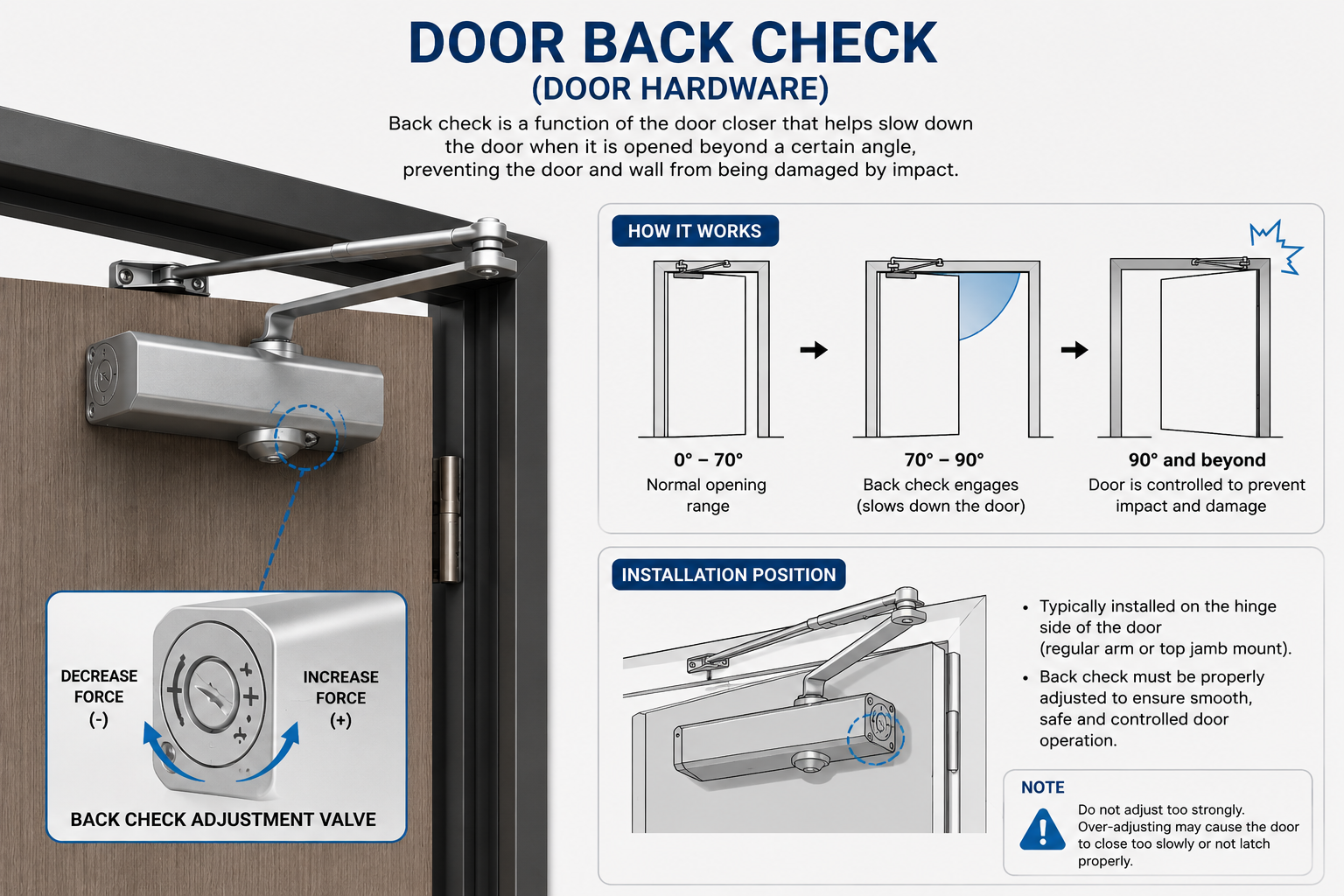
Backcheck is a safety feature on a door closer that acts as a shock absorber. When a door is flung open forcefully, whether by heavy winds or a person, the back check function engages to slow the door’s swing, protecting the door, frame, adjacent walls, and hinges from major damage.
How Does Door Back Check Work?
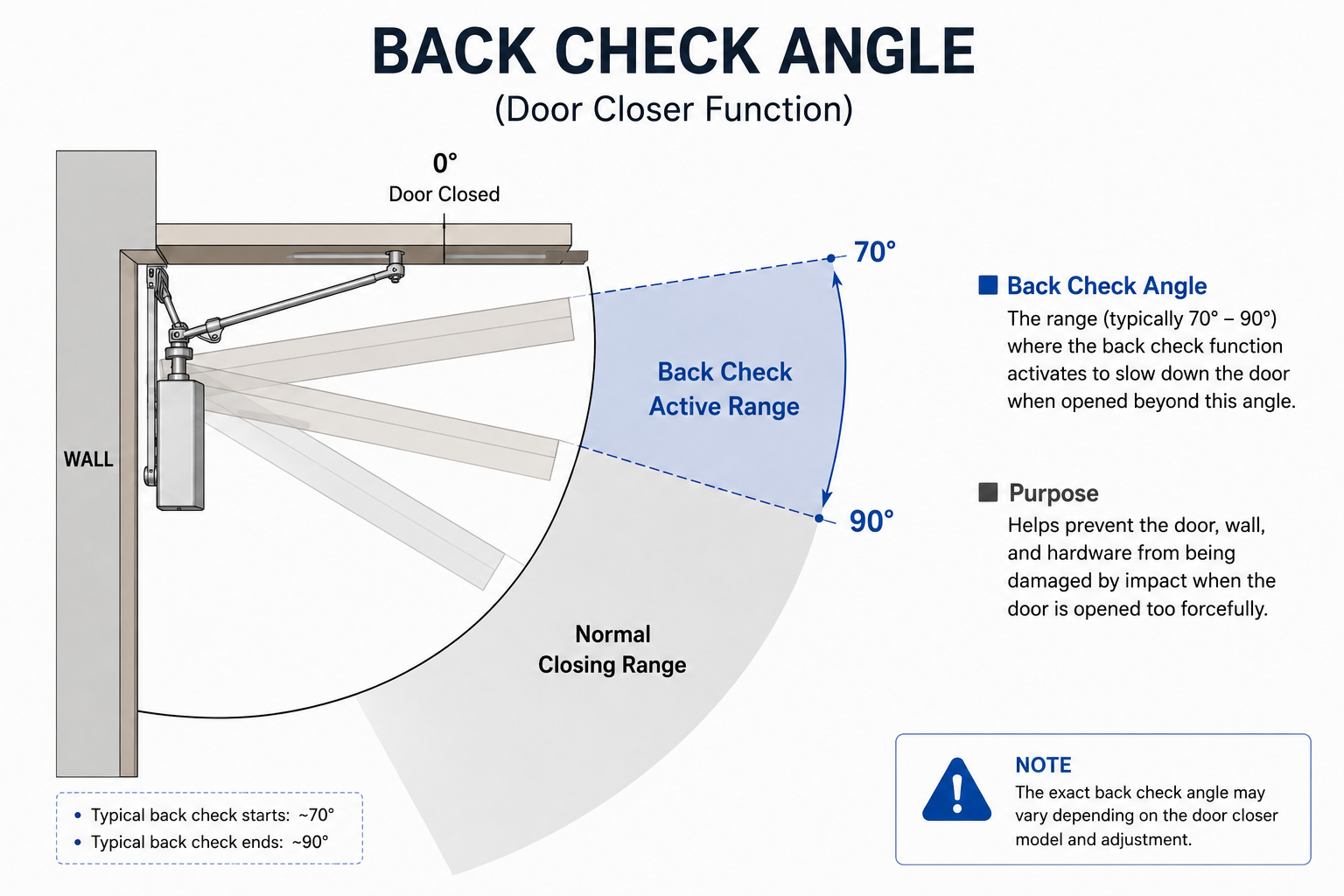
- Engagement Angle: The feature usually engages when the door is opened past a certain point, typically around 70° to 90°.
- Hydraulic Cushioning: It restricts the flow of hydraulic fluid within the closer, creating firm resistance to act as a cushion before the door reaches its full maximum opening.
- Adjustability: Most back checks have an adjustable valve (usually an Allen screw) on the closer body.
Why is the Door Back Check Important?
While it may seem like a minor feature, door back check plays a significant role in extending the lifespan of your door system and protecting the people around it.
- Preventing Structural Damage Without back check: a door flung open with force can crack door frames, gouge walls, and stress hinge screws over time. Repeated impact wears down even solid hardware, leading to costly repairs or full replacements.
- Reducing Liability Risks: In commercial settings such as offices, schools, hospitals, or retail spaces, an uncontrolled swinging door poses a real safety hazard. Back check helps building owners and facility managers reduce the risk of injury to occupants and visitors.
- Extending Hardware Lifespan: By absorbing and redistributing the kinetic energy of a fast-opening door, back check reduces mechanical stress on the closer, hinges, and frame, keeping the entire door system in better condition for longer.
Door Back Check vs. Door Stop: What Is the Difference?
These two features serve a similar purpose but work in fundamentally different ways.
| Door Back Check | Door Stop | |
|---|---|---|
| Type | Hydraulic resistance | Physical barrier |
| How it works | Slows the door mid-swing | Limits the opening angle |
| Installation | Built into the door closer | Floor, wall, or hinge-mounted |
| Adjustability | Yes, via valve | Fixed or limited |
| Best for | High-traffic, wind-exposed doors | Any door needing swing control |
In many cases, using both together provides the most complete protection, especially for exterior doors in high-wind environments.
Do Waterson Hinges Have Door Back Check on Their Hardware?
No, Waterson hinges do not include a traditional back check valve. Their design integrates the soft-closing function directly into the hinge body rather than using a separate overhead closer, and that closing mechanism controls the door on the way shut, not on the way open.
What Waterson offers as an alternative is an optional integrated door stop. It is not the same as a back check, but for most installations where the primary concern is preventing the door from striking the wall, it serves that purpose effectively.
Optional Integrated Door Stop
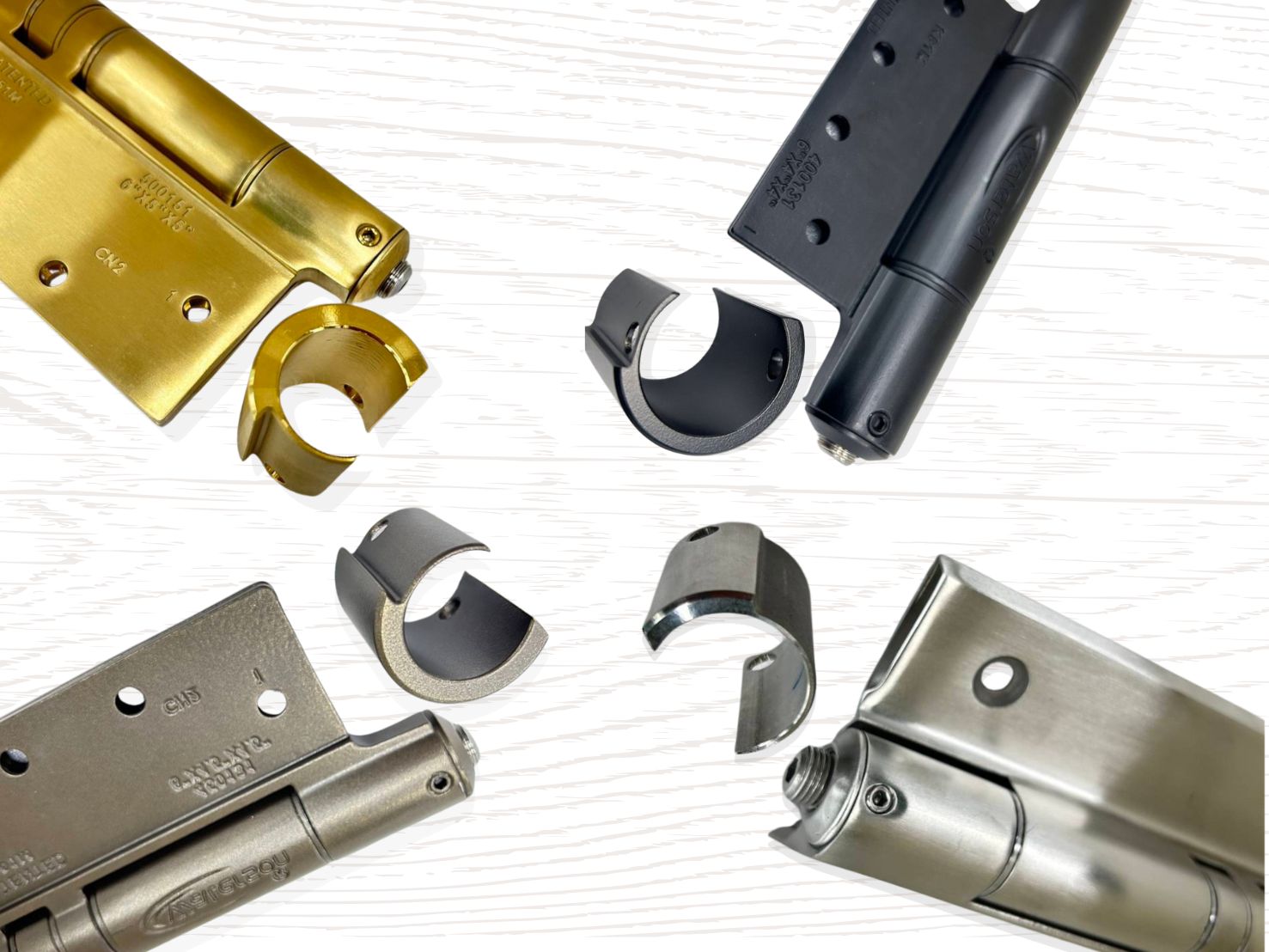
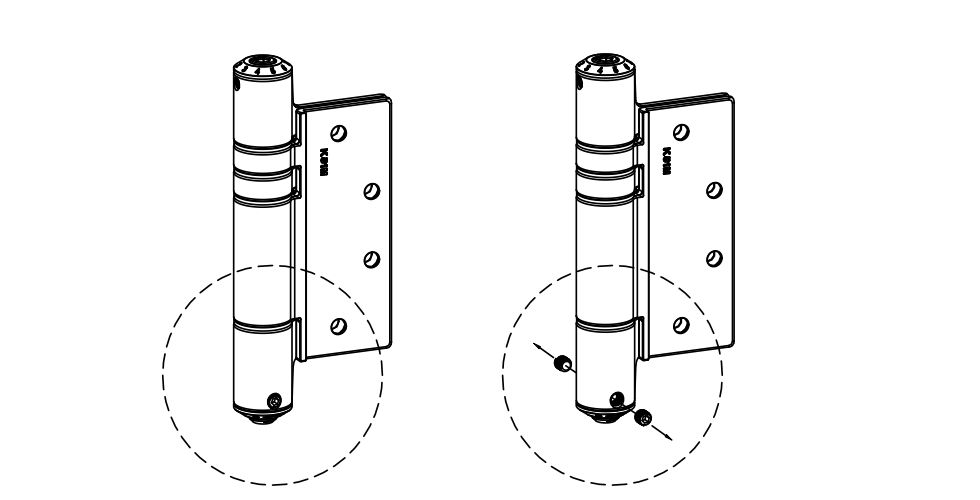
Waterson stainless steel door stop is available in 90° and 120°, and can support in several ways:
A. Hinge-integrated stops when you want the control built directly into the hardware line.
B. Concealed overhead stops for projects that prioritize a clean aesthetic
C. Wall or floor stops if the space allows for extra components
Where clearance and cleanliness are required, a door stop on hinge is the most dependable option. No overhead hardware, no bulky components, just a precise stopping angle built directly into the hinge.
To be clear about what it does and does not do: the door stop will not cushion the swing or create resistance as the door opens. It will stop the door at a defined angle before it ever reaches the wall. For the large majority of commercial and residential installations, that is sufficient protection.
Looking for a hinge-integrated door stop? See Waterson door stop options here!
Can the Door Stop Angle on Waterson Hinges Be Customized?
Custom angles are regularly accommodated for projects with specific clearance or layout requirements. Here is an example of a real inquiry the team has handled:
“I would like to use your hinges on a steel and glass arched door. I only need Hold Open and Stop. The rotational hold should be around 90 degrees. The stop rotation should be 95 degrees. Is this possible?”
A 95° stop is fully achievable as a custom order. No special tooling is required. We can accommodate your specific angle. Please note that custom orders cannot be returned or refunded.
Can Waterson Door Stopper Work with Other Manufacturers’ Door Hinges?
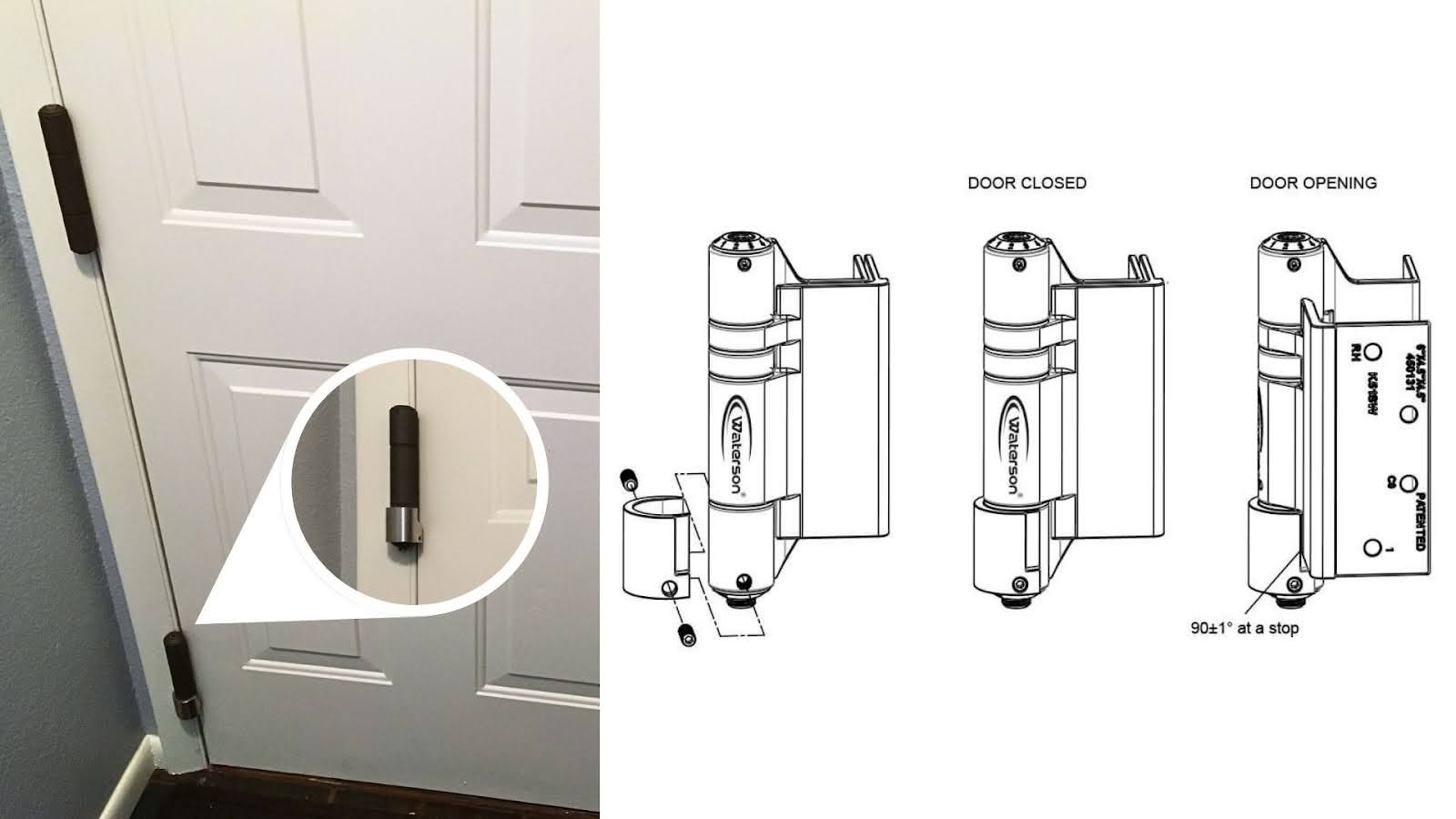
No. The Waterson door stopper is engineered as an integrated component of the Waterson hinge system and relies on the hinge’s internal structure and geometry for proper engagement and load transfer. It is not a surface-mounted or universal accessory, and therefore cannot function correctly with standard butt hinges or other manufacturers’ hinges.
For predictable performance and code-aligned operation, the stopper must be used with compatible Waterson hinge models only.
Not all closers support back check as an add-on. Many mid-range and commercial-grade closers include it as a built-in, adjustable feature. If your current closer does not have it, the most reliable solution is to upgrade to a model that includes it.
Back check itself is not universally mandated by building codes, but controlling door swing and preventing damage or injury often is. Check your local accessibility and safety regulations, particularly for fire-rated or ADA-compliant doors.
Request For Quote
Please note that Waterson Closer Hinges start from a size of 4″x4″. If you’re in need of smaller self-closing hinges, we’d recommend checking out some other resources! Also, we only provide single acting closer hinges. Thank you.
Recent Post
How to Stop a Door From Swinging Open
In high-traffic projects, when a door swings open on its own, it can create serious trouble. It disrupts daily use, and worse—bam!—the door can slam [...]
Can a Tension Hinge Hold a Door Open? When to Specify a Hold Open Hinge
Quick Answer No. Waterson closer hinges are spring-powered self-closing hinges, not friction hinges, so tightening the speed control will not make a door stay at [...]

Anti Slam Door With Heavy Duty Soft Close Door Hinges
Anti-slam door hardware is designed to prevent doors from slamming shut. It’s a great feature in homes, especially with children, as they protect little fingers [...]