
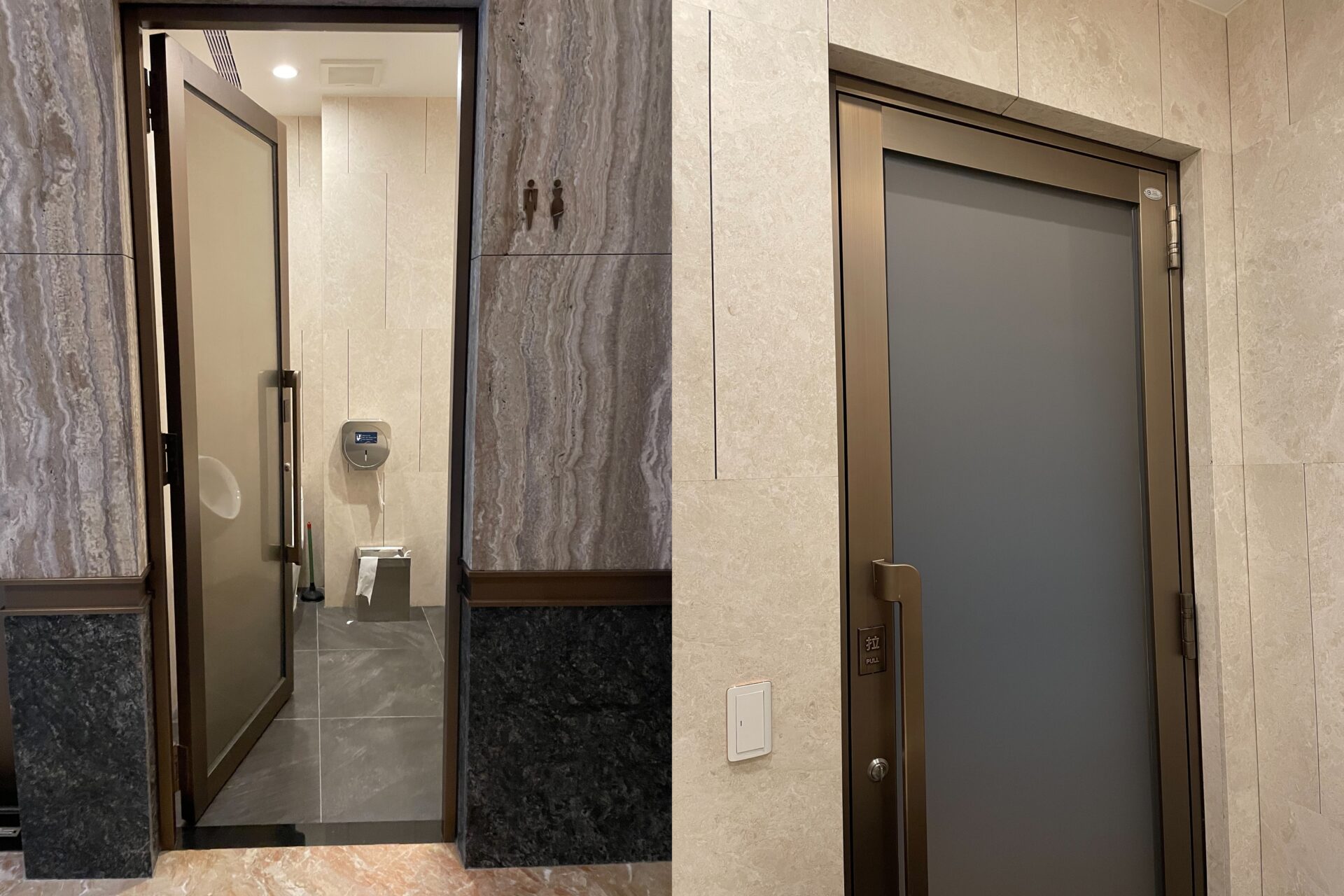
“We are installing self-closing hinges on a bathroom door right now. When we turn on the light, the door will not close all the way, so it will not latch. Turn the light off and it closes fine.”
That inquiry names two complaints at one opening, and both read like a hinge fault, but they’re not. When a door won’t close all the way, the last two inches of travel are decided by air, alignment, and seals long before the closing mechanism gets the blame. So what do you rule out first, before anyone adjusts a spring or swaps a hinge?
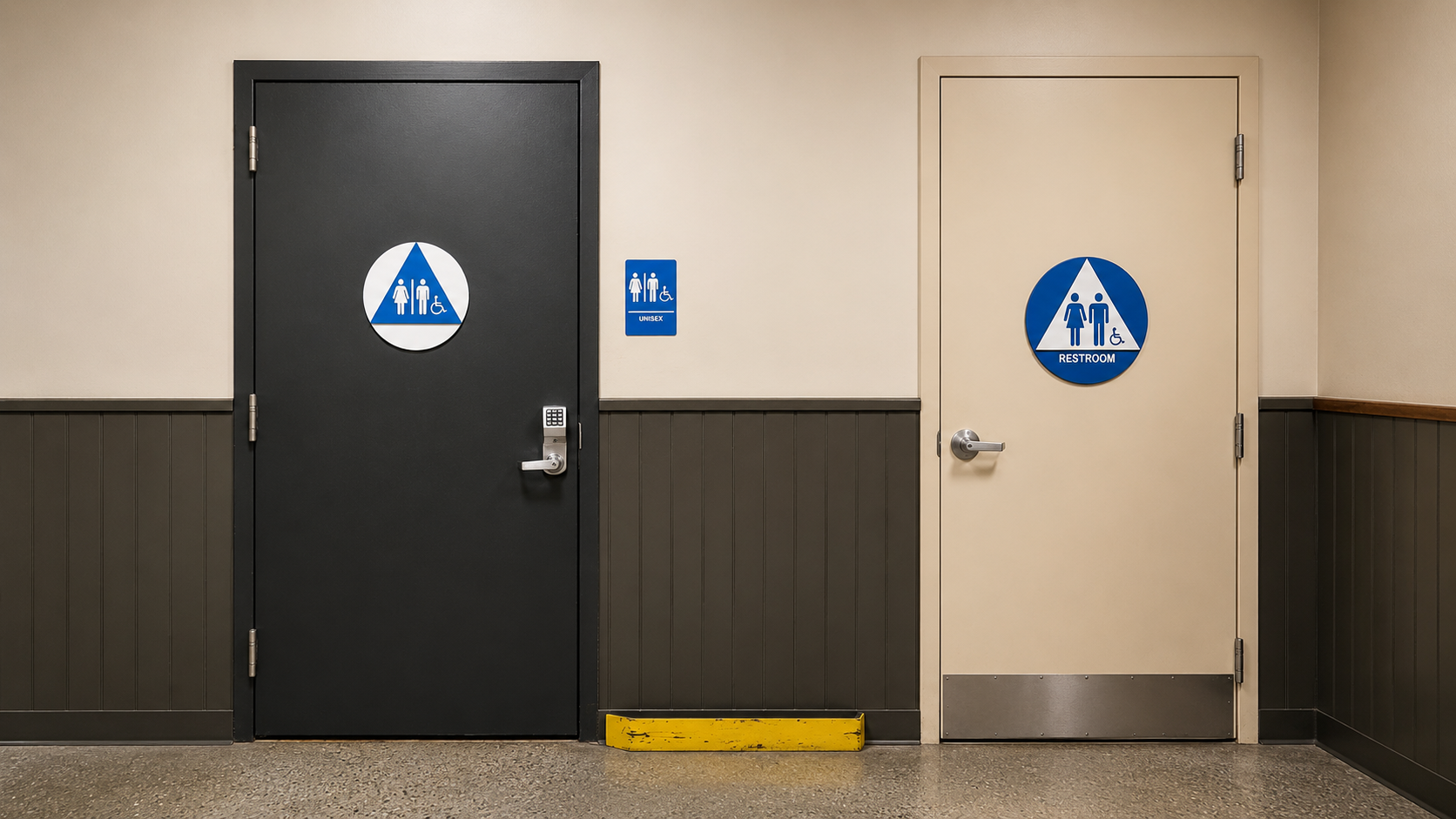
Problem 1: Why Does the Door Only Fail to Latch When the Exhaust Fan Is On?
An exhaust fan pulls air out of the room. If too little comes back in, the room drops below corridor pressure, and that difference pushes the door toward open. It bites hardest in the last inch, where the gap is smallest and the closing force is weakest. The tell is simple: the door latches with the fan off and fails with it on, often on the same switch as the light. That points to air, not the hinge.
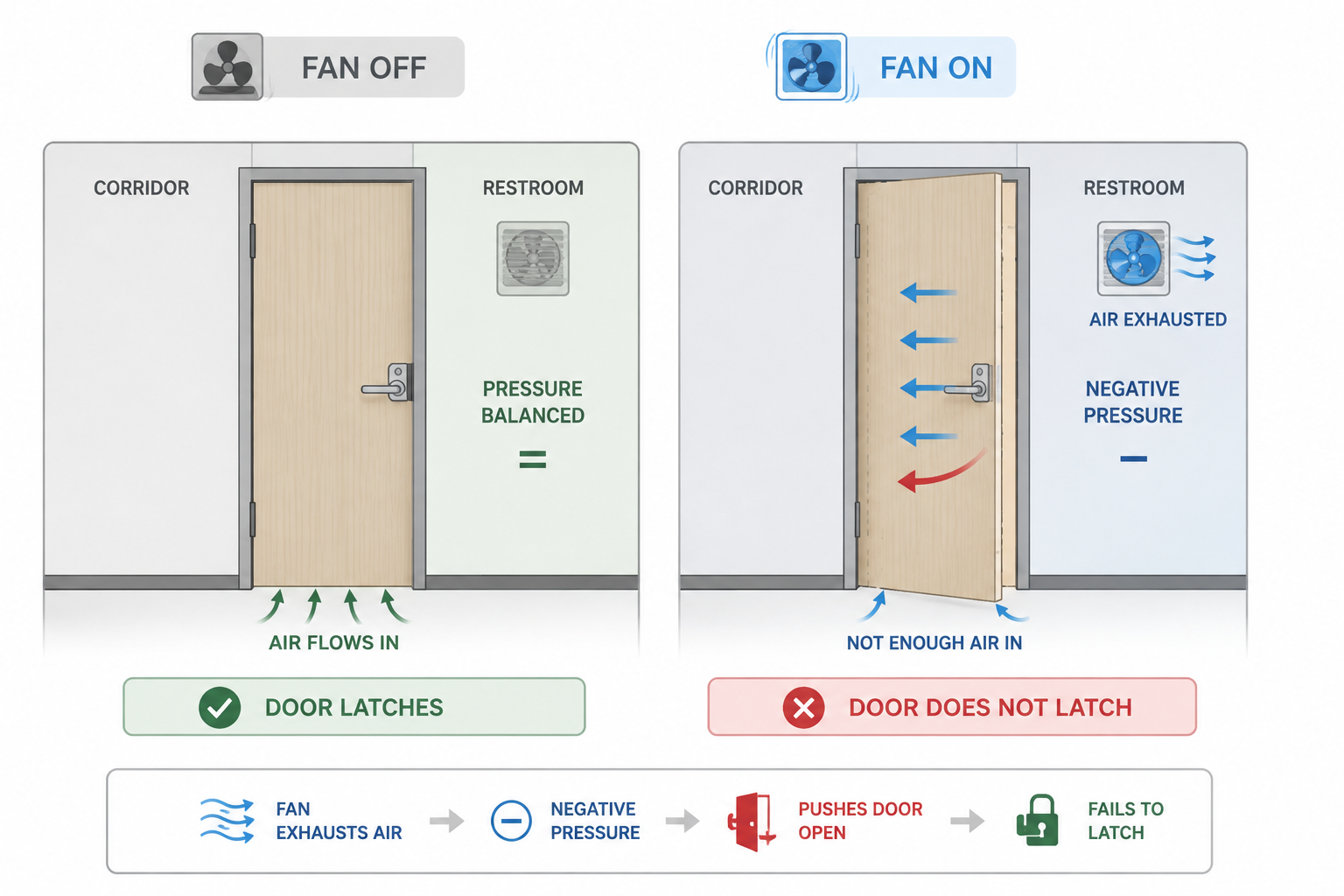
Did New Flooring or a Threshold Shrink the Undercut That Feeds Make-Up Air?
The gap under the door does two jobs: it clears the floor and, on a room with mechanical exhaust, it is the main path for make-up air. New carpet, a raised tile bed, or an added threshold can eat that undercut after the door was hung, which raises floor drag and starves the air path at the same moment. The penalty is not linear. Halve the undercut and the resistance does not double, it climbs roughly fourfold, because the opening area works on a square relationship.
| Undercut gap | Relative closing resistance to overcome |
|---|---|
| 25 mm (1 in) | 0.19 |
| 19 mm (3/4 in) | 0.33 |
| 12 mm (1/2 in) | 0.82 |
| 8 mm (5/16 in) | 1.85 |
| 5 mm (3/16 in) | 4.74 |
Figures are an order of magnitude estimate in kilograms force for a 50 CFM fan and a 32 by 80 inch leaf, with the undercut as the only make-up air path. They are for judging the trend, not a precise engineering value. The lesson holds either way: measure the real gap, and if flooring closed it off, that is your fix.
Is the Latch Landing on the Strike, or Catching Its Edge?
Before touching the closer, watch the latch bolt at the instant the door meets the frame. If the bolt lands high, low, or on the lip of the strike, the door cannot seat at any closing force. Check these in order:
- The bolt is centered on the strike opening at the moment of contact, not above or below it.
- The strike plate is flush and tight, with no proud edge for the bolt to ride up on.
- The frame has not racked and the door has not dropped on worn or loose self-closing hinges.
- The gap along the strike jamb is even top to bottom, which tells you the frame is square.
A misalignment of two or three millimetres is enough to hold a door open a crack. If the bolt is off the strike, the work is at the strike and the frame, and no closing adjustment will rescue it.
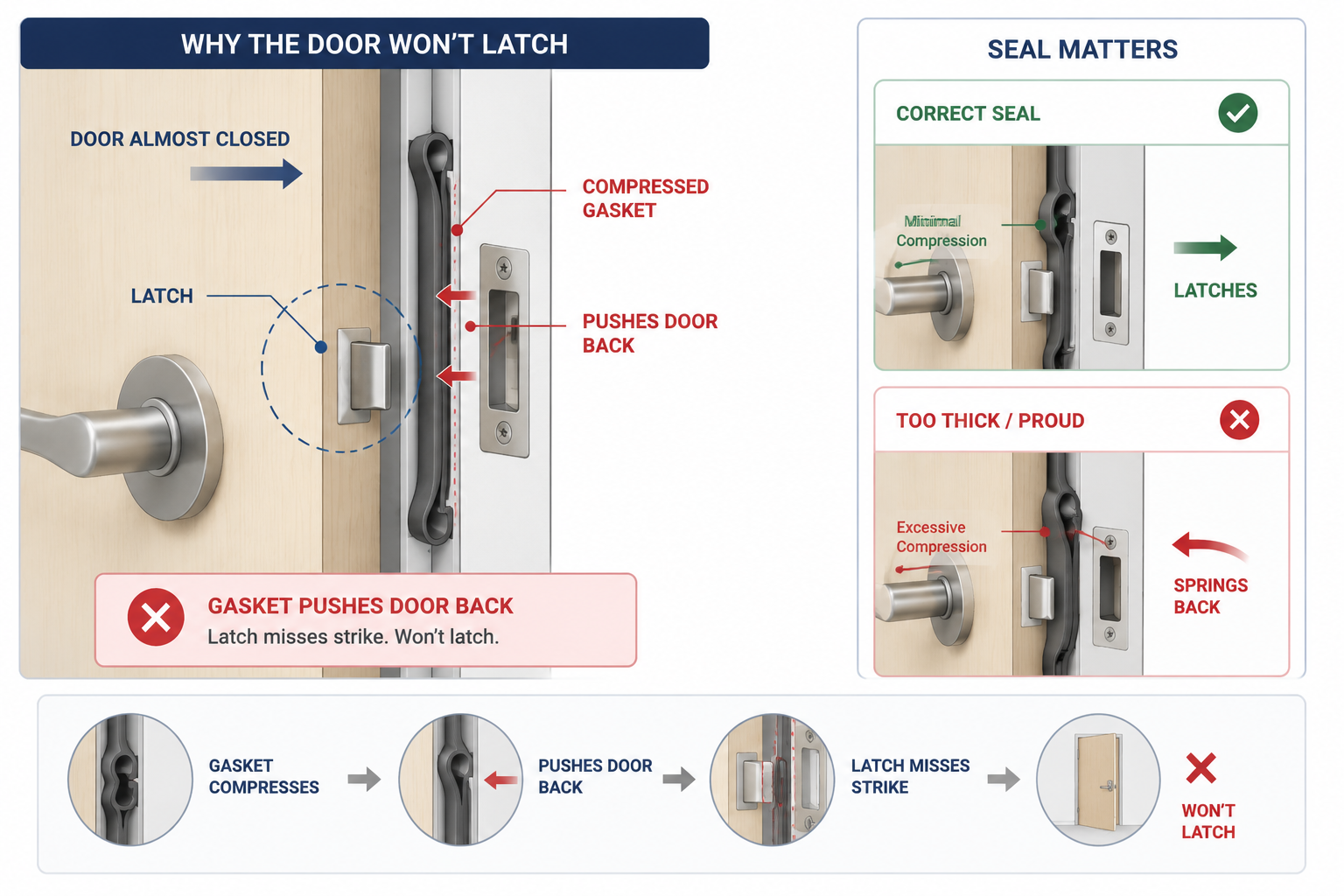
Could a Smoke Seal or Weatherstrip Be Springing the Door Back Open?
Gaskets compress in the final degrees, exactly where closing force is at its lowest. A smoke seal that is too thick, sits proud of its kerf, or was doubled during a later upgrade behaves like a spring that pushes the door back out. The leaf hangs a hair off the stop, the bolt never reaches the strike, and the opening reads as failed even though the mechanism is fine.
Re-seating the seal or reducing excessive compression may temporarily restore enough clearance for the door to latch. However, this is only a short-term adjustment. The long-term solution is to use a correctly sized and installed seal that does not interfere with the door’s closing force.
Problem 2: Why Does the Same Door Slam Shut the Moment the Air Is Off?
Here is the second half of the field complaint. With the fan off there is no pressure holding the door back, so the full spring force lands on the latch and the door bangs the stop. Lowering the numbered tension setting reduces closing force, but on a friction based mechanism it does not add real control over the final approach, so a door tuned soft enough to stop slamming can end up too weak to latch when the fan comes back on.
That is the trap: one static setting cannot satisfy both states of the room. This is where the type of closing control matters.
Mechanical Friction or Hydraulic Hybrid: Which Buffer Handles Changing Pressure?
| Buffer type | How it controls the door | When pressure or wind shifts suddenly | Best fit |
|---|---|---|---|
| Mechanical (friction) | Fixed friction, set once by the tension adjustment | Friction stays constant, so it cannot absorb a gust or pressure spike, and the door can still slam | Stable interior openings with steady conditions |
| Hydraulic hybrid (K51M) | Fluid soft close damping on the closing arc, speed sensitive | Damping rises with speed, buffering sudden changes far more consistently | Openings that need controlled, soft closing under changing conditions. |
When the negative pressure is large and steady, no single hinge setting wins both the fan on and fan off states at once, and the durable answer is restoring make-up air at the opening, not chasing the buffer. Waterson has clear limits in constant high wind or a significant sustained pressure differential, and pointing that out early is what keeps a spec honest.
Where Do Waterson Stainless Steel Self-Closing Hinges Fit This Opening?
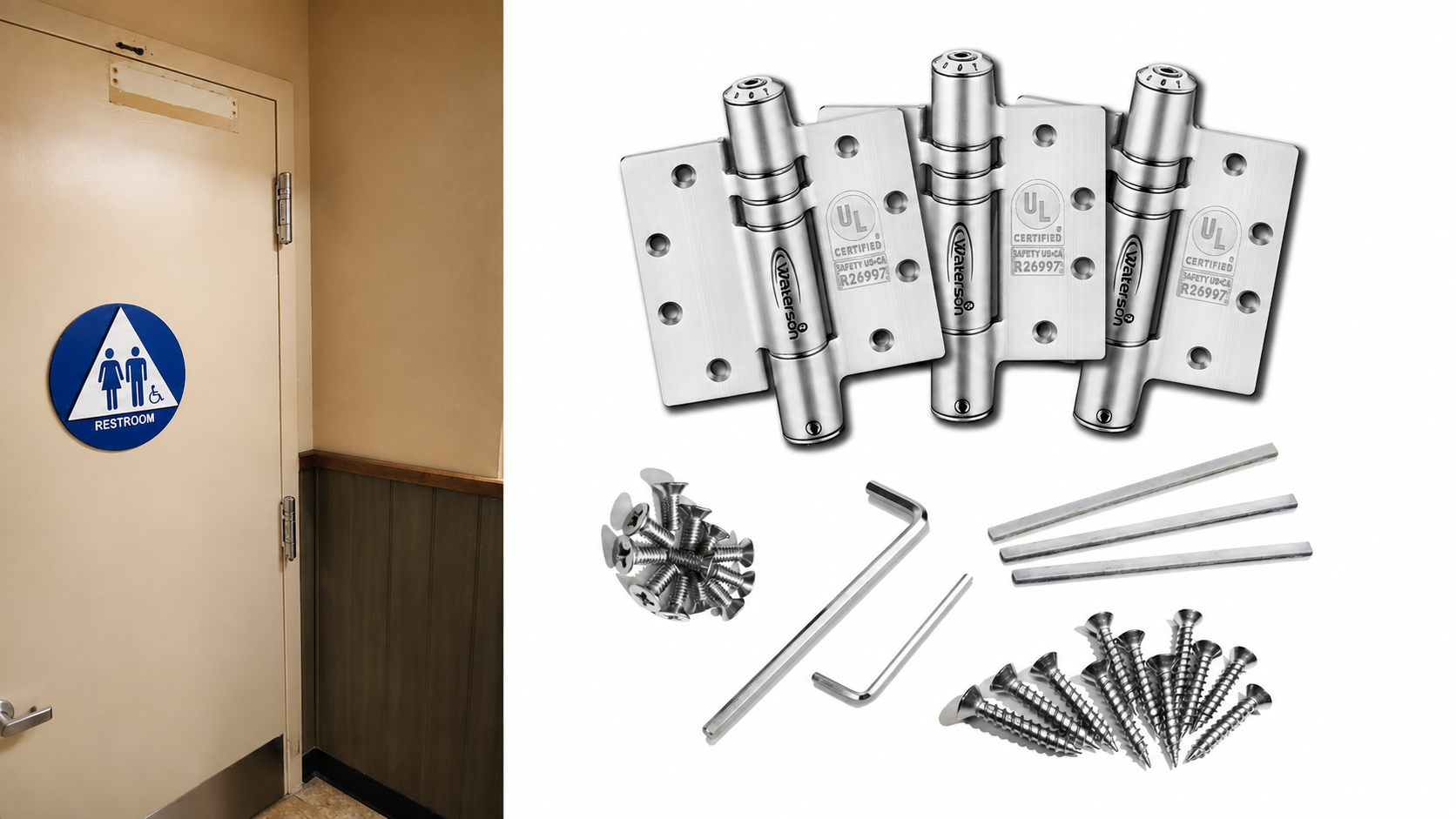
Once airflow, alignment, and sealing issues have been ruled out, the focus can shift to the closing device itself. Waterson self closing door hinge folds the hinge, the closer, an optional hold open, and a door stop into one full mortise stainless component on standard prep. For a door that stalls short of shut, these are the specifications that matter.
| Feature | Specification | What it does at this opening |
|---|---|---|
| Material | Type 304 standard, 316 optional, 316L marine grade | Corrosion resistance for restrooms and wash down, so buffer force does not drift over time |
| Self-closing mechanism | Built in spring, field adjustable tension | Sets closing force to the lowest level that still latches, with no separate overhead closer |
| Hydraulic soft close | Speed sensitive damper on the final degrees | Meters the last two inches so the door seats instead of slamming when the room is calm |
| Anti slam | Independent latch region damping | Holds control of the final approach when pressure suddenly drops |
| Heavy duty | Up to 330 lb, doors to 4 by 8 ft, add hinges to scale | Gives a tall or heavy leaf the authority to finish its swing on standard prep |
| Hold open | Field set near 90 degrees, optional, not on fire doors | One component covers self-closing and hold open openings |
| Door stop | Integrated 90 and 120 degree barrel stops | Removes a separate floor or wall stop that can foul the swing |
| Fire rated | UL certified to 3 hours, meets NFPA 80 | Keeps a rated opening compliant while you tune closing |
| Cycle life | ANSI/BHMA A156.17 Grade 1, 1,000,000 cycles | Consistent force, so a door that seats today keeps seating |
| Non-handed | One part fits left and right swing | Fewer part numbers to spec and stock |
Finishes are Satin Stainless Steel (US32D), Flat Black (US19), Dark Satin Bronze (695), and Satin Brass (US4), so matching the opening does not cost the rating.
Limitations: What Closing Hardware Can’t Fully Solve
Hydraulic control can help reduce slamming and provide more consistent closing behavior, but sustained negative air pressure is a limitation for any self-closing hinge or door closer. If the pressure resisting the door is greater than the available closing force, the door may still stop short of the latch. This is not unique to Waterson; it is a condition of the opening itself, and increasing closing force indefinitely can create other problems when the pressure disappears.
For this reason, Waterson hinges should not be expected to compensate for a significant or continuous pressure imbalance. When a door closes normally with the exhaust fan off but will not latch with the fan on, the long-term solution is to address the make-up air and pressure conditions first. Once the opening is properly balanced, the hinge can then be adjusted to provide the closing force and speed control the door actually needs.
Waterson Commercial Restroom Self Closing Door Hinges
Waterson ADA Swing Clear Hinge combines an overhead closer and hinge into one attractive component with optional hold-open and door stop features. These hinges are ideal for commercial openings, gates, and glass doors. These hinges are easily installed and adjusted to comply with ADA & ICC A117.1 requirements for opening force and to assure quiet, secure closing. Made with stainless steel, Waterson closer hinges meet NFPA 80 and are UL 3-hour fire-rated, as well as being one of the best door hinges for both interior and all-weather exterior openings. See all our features.
Request For Quote
Please note that Waterson closer hinges start from a size of 4″x4″. If you’re in need of smaller self-closing hinges, we’d recommend checking out some other resources! Also, we only provide single acting closer hinges. Thank you.
Recent Post
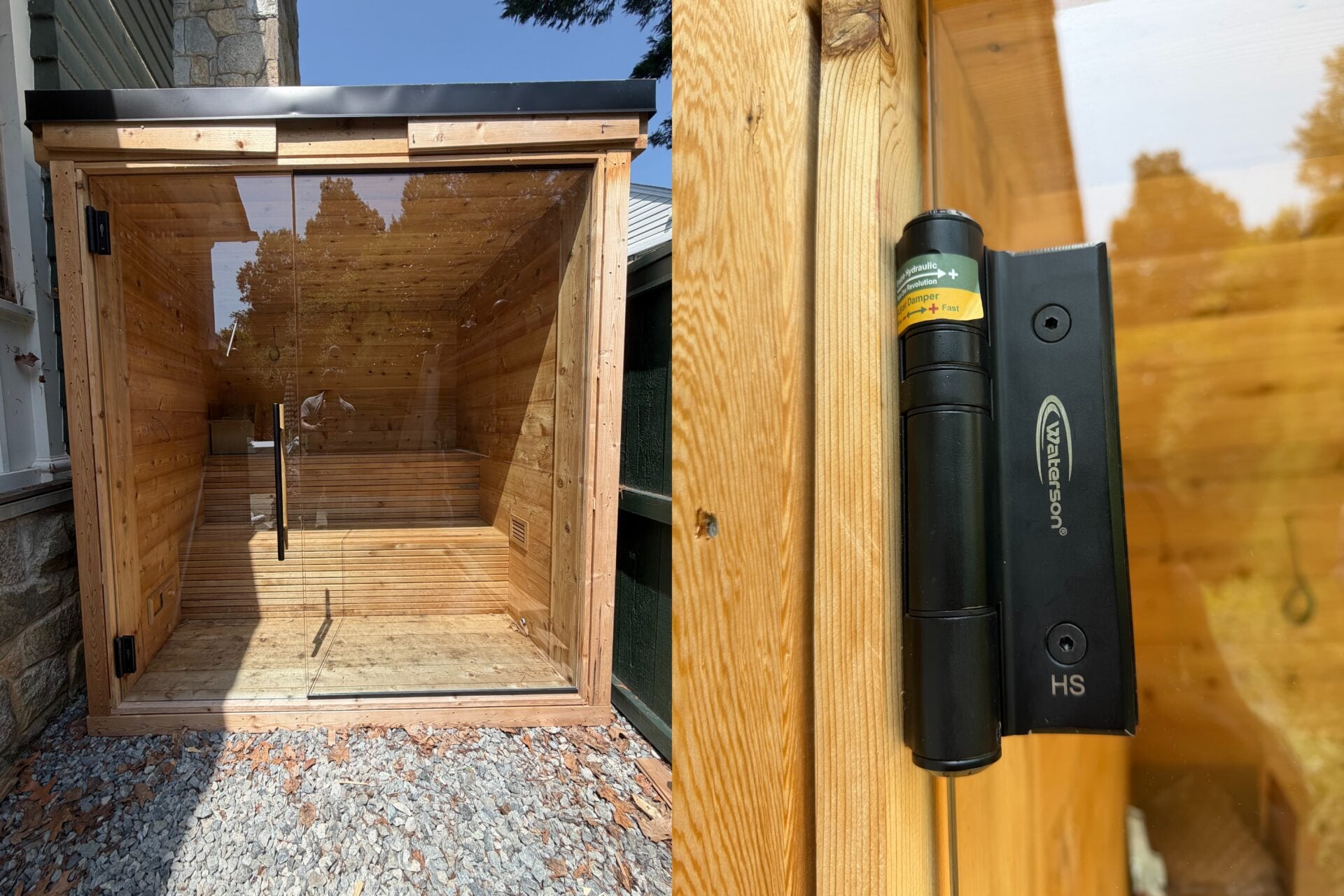
Frameless Glass Sauna Door Hinges: ADA Self Closing Solution for Commercial Saunas
Quick Answer For a frameless tempered glass sauna door that swings from a wall, use the Waterson K51GWL glass-to-wall hinge in the hydraulic hybrid version. [...]

Self Close vs Soft Close Hinges: Two Different Needs, Explained
Most commercial self-closing hinges still adopt either spring or hydraulic damper for [...]
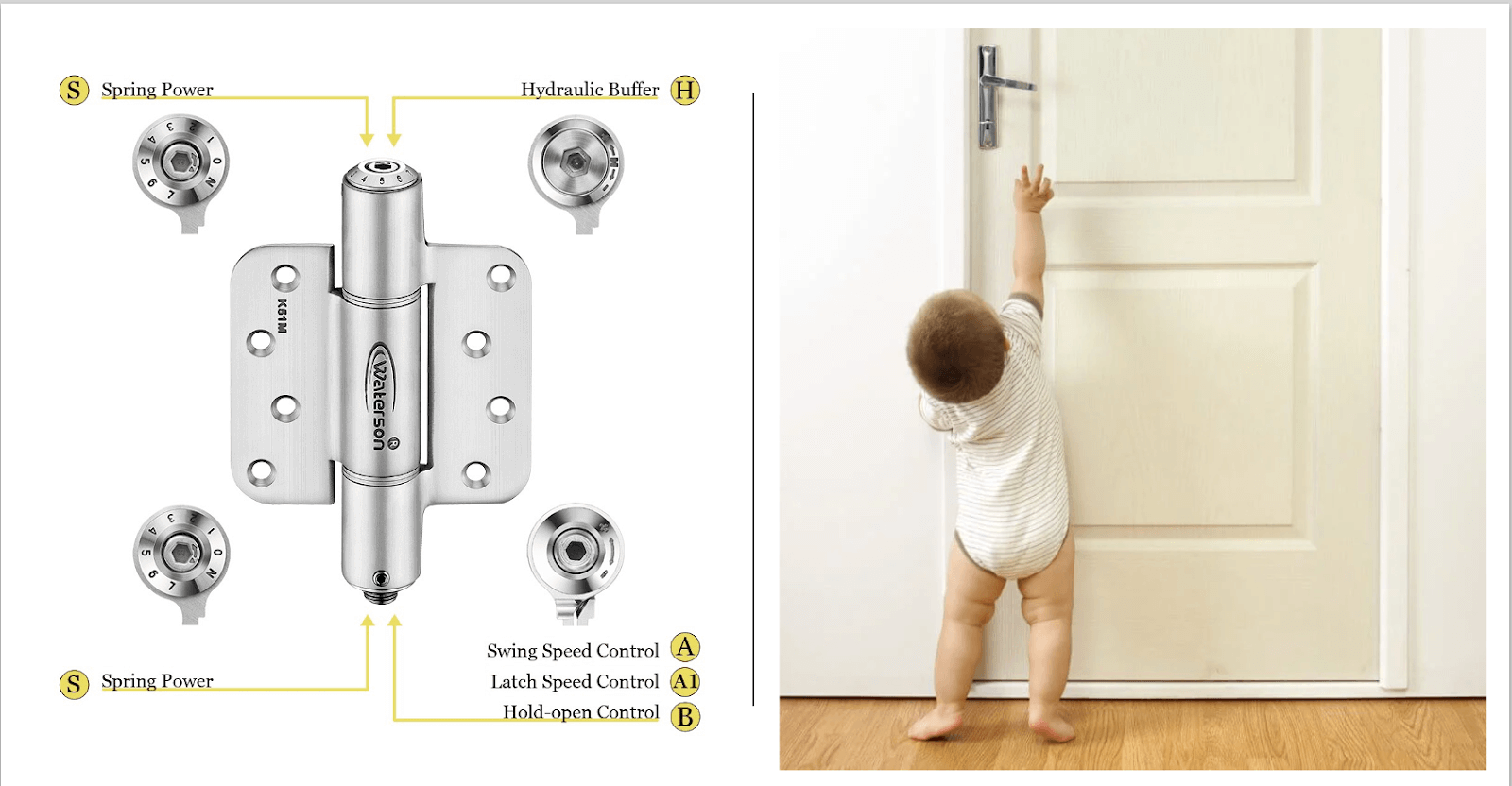
4 Inch Self Closing Door Hinges for Residential & Commercial Doors
Quick Answer Waterson 4-inch self-closing hinges (K51M-400) fit standard 4" x 4" templates on 1-3/8" or 1-3/4" residential doors, in mechanical or hydraulic versions with [...]