
Quick Answer
Doors and gates get harder to close in winter because wood swells with moisture, metal contracts in the cold, and hardware tension shifts, causing sticking, dragging, or failed latching. Mechanical self closing hinges stay stable across temperature swings, while hydraulic hinges slow down in cold weather and need seasonal adjustment. For exterior gates, stainless steel hydraulic self closing hinges with adjustable speed and a dry bearing design hold up best through freeze thaw cycles.
When winter hits, many homeowners notice something strange: doors and gates that used to glide shut suddenly become stubborn, noisy, or misaligned. Freezing temperatures, fluctuating humidity, and icy winds don’t just make things uncomfortable outside. They directly affect how materials behave.

Wood swells. Metal contracts. Hardware alignment shifts. Over time, these small seasonal changes add up, turning a smooth-swinging gate into a daily frustration; or worse, a safety concern.
“So what’s actually going on, and what can you do about it?”
How Freezing Temperatures Affect Door Function
When the temperature drops, materials naturally respond. Wood and metal expand or contract depending on moisture and cold, changing how the door aligns and moves inside its frame.
- Wood absorbs moisture and swells, creating tight clearances and hinge binding. Even a well-fitted door in October can start dragging along the floor by January.
- Metal contracts slightly in the cold, causing small gaps or hinge misalignment that weren’t there before.
- Hardware like pins, screws, and fasteners can shift tension as temperatures change, altering how smoothly the door closes and latches.
These reactions put stress on the frame and hardware over time. Repeated freeze–thaw cycles make it worse, often leading to doors that stick, drag, or fail to latch consistently.
How to Tell If Your Door Is Misaligned vs. Just Stiff
Not every winter door problem is the same. Here’s a quick way to tell them apart:
- Stiff but still latches? Likely wood swelling from moisture — the door closes, it’s just harder to push. This often resolves slightly as the season progresses.
- Door drags on the floor or frame? That’s an alignment shift. The door frame or hinge position has moved enough to cause physical contact.
- Won’t latch at all, or latch misses the strike plate? Classic misalignment. The door and frame are no longer lined up the way they were installed.
If you’re seeing the third issue, the fix goes beyond lubrication: it’s a hardware or structural adjustment.
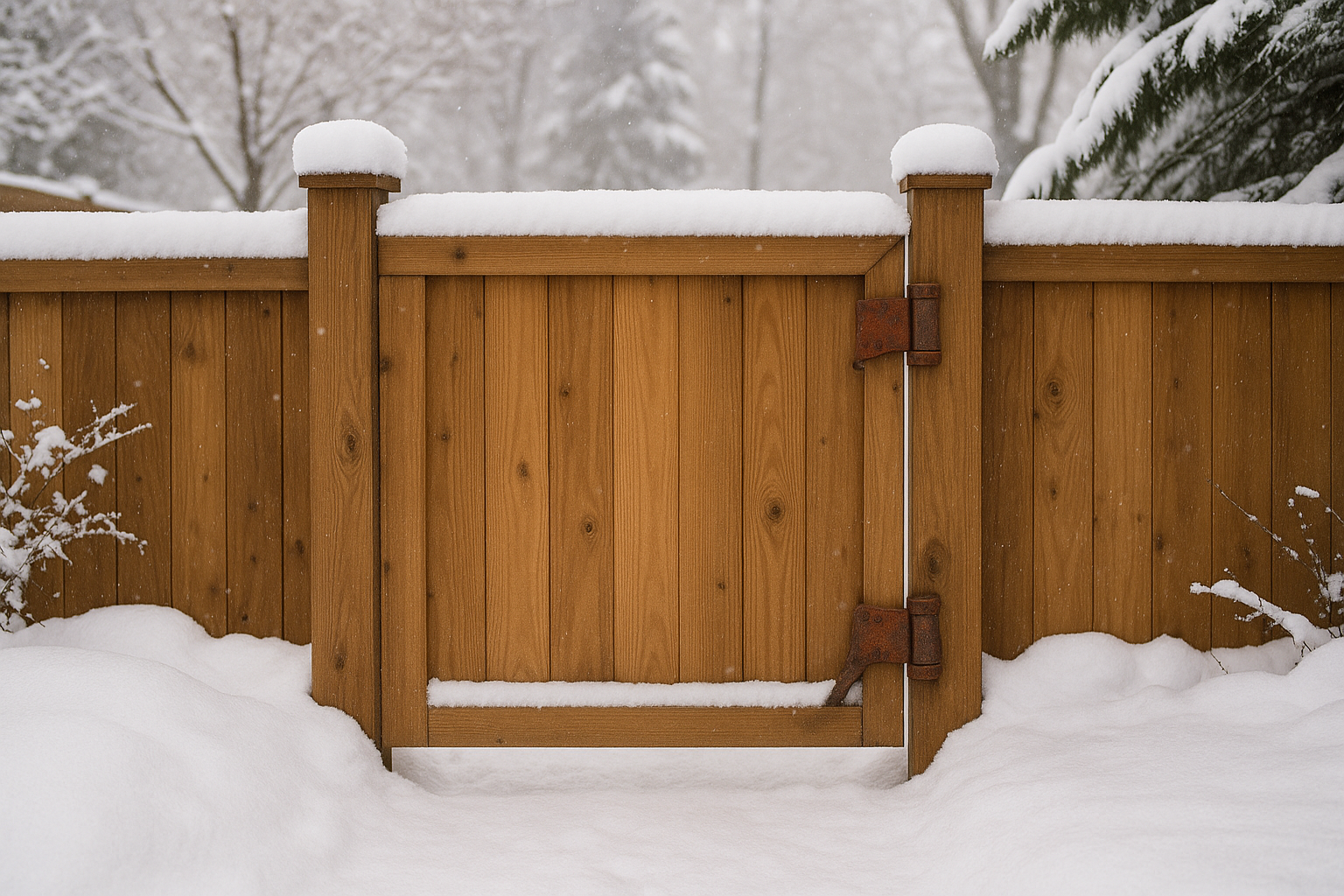
A Real-World Example: Wood Gate Hinges in New Jersey
For a residential project in Sea Girt, NJ, a landscape architect came to us with a specific challenge. A pair of 4.5′ H × 4.5′ W × 3″ thick wooden fence gates (100 lbs each) needed a hinge set in dark bronze (US10B) that could support the weight, ensure self-closing without slamming, and hold up through harsh Northeast winters.
The gates were well-built. But winter changes the equation.
Cold weather means wood expands, metal shifts, and what used to fit perfectly can suddenly start to stick, drag, or stay slightly open. Even a professionally installed setup can drift out of alignment as temperatures drop across the season.
Mechanical vs. Hydraulic Hinges: What Hinge Type Should I Choose?
Both hinge types work differently when the temperature drops. The key is knowing which performs more consistently under winter conditions.
| Type | Performance in Cold Weather | Best Use Case |
|---|---|---|
| Mechanical (Self-close Type) | Stable across temperature swings; minimal impact from cold. | Exterior gates needing reliable self-closing all year. |
| Hydraulic (Soft-close Type) | Slower in cold, faster in heat; may need seasonal readjustment | Controlled indoor or mild-climate applications. |
Mechanical hinges offer dependable closing performance through temperature changes. Hydraulic hinges deliver smoother, more controlled motion, but the fluid inside responds to temperature, so they close slower in winter and faster in summer. In fluctuating climates, that means periodic adjustment.
The right choice depends on your environment and how exposed the door or gate is to seasonal changes.
Can Waterson Hydraulic Hinges Be Used on Exterior Gates?
Yes! Our hydraulic hinges can be used on exterior gates. Just keep in mind that hydraulic closer hinges only work on a certain degree of the door opening (≤ 120°) for the best performance and durability.
Additionally, hydraulic fluid naturally flows slower in cold temperatures and faster in hot temperatures, which means the closing speed may vary with day and night temperature changes. This is a common characteristic of all hydraulic products.
If needed, closing speed can be adjusted using the Allen wrench included in the package.
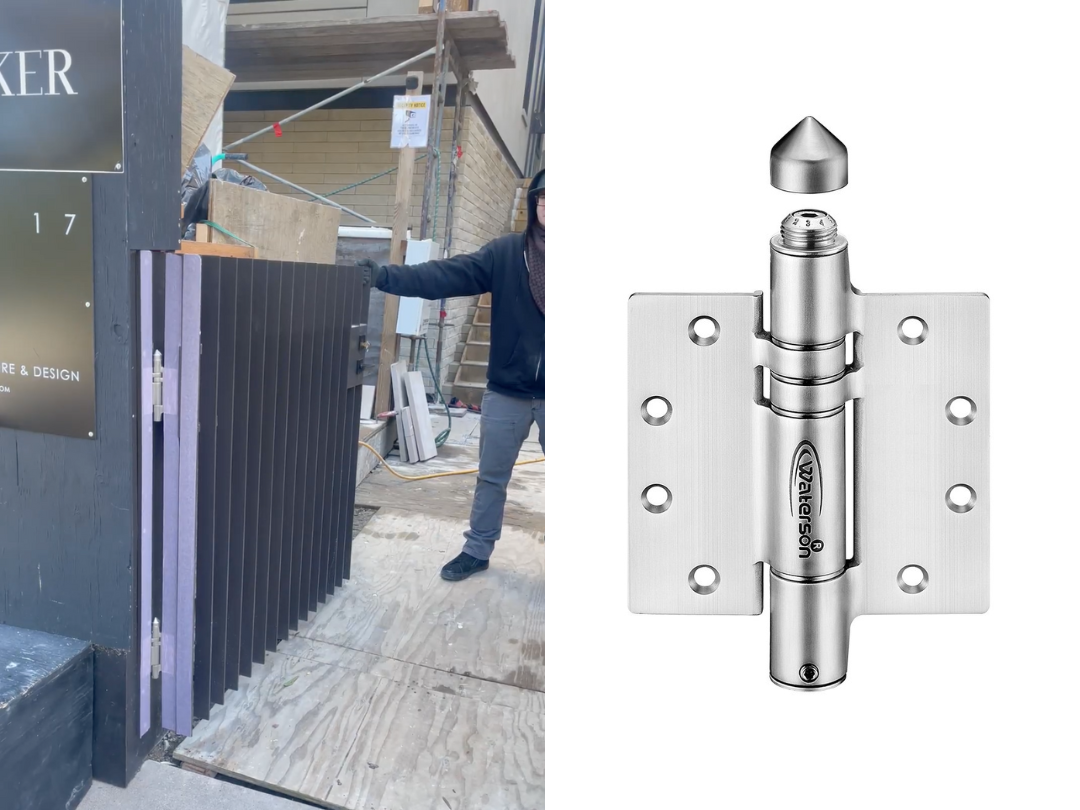
Project Outcome
In this New Jersey hinge replacing project, the client prioritized anti-slam control and preferred the US10B dark bronze finish, so dark bronze hydraulic self-closing hinges (K51M-660-B3-US10B) were selected. Using three 6-inch hinges to replace the old hardware, Waterson hinges ensured smoother closing and added mechanical resistance to prevent slamming — a balanced solution for both performance and finish preference.
“We have specified your hinges in the past and like them very much.”
The client returned with another order not long after. That kind of follow-up says more than any spec sheet.
A Proactive Solution for Wooden Gate Hinges in Winter
Waterson hydraulic self closing hinges are engineered to combine strength, control, and long-term reliability. Built from stainless steel and equipped with adjustable closing features, they offer precise motion even under harsh seasonal changes.
- Stainless steel (304/316): Corrosion-resistant for exterior gates exposed to snow, moisture, and de-icing salts.
- Hydraulic Mechanism: Ensures reliable closure without slamming, even in cold or windy conditions.
- Self Closing: Controlled, anti slam, maintains closure every time, good pair with gate latch.
- Adjustable Closing and Latching Speed: Allows fine-tuning for temperature and door weight changes across seasons.
- High Load Capacity: Supports heavy gates of 260-330 lbs or more, ensuring long-term alignment and stability.
- PVD Finishes: Includes dark bronze (695) for aesthetic consistency and durability beyond 1,000,000 cycles.
- Dry Bearing Design: No grease or frozen lubricant issues, ideal for freeze–thaw environments.
- Code-compliant: Meets ADA Compliance, UL-List 3 hours, and BHMA A156.17 Grade 1 for 1.000.000 tested cycles
- Flexible gate hinge options: Supports full-surface, mid-post, and heavy-duty mounts for various gate structures.
Together, these features make Waterson hydraulic self closing hinges a dependable solution for winter conditions — combining mechanical strength with controlled, anti-slam performance.
Waterson Hydraulic Self Closing Gate Hinges for Winter Weather
Waterson self closing wood fence gate hinges combine the function of an overhead closer and a hinge into a single, sleek component—complete with optional hold-open and door-stop features. Designed for commercial openings, gates, and glass doors, these hinges are easy to install and adjust to meet ADA and ICC A117.1 standards for opening force, while ensuring quiet and secure closure. Crafted from durable stainless steel, they are NFPA 80 compliant, UL 3-hour fire-rated, and built to perform reliably in both interior and all-weather exterior environments. See all our features.
In addition to these performance advantages, Waterson offers custom hinge services. As a direct manufacturer, we can tailor hinge sizes, finishes, and especially hinge leaf designs to meet the specific structural needs of your doors. This makes our hinges an ideal solution for door manufacturers seeking custom options that integrate seamlessly with their existing frames.
Request For Quote
Please note that Waterson closer hinges start from a size of 4″x4″. If you’re in need of smaller self-closing hinges, we’d recommend checking out some other resources! Also, we only provide single acting closer hinges. Thank you.
Recent Post
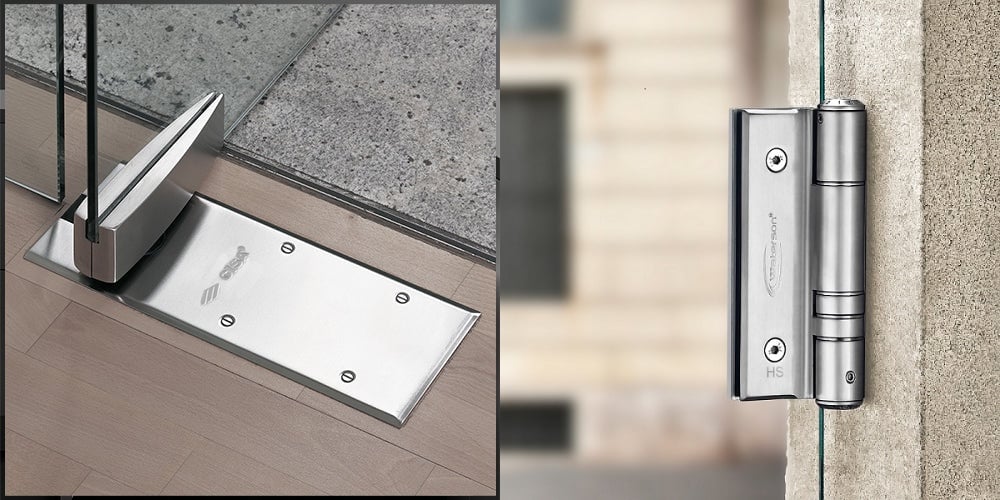
Glass Door Hinges: Floor Spring vs Spring Hinge Compared
Quick Answer Floor hinges (also called floor springs) are hydraulic closers set into the floor slab for center-hung or double-acting glass doors with fully concealed [...]
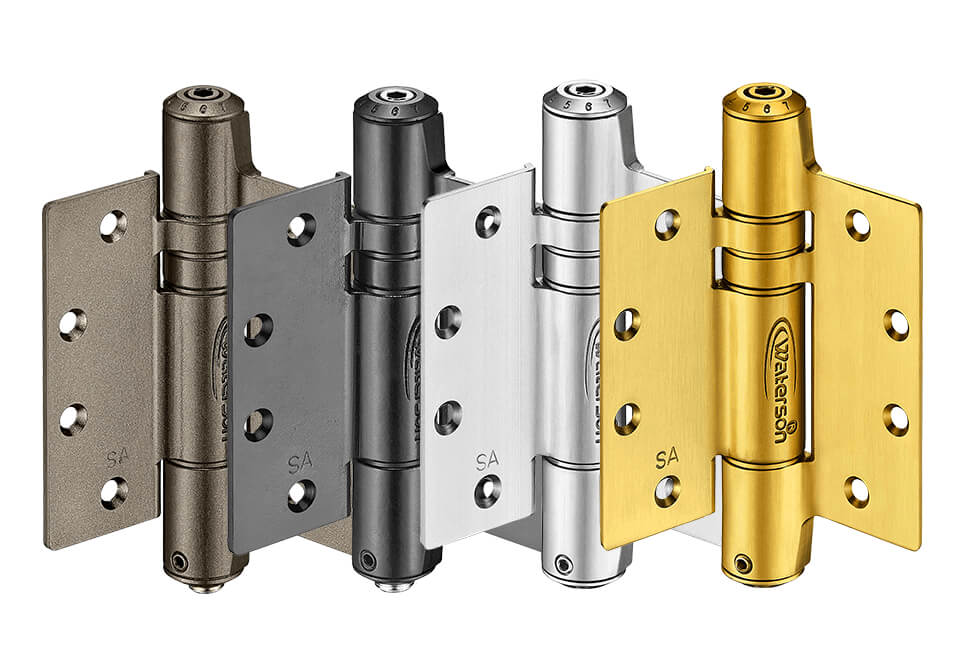
Stainless Steel Spring Hinges: Self-Closing Hinges for Interior and Exterior Doors
Quick Answer A stainless steel spring hinge is a self-closing hinge with a torsion spring inside the barrel, so it swings the door and closes [...]
Cold Weather Gate Hinges: How Waterson Performs in Winter
When winter comes, temperatures drop, and outdoor fence gates start to behave differently. Wood absorbs moisture and swells, metal contracts slightly, and hardware components shift [...]