
Quick Answer
ADA bathroom doors fail most often because standard spring hinges use one shared tension for both opening and closing, so increasing closing torque pushes opening force above the 5lbs limit. Code requires 32in clear width, under 5lbs opening force, and at least 5 seconds to close from 90° to 12°. Waterson’s ADA compliant swing clear hinges solve this by separating opening and closing control, offering soft close, 90° hold open, and concealed design, while meeting ANSI/BHMA A156.1, NFPA 80, and UL 3-hour fire rating standards.
Ever submitted restroom drawings that passed plan check—but failed on-site inspection because the door clipped the clearance or required too much force to open?
It’s one of the most common accessibility issues in commercial construction. So, what handicap bathroom door requirements exactly affect ADA compliance, and how can we ensure both function and code go well?

Why Most ADA Doors Fail the 5 lbs Test
In most projects, compliance issues originate from hardware rather than design. Standard spring hinges rely on a shared tension mechanism that simultaneously drives both opening resistance and closing power. Once the closing torque is increased to ensure latching, the opening force almost always exceeds the ADA standards of 5 lbs.
Overhead closers can slow the door, but they also add friction, require maintenance, and disrupt the clean look of restroom or corridor entries. In both cases, the mechanics are unbalanced: too much power for closure, not enough control for accessibility. That imbalance is exactly what ADA testing detects — inconsistent force and speed.
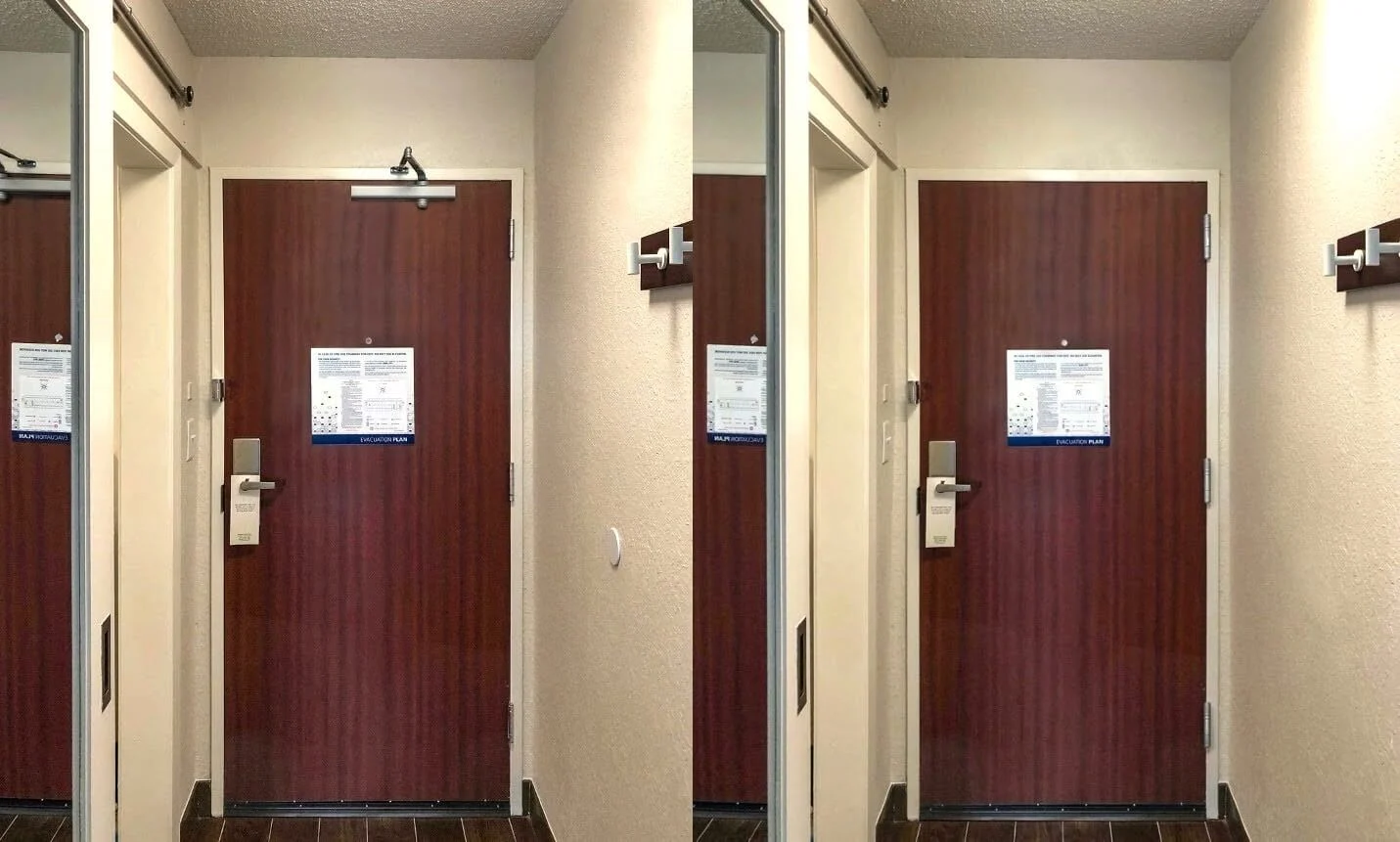
Understanding Core Handicap Bathroom Requirements for Doors
How wide does a handicap door need to be?
Every functional restroom starts with three control factors: maneuvering space, reach range, and operating force. According to the ADA Accessibility Standards §404.2 & ADA Toilet and Bathing Room Requirements §603.2:
- Clear Width: 32 in minimum between the face of the door and the stop, measured with the door open 90°.
- Depth Rule: If the approach depth exceeds 24 in, clear width must increase to 36 in.
- Operating Force: Interior hinged doors must not require more than 5 lbs (22 N) to open.
- Closing Speed: From 90° to 12°, the door must take at least 5 seconds to close.
- Swing Logic: Doors may swing into the 60-inch turning space but not into required fixture clearances unless a 30 × 48 in wheelchair space exists beyond the swing arc.
Each of these defines how a person approaches, operates, and exits—a system of physics, not paperwork.
Force Control Is the Core of Compliance
Experienced specifiers know that meeting ADA is about force balance, not accessory selection.
According to Advisory 404.2.9 Door and Gate Opening Force, you need to isolate three variables:
- Opening force — to keep below 5 lbs.
- Closing speed — to achieve ≥ 5 sec movement from 90° to 12°.
- Latch engagement — to ensure closure without slam.
A well-engineered system separates the mechanisms that control opening and closing. When both rely on the same spring tension, performance becomes inconsistent and requires constant field adjustment.
To meet the handicap bathroom requirements, you need a combined mechanical solution——one that regulates both torque and motion within the same structure while maintaining independent ADA force control. This is where modern hinge systems bridge the gap between accessibility and reliability, providing measurable control without adding complexity.

When an Ideal ADA Bathroom Door Works Without Compromise
Waterson self-closing ADA compliant swing clear hinges combine the reliability of a closer and the simplicity of a hinge, making ADA compliance both easier to design and smoother to operate.
- Stainless Steel: 304 and 316 stainless steel for corrosion resistant marine/exterior use.
- ANSI/BHMA A156.1: 1,000,000 cycles tested. Built to handle oversized doors beyond 260 lbs.
- ADA compliance: < 5 lbs opening; ≥ 5 sec closing time, 33” ADA clearance
- Soft Close / Self Closing: Prevents sudden impact, protecting both frame and mirror.
- 90° Hold Open: Essential for usability, delivered reliably.
- Concealed Design: Panels inside, mirror outside—the hinges remain invisible.
- Custom Finish: Polished Satin/Black/Brass/Bronze tailored to the interior scheme.
- Adjustable Tension: Fine-tuned for smooth swing and user comfort.
- Installation: No bulky arms or brackets to disrupt the design.
- Fire & Code Ready: UL-listed for 3-hr fire doors; NFPA 80 standard.
- Warranty: Indoor is from 5-10 years; Outdoor is from 3-10 years
Waterson Heavy Duty Self Closing ADA Swing Clear Hinges
Waterson ADA compliant swing clear hinges combine the function of an overhead closer and a hinge into a single, sleek component—complete with optional hold-open and door-stop features. Designed for commercial openings, gates, and glass doors, these hinges are easy to install and adjust to meet ADA and ICC A117.1 standards for opening force, while ensuring quiet and secure closure. Crafted from durable stainless steel, they are NFPA 80 compliant, UL 3-hour fire-rated, and built to perform reliably in both interior and all-weather exterior environments. See all our features.
In addition to these performance advantages, Waterson offers flexible customization services. As a direct custom hinge manufacturer, we can tailor hinge sizes, finishes, and especially hinge leaf designs to meet the specific structural needs of your doors. This makes our hinges an ideal solution for door manufacturers seeking custom options that integrate seamlessly with their existing frames.
Request For Information
Please note that Waterson Closer Hinges start from a size of 4″x4″. If you’re in need of smaller self-closing hinges, we’d recommend checking out some other resources! Also, we only provide single acting closer hinges. Thank you.
Recent Post
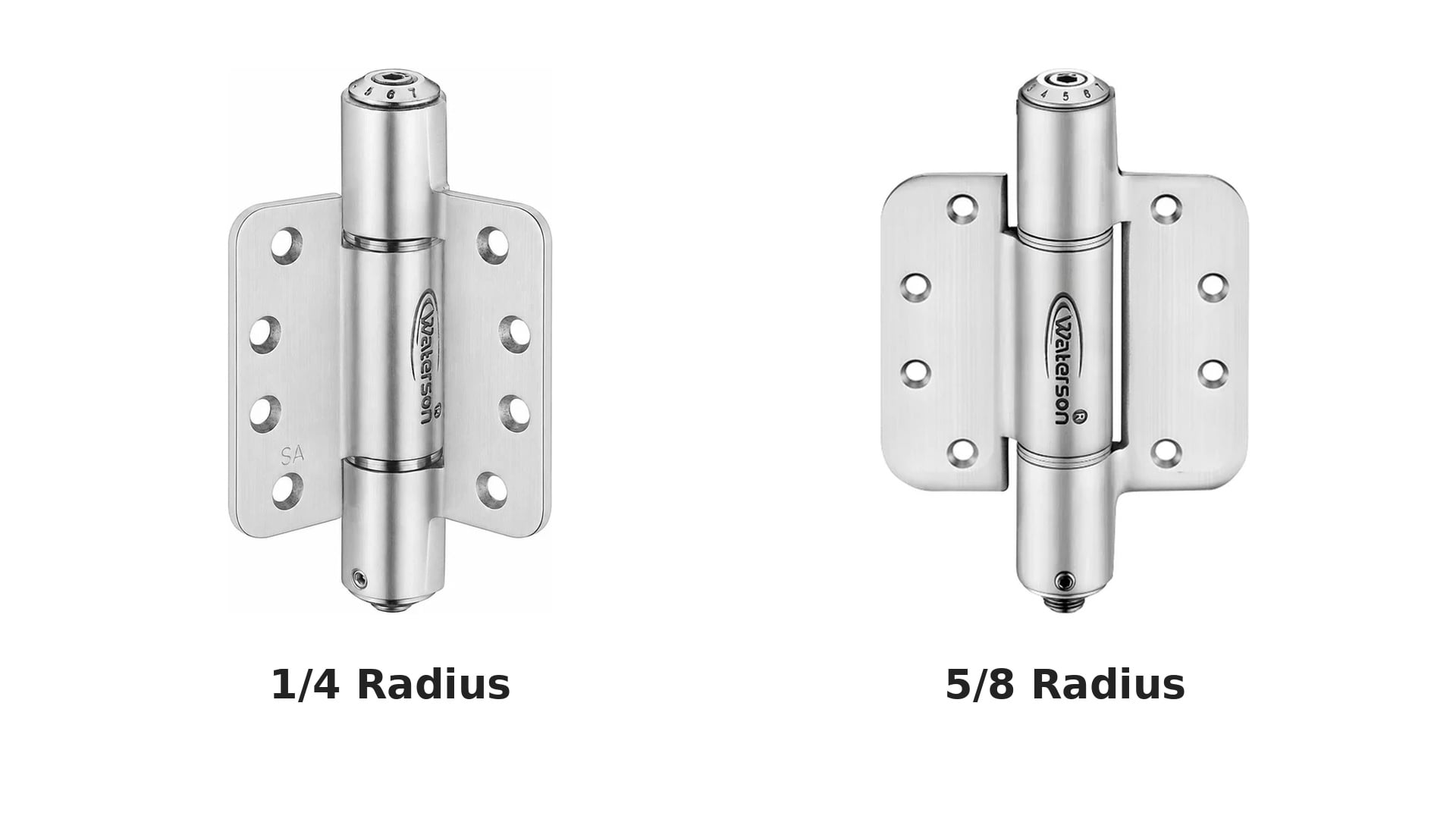
Replacing Door Hinges: 1/4 vs 5/8 Radius vs Square Corners
Quick Answer Most 4 inch residential door hinges have one of three corners: square, 1/4" radius, or 5/8" radius. A rounder hinge fits a mortise [...]
Why Won’t My Self Closing Door Hinges Close in Cold Weather
Quick Answer An exterior door that closes fine in summer but won't latch in winter is usually affected by two things: weather stripping that stiffens [...]

Soft Closing Hinges: 9 Most Frequently Asked Questions
Since the AIA in 2018, there has been an increased interest in Waterson hinges for many different projects. We have been inundated with questions by [...]