
“We have a 4 by 8 solid core entry on a hospital corridor that keeps sagging on standard hinges. My architect wants pivots, but I do not want to open up the floor slab this late in the schedule. Is a butt hinge going to hold this door, or do I have to go pivot?”
The butt hinge vs pivot hinge call comes down to four things you can measure at the opening: where the load goes, what the frame or floor can carry, what the schedule allows for prep, and what the code requires. Here is how the two compare on each, with the numbers that decide it.
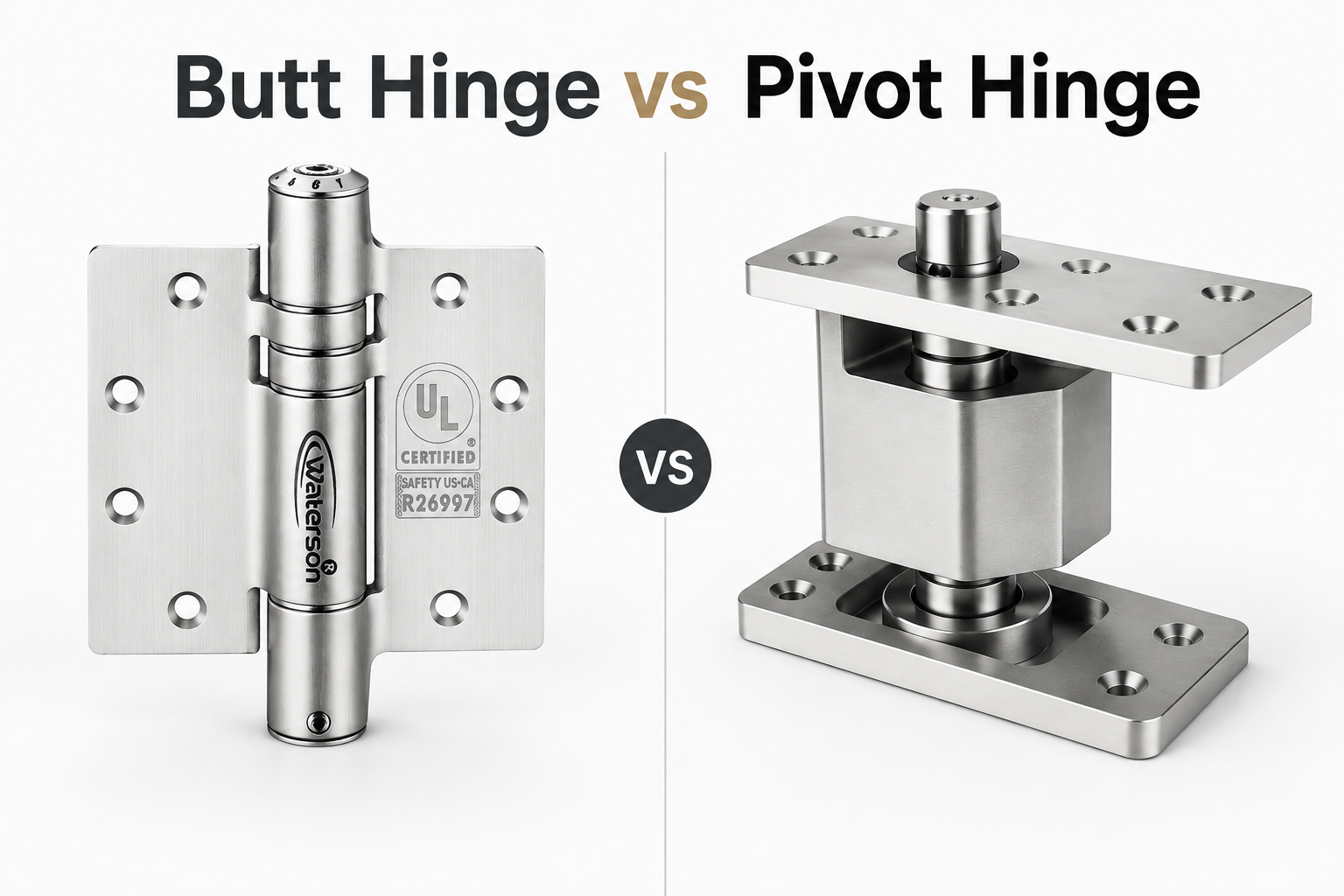
How Butt Hinge vs Pivot Hinge Compare, Factor by Factor
| Factor | Butt hinge | Pivot hinge |
|---|---|---|
| Load path | Horizontal, into the jamb and frame | Vertical, into the floor slab and header |
| What carries the door | Sound jamb and backing | Floor slab (bottom pivot), header (top pivot) |
| Contact points | 3 to 4 leaves along the door edge | 2 points, top and bottom |
| Door and frame prep | ANSI/BHMA A156.7 template, standardized | Manufacturer-specific pivot prep |
| Retrofit into an existing opening | Direct swap into existing mortises | New floor and header prep, often slab work |
| Meeting self-closing | Add a closer, or use a closer hinge | Add a closer, floor spring, or center-hung device |
| Field replacement | Any tech, standard prep | Specialized, disturbs the floor detail |
| Strong fit | Frame-sound openings, most doors, retrofits | Oversized or very heavy doors, frameless glass, double-action |
Where Does the Door’s Weight Go?
A butt hinge carries the leaf as a cantilever. Weight moves horizontally through the leaves and fasteners into the jamb, then into the rough opening, so the frame and its backing have to be sound. A pivot sends the weight vertically: the bottom pivot puts it straight onto the slab or a floor plate, and the top pivot only stabilizes.
The read for a spec writer is short. If the jamb or backing is the weak link, pivots move the problem to the floor. If the frame is sound, a butt hinge keeps the load in a detail your section already resolves.
At What Weight Point Does a Butt Hinge Stop Being Enough?
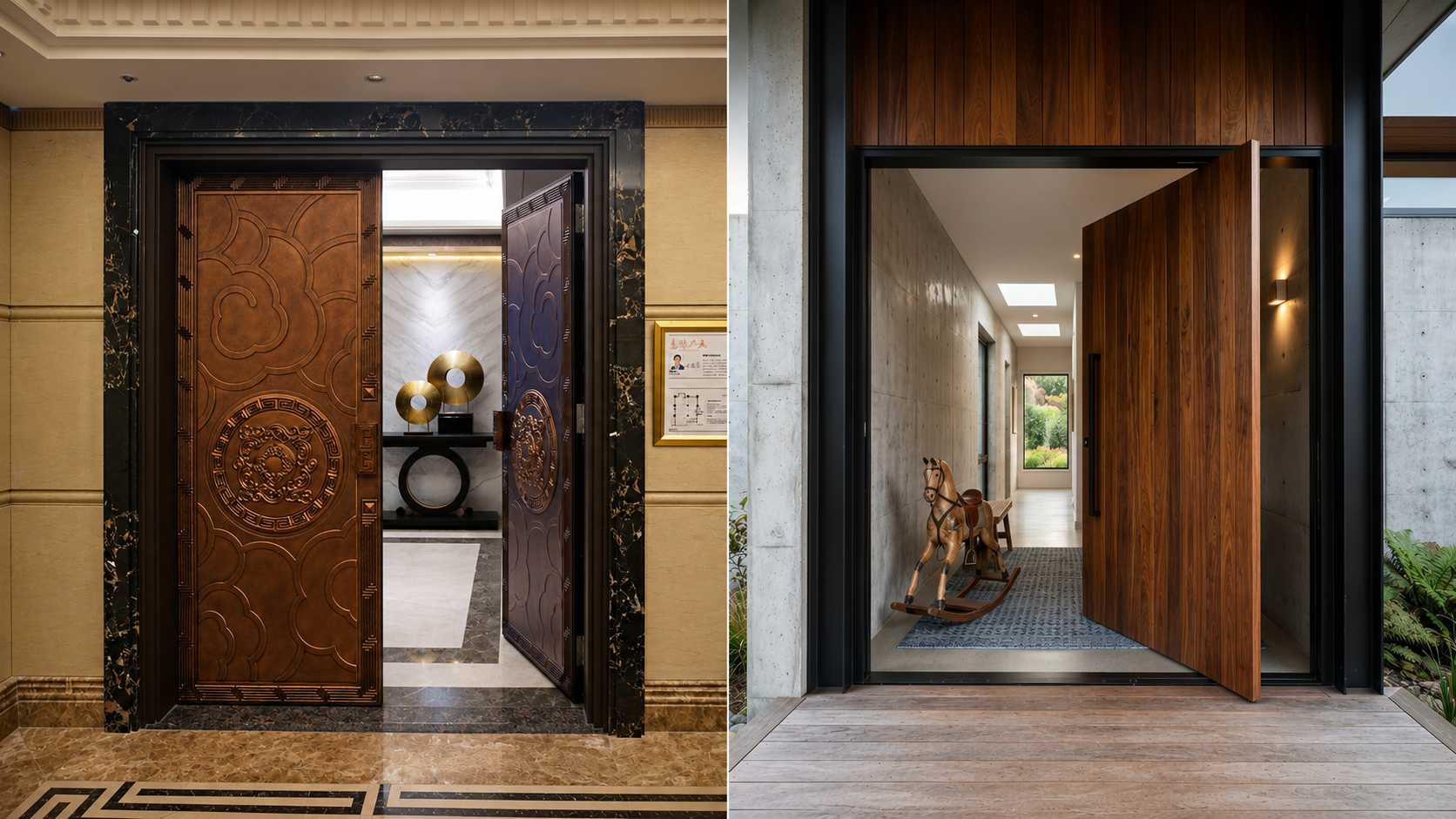
The old habit sent anything oversized, tall, lead lined, or past roughly 300 pounds straight to pivots. That ignores how a butt hinge carries load. A butt-hinged door shares its weight across every hinge on the edge, so capacity scales with what you specify. Add a fourth or fifth heavy-duty ball-bearing hinge and a properly specified stainless set clears 400 pounds on standard prep, with no single point carrying the whole door.
A pivot has only two working points, and the bottom pivot takes nearly all of the vertical load. You cannot add points to share it, so everything rides on one place. Overload or wear it and the failure lands there: a sheared pin or a damaged pivot can drop the door. So a butt-style hinge does not cap out at a fixed number, it scales with the hinges you add. The pivot is the format that runs out of room.
What the Prep Difference Costs on a Retrofit
The schedule impact splits cleanly:
- Butt hinges: Expensive at first, but no extra fees in the end.
Normal frame and door machining to the A156.7 template, and a direct swap into existing mortises on a retrofit. No new floor work. - Pivots: Affordable at first, but need to build new floor work and are expensive to maintain
Matched top and bottom sets, floor prep, and precise alignment between them. Planned into new construction, but on a retrofit they mean new preparation and possible slab work at the opening.
For the corridor door in the quote above, that difference is the reason the contractor wants to stay with a butt-style solution.
Fire, ADA, and self-closing at the opening
the code narrows the field regardless of hinge type:
- Fire door assemblies must be self-closing and positive latching, and every hinge has to be listed for the rated assembly.
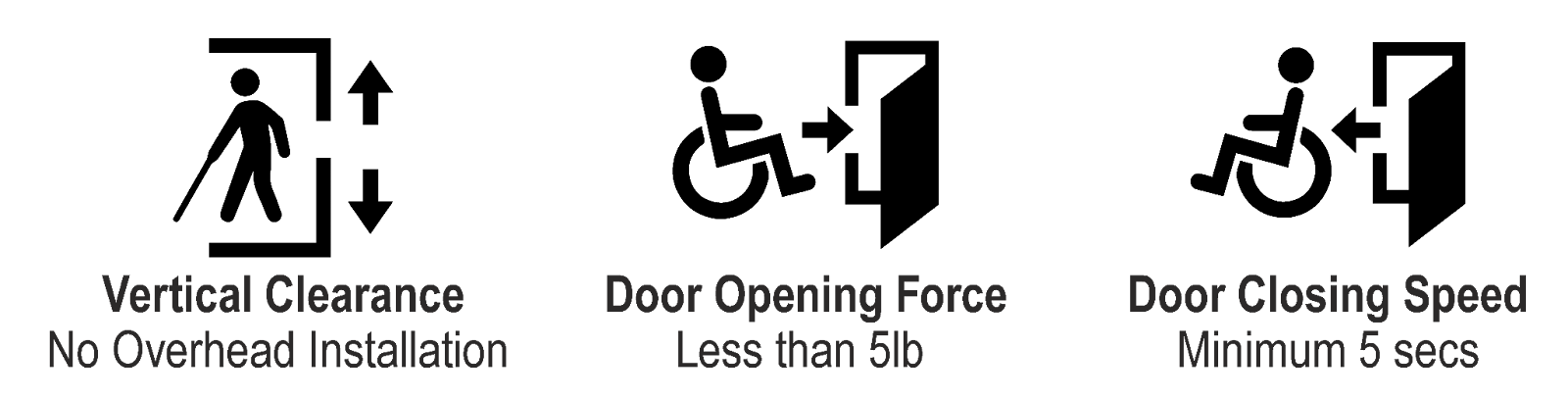
- ADA and ICC A117.1 govern opening force and closing behavior at accessible openings.
- Both butt and pivot openings frequently need a separate closer added to satisfy the self-closing requirement, which raises the real hardware count, the sightlines, and the number of devices to adjust.
Which Hinge Can Service The Heavy Door in Year Eight?
Butt hinges are interchangeable and field replaceable, and mechanical heavy-duty models are field adjustable on top of that. Because the prep is standard, any technician swaps or tunes a leaf without re-machining the frame, and these hinges commonly carry a 10-year warranty. Upkeep stays low: less labor, lower repair cost, and simpler service calls over the life of the opening.
A pivot concentrates the opposite. The bottom pivot sits in floor traffic and grime; replacing one is a larger job that usually disturbs the floor detail, and there is little to adjust in the field. Over a twenty-year service life, that gap in adjustability, repair cost, and labor is a real line item for the owner.
Where Waterson Stainless Steel Butt Door Hinges Fit the Commercial Building Code-Rated Opening
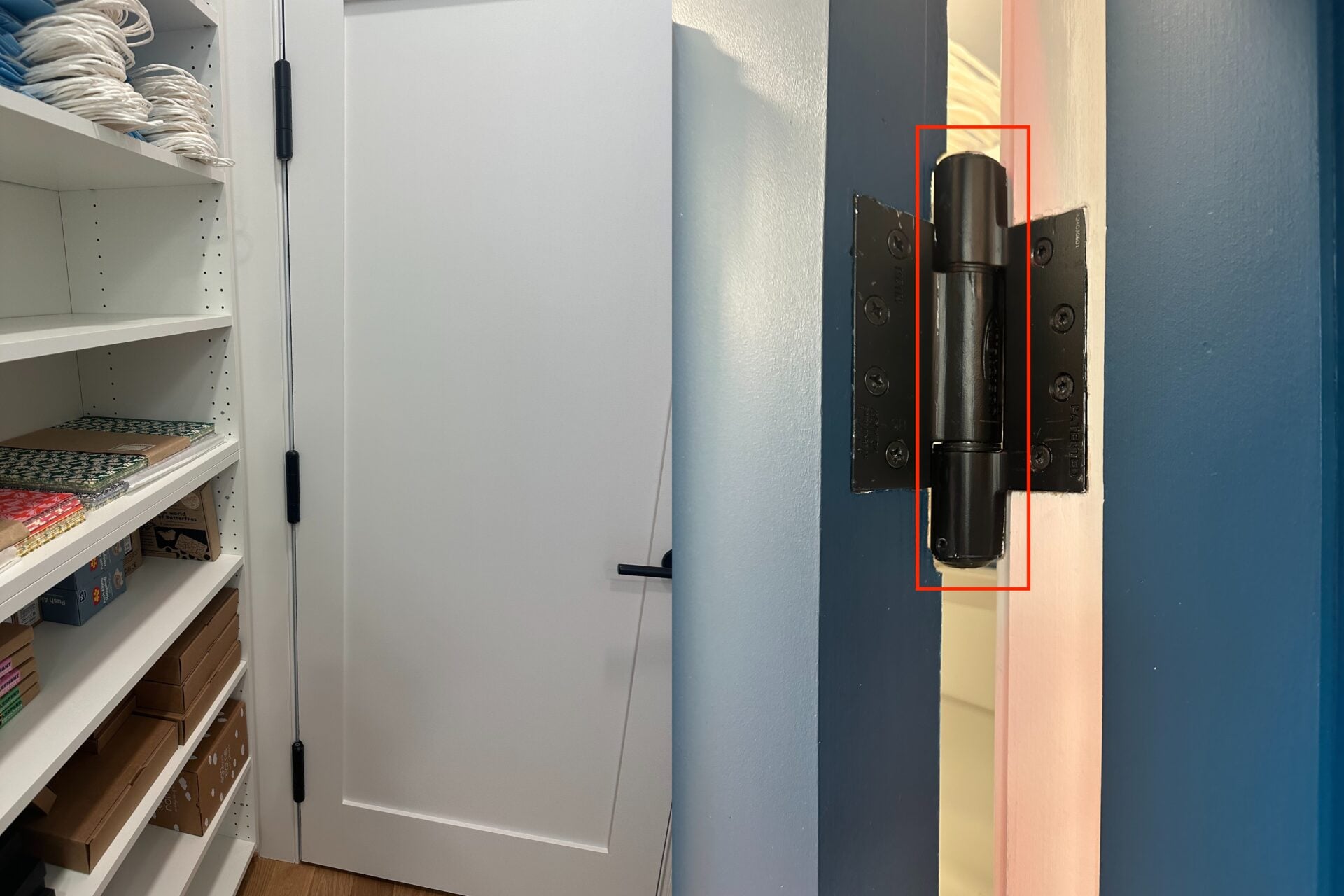
Waterson self closing butt door hinge is a full mortise concealed hinge, butt-style stainless hinge that also closes, holds open, and stops the door on standard A156.7 prep. For the heavy fire-rated healthcare opening above, the relevant specifications are:
| Feature | Specification | What it does at this opening |
|---|---|---|
| Material | Type 304 standard, 316 optional, 316L marine grade | Corrosion resistance for wash-down, coastal, and wet locations |
| Self-closing | Built-in mechanical spring, field adjustable | Meets self-closing with no separate overhead closer |
| Soft close | Hydraulic damper on the final degrees of travel | Prevents slamming, protects the frame, latch, and user |
| Heavy duty | Up to 330 lb, doors to 4 by 8 ft, add hinges to scale | Carries the sagging heavy leaf on standard prep |
| Cycle life | ANSI/BHMA A156.17 Grade 1, 1,000,000 cycles | Durability for a high-traffic corridor |
| Non-handed | One part fits both left and right swing doors | Fewer part numbers to spec, order, and stock |
| Hold-open | Field set near 90 degrees, optional, not on fire doors | One part covers self-closing and hold-open openings |
| Door stop | Integrated 90 and 120 degree barrel stops | Removes the separate floor or wall stop |
| Fire rated | UL certified to 3 hours, meets NFPA 80, tested to 8 ft leaves | Passes the rated corridor |
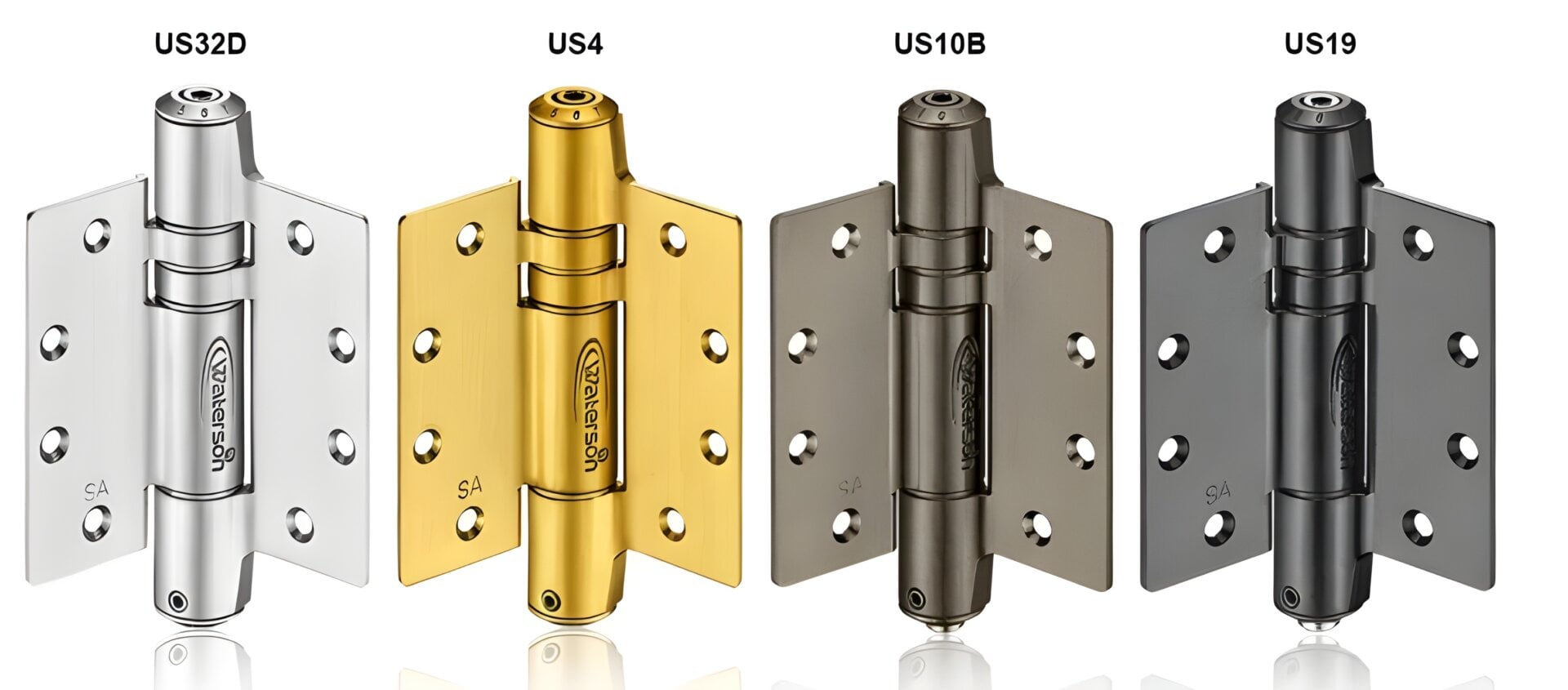
Finishes are Satin Stainless Steel (US32D), Flat Black (US19), Dark Satin Bronze (695), and Satin Brass (US4), so the design match does not cost you the rating. The set ships engineered for the opening and is backed by Waterson’s product warranty.
Waterson Stainless Steel Self Closing Butt Hinges
Waterson full mortise ball bearing hinges combine the function of an overhead closer and a hinge into a single, sleek component—complete with optional hold-open and door-stop features. Designed for commercial openings, gates, and glass doors, these hinges are easy to install and adjust to meet ADA and ICC A117.1 standards for opening force, while ensuring quiet and secure closure. Crafted from durable stainless steel, they are NFPA 80 compliant, UL 3-hour fire-rated, and built to perform reliably in both interior and all-weather exterior environments. See all our features.
In addition to these performance advantages, Waterson offers flexible customization services. As a direct manufacturer, we can tailor hinge sizes, finishes, and especially hinge leaf designs to meet the specific structural needs of your doors. This makes our hinges an ideal solution for door manufacturers seeking custom options that integrate seamlessly with their existing frames.
Request For Quote
Please note that Waterson closer hinges start from a size of 4″x4″. If you’re in need of smaller self-closing hinges, we’d recommend checking out some other resources! Also, we only provide single acting closer hinges. Thank you.
Recent Post
Waterson Self Closing Hinges Canada Policy
Waterson provides self-closing hinges for architectural and construction projects across Canada. Below is an overview of how we support Canadian customers, from shipping and certification [...]

Can Waterson Self Closing Gate Hinges Work on a Chain Link Fence
"Hi, we're closing out a commercial lot and the spec calls for self closing hinges on the entry gates. These are customized metal gates: a [...]
Is Your Door Gap Too Tight for Waterson Self Closing Hinge Barrel?
"I bought these to replace standard 4 inch hinges, which, when open are 4 inches wide x 4 high. The Waterson hinges are 4 5/16 [...]