
“We installed frameless glass doors in our client’s open plan office, and now every door slam echoes through the entire floor. The tenant is also worried about pinch injuries.”
We hear versions of this inquiry every week, and it points to a truth many projects discover too late: on a glass door, the hinge is the acoustic system and the safety system. Before you specify another pivot or patch fitting, look at what the opening actually has to do.
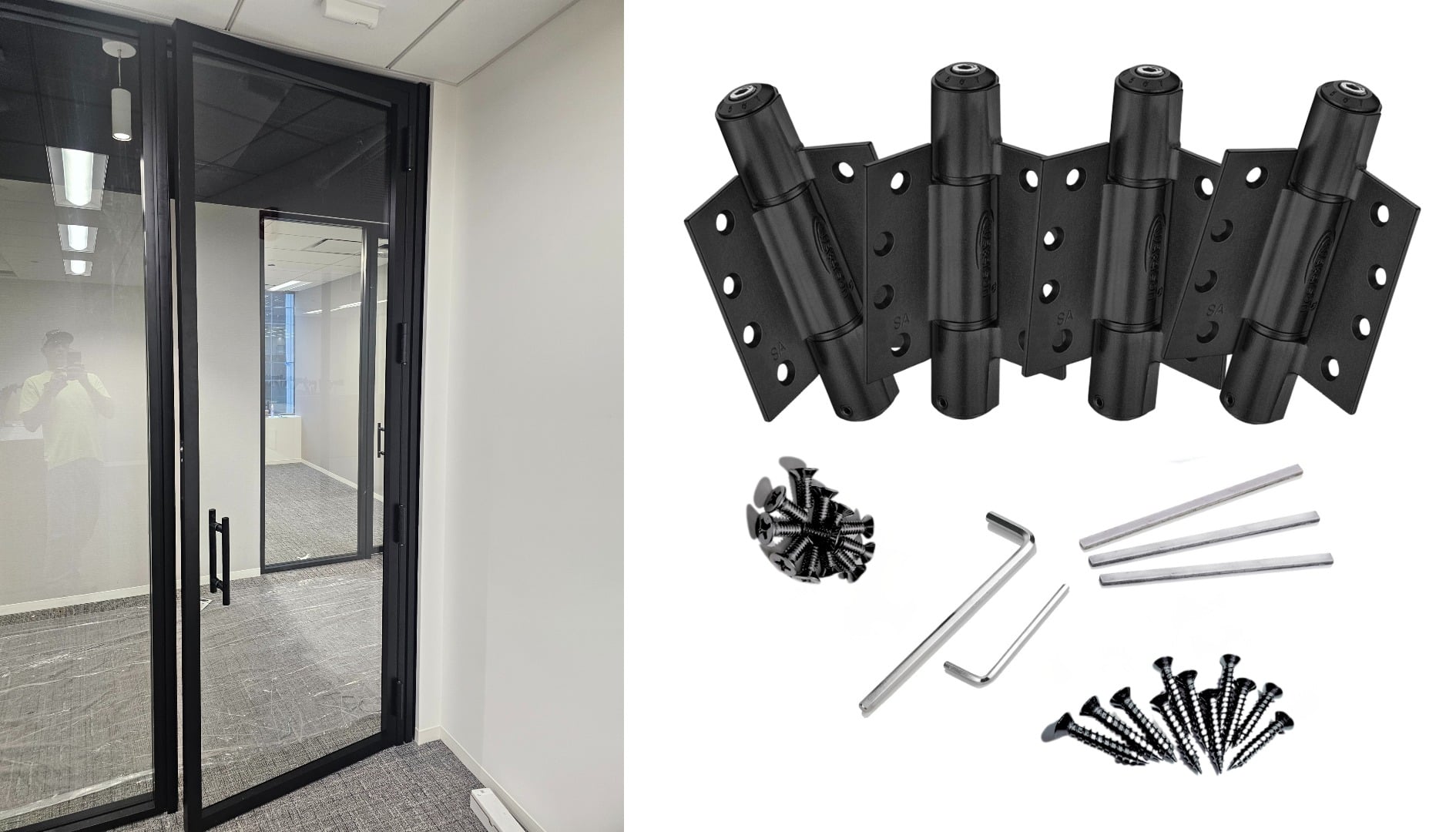
What Would A Commercial Office Glass Partition Door Need From These Hinges
Glass changes the physics of the opening. A 10 mm or 12 mm tempered leaf carries real mass but has none of the acoustic damping a solid core wood door provides. Impact energy travels straight through the panel and radiates as noise across the floor plate.
That means the hinge set has four jobs, not one:
| Job | Why glass makes it harder | What fails without it |
|---|---|---|
| Carry the load | 100 to 155 lbs on a thin clamp edge | Sag, misaligned latch, ghost gaps |
| Control closing speed | No air cushion from a frame rebate | Accelerating leaf, hard strikes |
| Absorb the final degrees | Glass transmits impact as airborne noise | The slam your tenant complains about |
| Hold a set open position | No wedge can grip a frameless leaf safely | Improvised props blocking the egress path |
This applies whether the leaf is frameless tempered glass or glass set in an aluminum or steel frame. Standard patch fittings and free-swinging pivots handle only the first row of that table. Floor springs handle the second, at the cost of a floor cut, a cement box, and fluid maintenance below grade. Nothing in the conventional kit addresses rows three and four together.
Why Is Hold Open With Controlled Self-Closing Needed Here
In a working office, a glass partition door lives in two states:
- Open on demand. Morning arrivals, catering carts, end of day. The door must hold at 90 degrees or more without a floor wedge that violates the accessibility path.
- Closed by default. A glass door left ajar defeats the acoustic separation the partition was installed to provide in the first place.
A hinge with an adjustable hold open detent plus hydraulic self-closing covers both states with zero electrification. Push past the detent and the door stays put. Pull it free and the damper decelerates the leaf through the last 15 to 20 degrees so the latch engages with a click, not a bang.
That final deceleration zone is where your two problems become one: it is the same mechanism that prevents the 85 dB slam and the crushed finger.
Does This Need Heavy Duty Use
Here are the assumptions I would take into a spec meeting. Verify each against your project documents:
- Cycle count: doors on main circulation paths see roughly 100 to 300 cycles per day. Over a 10-year service life that approaches one million cycles, which is ANSI/BHMA Grade 1 territory. Confirm with the traffic study.
- Leaf weight: 12 mm tempered glass at a standard 900 mm width typically lands between 50 and 65 kg. Specify hinge sets rated for at least 80 kg to leave margin for wider leaves and HVAC pressure differentials. Confirm against the glazier’s schedule.
- Duty grade: a low-traffic executive suite might get away with Grade 2, but the cost delta rarely justifies the downgrade or the split spec.
If your numbers land lower than mine, tell me and we adjust. If they land higher, heavy duty is not optional.
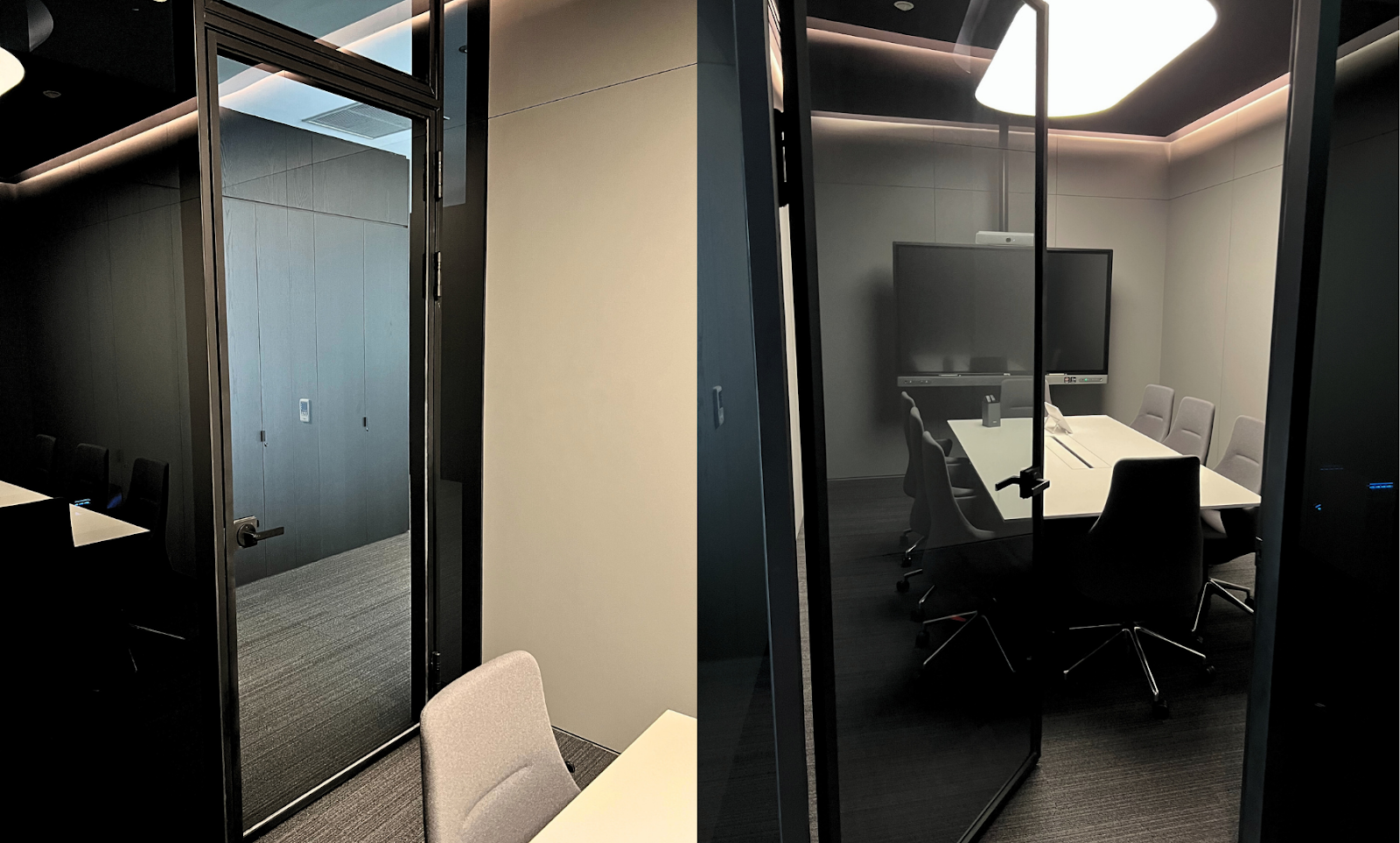
After All, Is There A Good Solution
The traditional answer splits the functions across four products and three trades:
| Function | Traditional hardware | Site reality |
|---|---|---|
| Load bearing | Pivot set | Glazier installs |
| Closing control | Floor spring | Floor cut, cement box, fluid leaks |
| Door stop | Overhead or floor stop | Separate trade, sightline clutter |
| Hold open | Hook, wedge, or arm | Often improvised, often non-compliant |
Every added component is another maintenance line item and another point where the acoustic chain breaks. The better answer consolidates all four rows into the glass door hinges themselves. This is exactly the problem Waterson set out to solve.
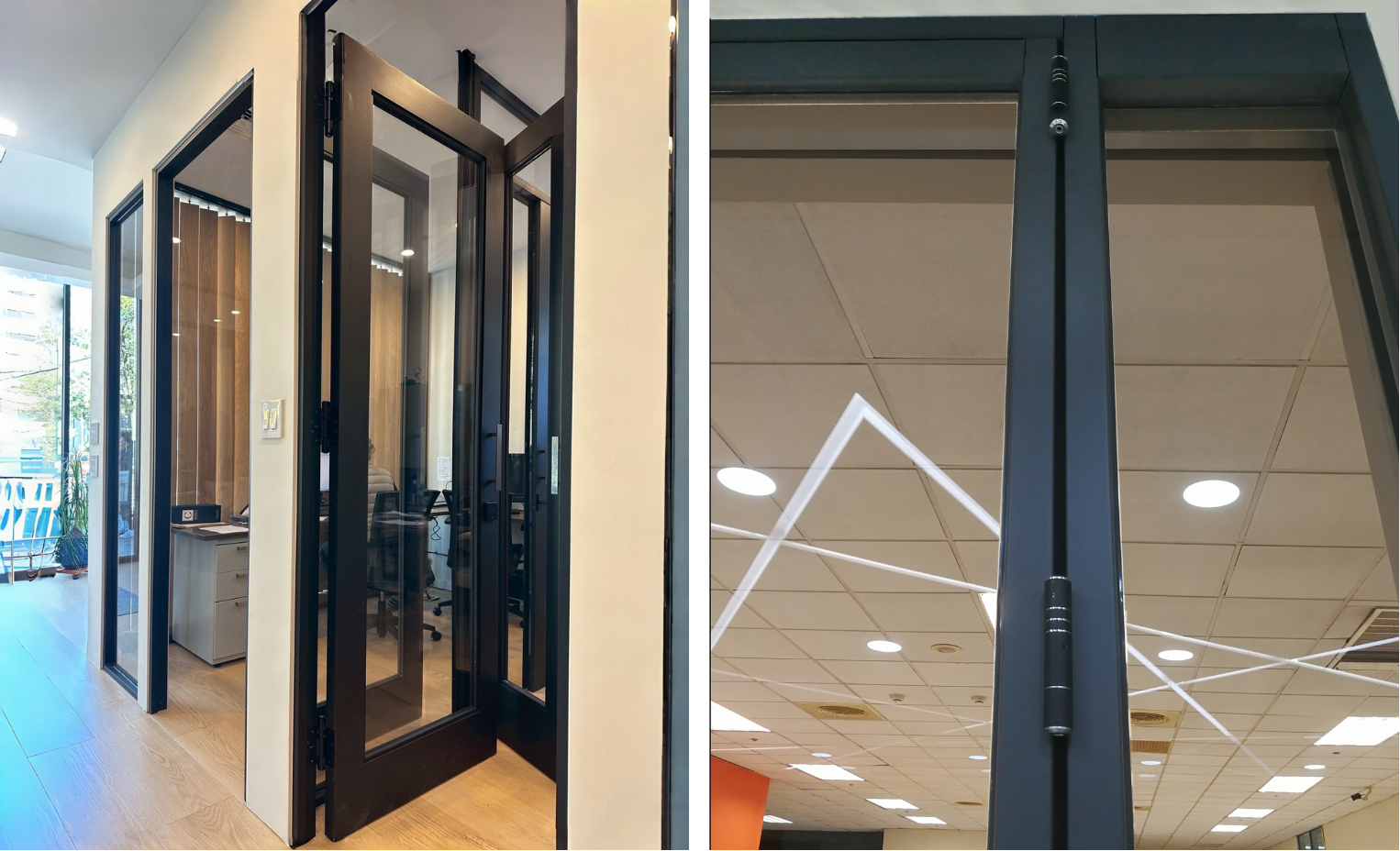
Waterson Self Closing Glass Door Hinges, Adjusted For Framed and Frameless Glass Doors
Waterson closer hinges integrate the spring closing mechanism and hydraulic damper inside the hinge barrel itself, which matters on frameless glass because there is nowhere else to hide hardware. For this application, the feature set translates as follows:
| Feature | What it means on a glass partition door |
|---|---|
| Stainless steel | 304 grade standard; the exposed barrel reads as intentional next to frameless glazing |
| Integrated door stop | Deletes the separate floor or wall stop from the hardware schedule |
| Hold open | Adjustable detent sets the exact hold angle, no wedges, no overhead arms |
| Self-closing mechanism | Field-adjustable speed tuned to actual leaf weight, meets accessibility opening-force expectations |
| Heavy duty | Rated for the Grade 1 traffic profile outlined above |
| Anti-slam damping | The acoustic payoff: the strike becomes a click, not a report |
| 3 years warranty | A service-life commitment you can pass through in the O&M manual |
One caveat worth a phone call: glass edge preparation differs from a mortised wood or hollow metal door, so confirm the clamp or adapter configuration for your leaf thickness with Waterson’s technical team before ordering.
How To Choose The Correct Glass Door Hinge: Framed Vs Frameless
The single decision that drives everything else is whether your glass sits in a frame. Answer that first, then the model selection is straightforward.
For Framed Glass Doors (aluminum or steel stile): Waterson K51M series
- Mortises into the frame stile like a conventional butt hinge, so the hardware schedule and prep drawings stay familiar to your installer.
- Available in four sizes, 4″, 4.5″, 5″, and 6″, letting you match hinge size to leaf weight and height instead of overspecifying.
- The go-to choice where the glass door sits on a corridor line, since framed assemblies are where UL listed closer hinge configurations apply. Confirm the listing for your exact assembly.
- Two to three hinges per leaf depending on weight; Waterson’s sizing chart maps this directly.
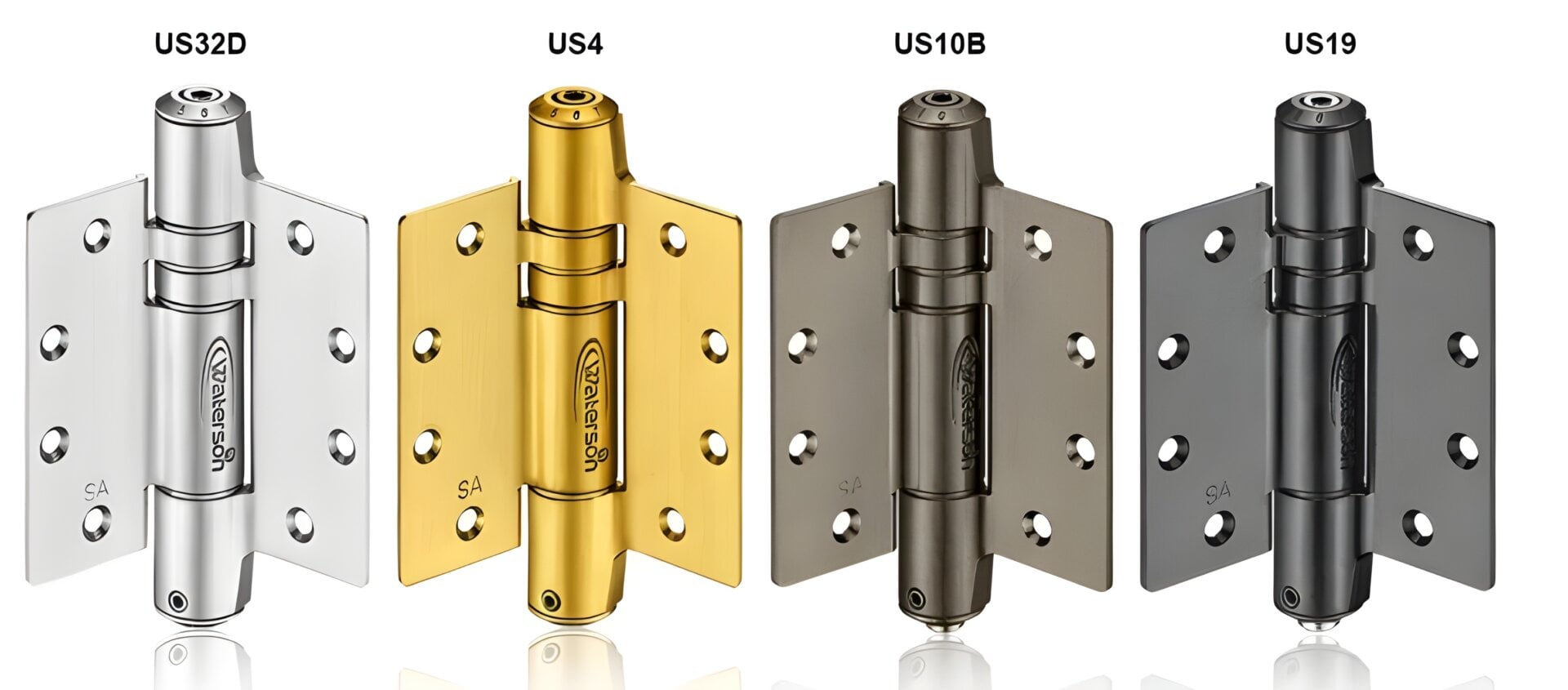
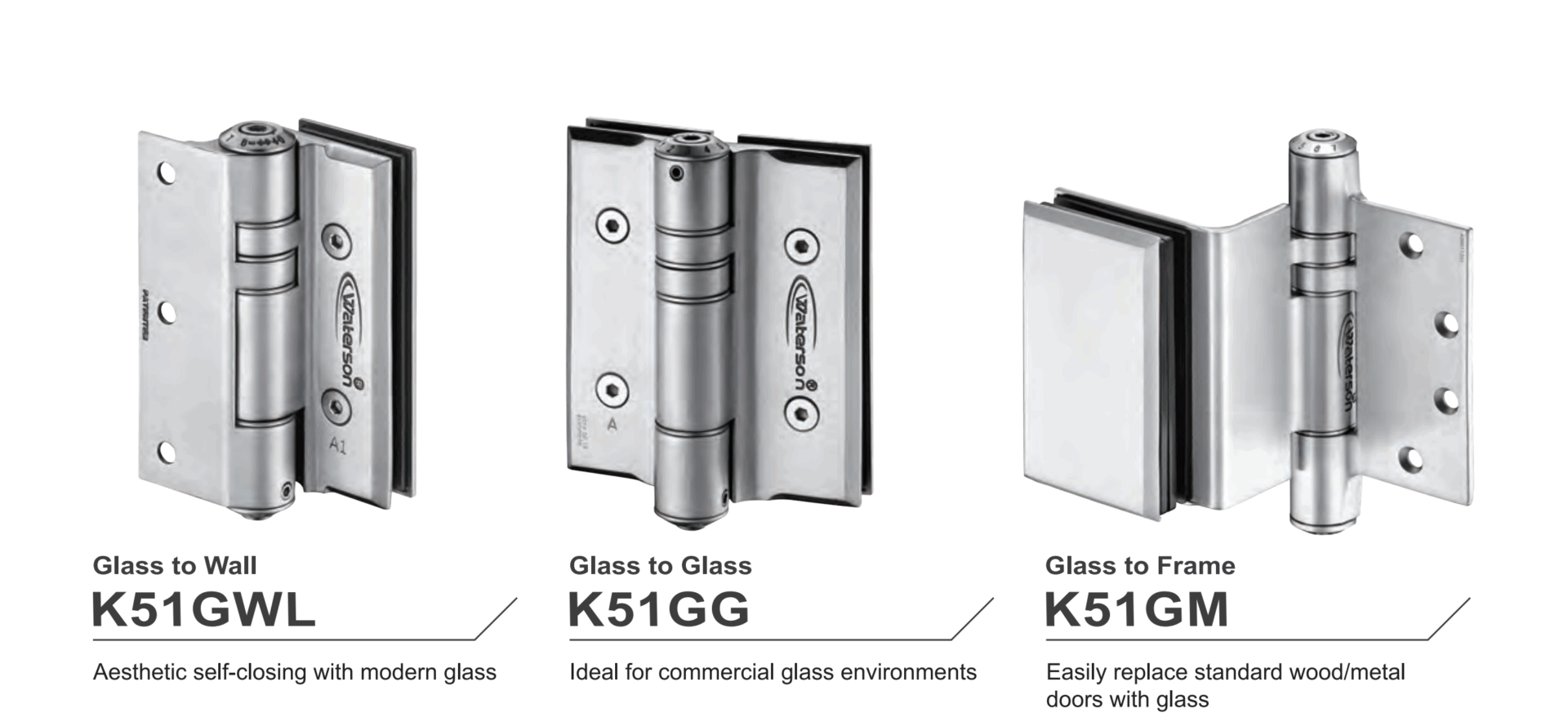
For Frameless Glass Doors (no stile to mortise into): Waterson K51G series
- K51GG: glass-to-glass configuration, for a frameless door swinging from a fixed glass sidelite or partition panel.
- K51GM: glass-to-metal configuration, for a frameless leaf hung from a metal frame or post.
- K51GWL: glass-to-wall configuration, for a frameless leaf mounted directly to a finished wall.
- All three clamp the tempered leaf rather than mortising it, so no glass fabrication beyond standard cutouts is required. Confirm supported glass thickness with the spec sheet before the glazier orders.
A 30-second Decision Path
- Framed leaf required: K51M, sized to weight.
- Frameless leaf hinged off fixed glass: K51GG.
- Frameless leaf hinged off a frame or post: K51GM.
- Frameless leaf hinged off the wall: K51GWL.
Same closing, damping, hold open, and anti-slam behavior across the range, so the acoustic and safety performance discussed above does not change with the mounting condition. Only the attachment method does.
Waterson Commercial Glass Door Hinges Self Closing
Waterson self closing glass door hinges combine the function of an overhead closer and a hinge into a single, sleek component—complete with optional hold-open and door-stop features. Designed for commercial openings, gates, and glass doors, these hinges are easy to install and adjust to meet ADA and ICC A117.1 standards for opening force, while ensuring quiet and secure closure. Crafted from durable stainless steel, they are NFPA 80 compliant, UL 3-hour fire-rated, and built to perform reliably in both interior and all-weather exterior environments. See all our features.
In addition to these performance advantages, Waterson offers custom hinge services. As a direct manufacturer, we can tailor hinge sizes, finishes, and especially hinge leaf designs to meet the specific structural needs of your doors. This makes our hinges an ideal solution for door manufacturers seeking custom options that integrate seamlessly with their existing frames.
Request For Information
Please note that Waterson Closer Hinges start from a size of 4″x4″. If you’re in need of smaller self-closing hinges, we’d recommend checking out some other resources! Also, we only provide single acting closer hinges. Thank you.
Recent Post
Which Self-Closing Gate Hinges Are Best for UK Commercial Exteriors?
Quick Answer All-mechanical self-closing hinges are the most reliable choice for UK outdoor gates. Specify an all-mechanical self-closing gate hinge (no hydraulic fluid) in 316 [...]
How Many Self Closing Hinges Per Door? The NFPA 80 Rule vs. Waterson Sets for Fire & Arched Doors
Quick Answer Choosing a Waterson self-closing hinge set takes two steps. First, door height sets how many Waterson hinges you need: 2 for a 6 [...]
NFPA 80 Residential Fire Door Requirements: 13 Point Inspection Checklist
Quick Answer NFPA 80 is the standard that defines minimum requirements for fire door installation, inspection, and maintenance in buildings. It requires fire doors to [...]