
A non fire-rated door and a fire-rated door may look similar at first glance. Both open, close, and separate spaces. But in terms of function, responsibility, and risk, they are fundamentally different, especially when viewed through the lens of fire safety.
The difference goes beyond fire resistance. It affects how the door is designed, how it must perform, and how every attached component is evaluated. Problems arise when a fire-rated door is treated as simply a heavier version of a standard door.
So what separates a fire-rated door from a non fire-rated door, and what actually changes once a door becomes fire-rated?

What Is a Fire Rated Door (vs. a Non Fire Rated Door)?
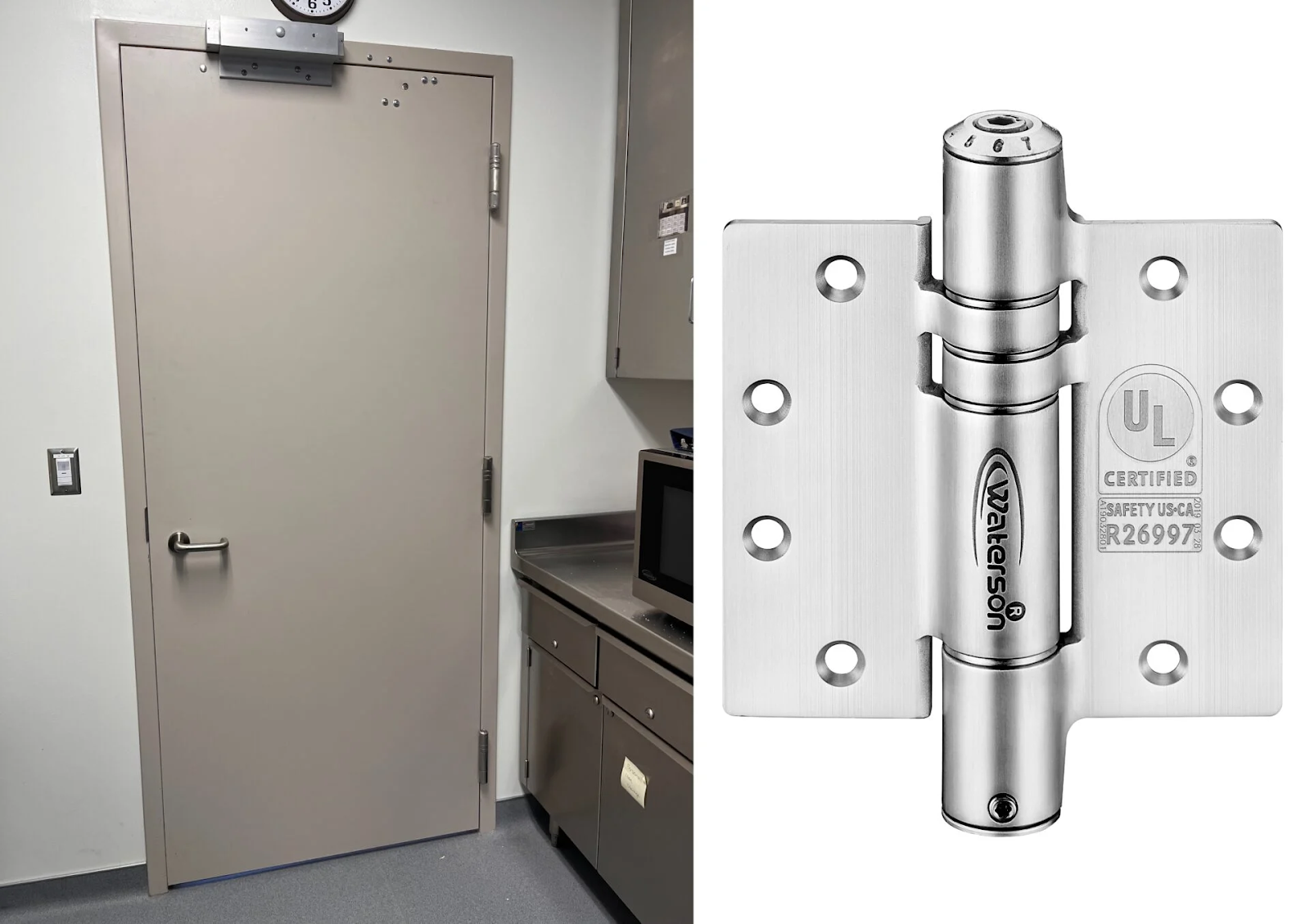
Fire Rated Door
Under NFPA 80, a fire-rated door is not a single component. It is a tested and labeled assembly engineered to resist fire exposure for a defined time, limit smoke and heat transfer, and remain functional (closing and latching automatically) under fire conditions. These requirements exist to ensure fire safety at the opening level, not just code compliance on paper.
That word assembly matters. A compliant fire door does not exist without its hinges, frame, fasteners, and closing hardware performing together under heat and stress.
Non Fire Rated
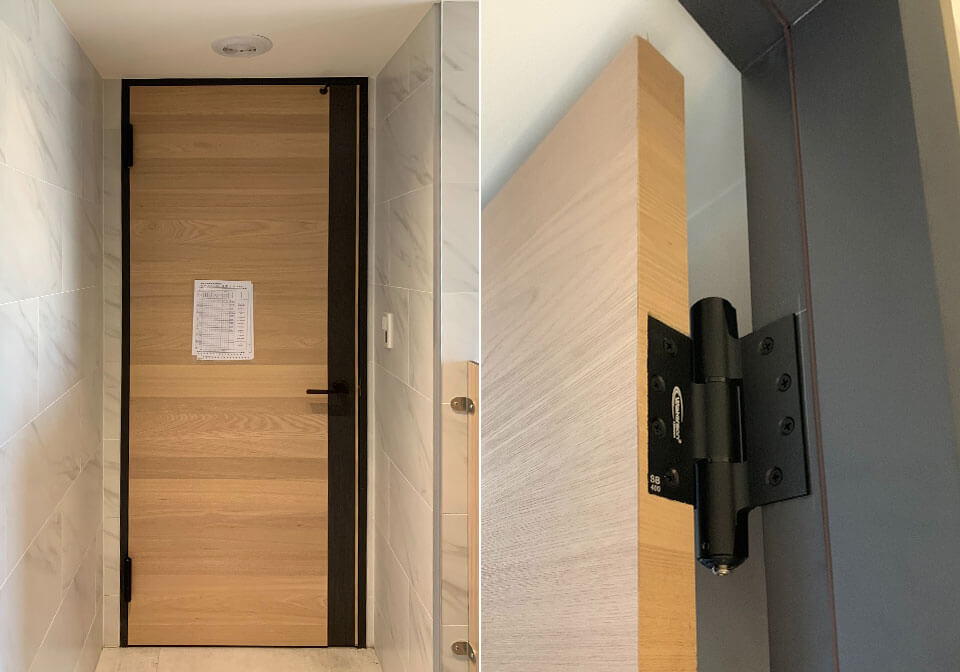
A non fire-rated door, by contrast, carries no fire or smoke performance obligation and is not evaluated as part of a life-safety system. Hardware selection is therefore far more flexible, typically driven by load capacity, fit, finish, and cost.
If you’re specifying hinges for a non fire-rated door, the decision path is straightforward.
But for a fire-rated door, it is not just that ending.
Why Fire Rated Doors Require More Than Load Capacity
Load capacity only answers one question: can the door be physically supported?
For fire-rated doors, the question would be: Will the door maintain alignment, required clearances, and fire safety under heat and repeated use?
Fire-rated door hinges are life-safety components, not accessories. That’s why NFPA 80 defines requirements that directly affect hinge selection, performance, and installation. So what exactly makes a fire rated door? Please check the table below.
Key Fire Rated Door Requirements
| Criteria | Requirements |
|---|---|
| Fire Resistance Rating | Door assembly must be labeled and tested for the specified rating (e.g., 20-, 45-, 60-, 90-, 120-, or 180-minute). |
| Temperature Resistance | Components must withstand elevated temperatures exceeding 250°F (121°C) without loss of function. |
| Self Closing Function | Door must fully close from any open position; on pairs, the inactive leaf must close before the active leaf. |
| Smoke Control | Door assembly must limit smoke migration through compliant materials, seals, and construction. |
| Structural Integrity | Door, frame, and components must remain intact and functional during fire exposure. |
| Seals and Gaskets | Intumescent or smoke seals must resist heat and prevent the passage of smoke and hot gases. |
| Hardware and Fasteners | All hardware and fasteners must be fire-rated and maintain integrity under heat. |
| Door and Frame Condition | Door and frame must be securely attached, properly aligned, and free of damage or deformation. |
| Latching Performance | Latching mechanism must engage automatically from a full open position without interference. |
| Door Clearances | Clearances must not exceed: top/vertical edges 1/8″ ± 1/16″; meeting edges ≤ 3/16″; wood doors ≤ 1/8″. |
| Signage | Signage must not exceed 5% of door surface area; adhesive-mounted only; must not interfere with door operation or glazing. |
| Testing and Inspection | Door assemblies are subject to fire testing and ongoing inspection to verify compliance. |
Where are Fire Rated Doors Required
Fire-rated doors are mandated in life-safety critical locations, including:
- Stairwells and exit enclosures
- Elevator lobbies and shafts
- Corridor separations in multi-family housing
- Mechanical and electrical rooms
- Fire barriers and fire partitions
These are all critical life-safety locations. As a result, any components installed as part of a fire-rated door assembly must deliver strength, durability, and consistent performance across residential, commercial, and industrial environments.
Because of that, among available material options, stainless steel is most commonly specified for fire-rated door hardware. Compared with other alloys and materials, stainless steel provides superior strength retention at elevated temperatures, higher resistance to deformation, and long-term durability under repeated use, making it well-suited for demanding fire-rated applications.
ADA + Fire Rated: A Requirement, Not a Preference
In a fire emergency, a fire-rated door is tested not only on how to stop the spread of fire and smoke, but also on who needs to use it.
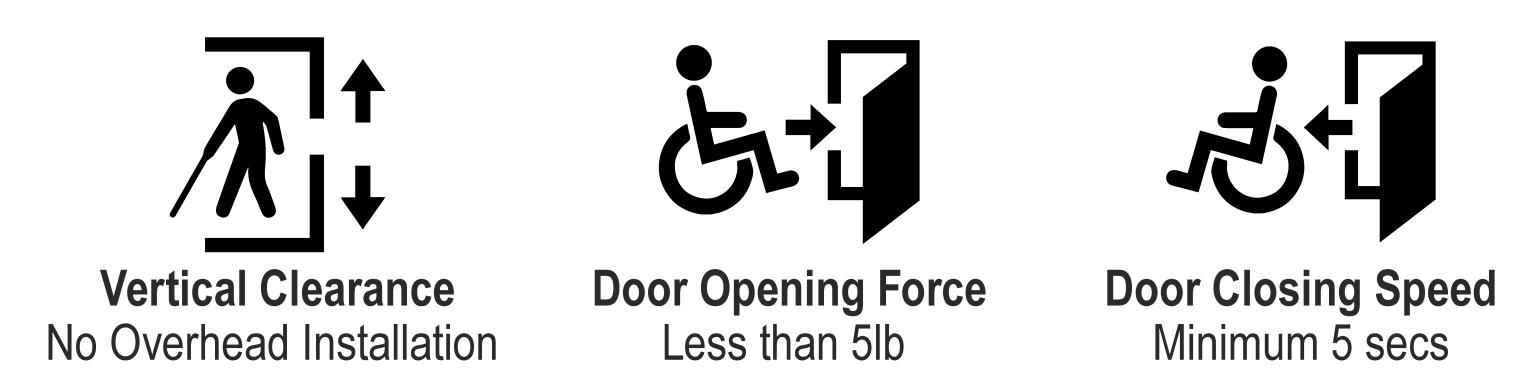
An able-bodied adult may be able to push open a heavy exit door without difficulty. For children, older occupants, or people with disabilities, the same door can become a serious barrier. This is where ADA compliance becomes essential, not optional. At its core, ADA-compliant fire-rated design ensures that:
- Doors remain operable by all occupants during emergencies
- Opening force and door movement do not impede escape
- Life-safety measures protect people, not just the building
The ability to open a door with reasonable force, predictable movement, and controlled closing behavior directly affects evacuation outcomes.
So How Can All Fire-Rated Door Requirements Be Met in a Single Hinge Solution
Waterson self closing fire rated door hinges are engineered to support fire-rated door assemblies in residential buildings by integrating life-safety, accessibility, and durability requirements into a single hinge solution.
- Self Closing Mechanism: Automatically shuts the door after every use, preventing smoke and fire from spreading.
- Fire Rated: Certified with 3-hour UL-list and NFPA 80 to resist high temperatures and maintain barrier integrity under extreme fire conditions.
- ANSI/BHMA A156.17 Grade 1: Proven durability with over 1,000,000 cycles—guaranteed to function in high-use and high-stress conditions.
- ADA Compliant: Smooth operation for everyone, including children, the elderly, and people with limited mobility—essential during panic evacuation.
- Heavy Duty: Designed for high-traffic, high-impact environments—reliable under real-world fire pressure.
- Stainless Steel: Equipped with heat-resistant SST304; maintains structural integrity during prolonged exposure to flame and stress.
- Concealed Design: Flush-fit hinge design minimizes snagging and keeps emergency routes clear and code-compliant
A fire-rated door only works when it closes completely and latches every time. If the hinge fails to perform, the fire rating of the door is effectively compromised. Therefore, please don’t play with your life at any risk, and protect it with Waterson self closing fire rated door hinges now!
Waterson Self Closing Fire Rated Door Hinges
Waterson self closing fire door hinges combine the function of an overhead closer and a hinge into a single, sleek component—complete with optional hold-open and door-stop features. Designed for commercial openings, gates, and glass doors, these hinges are easy to install and adjust to meet ADA and ICC A117.1 standards for opening force, while ensuring quiet and secure closure. Crafted from durable stainless steel, they are NFPA 80 compliant, UL 3-hour fire-rated, and built to perform reliably in both interior and all-weather exterior environments. See all our features.
In addition to these performance advantages, Waterson offers custom hinge services. As a direct manufacturer, we can tailor hinge sizes, finishes, and especially hinge leaf designs to meet the specific structural needs of your doors. This makes our hinges an ideal solution for door manufacturers seeking custom options that integrate seamlessly with their existing frames.
Request For Quote
Please note that Waterson closer hinges start from a size of 4″x4″. If you’re in need of smaller self-closing hinges, we’d recommend checking out some other resources! Also, we only provide single acting closer hinges. Thank you.
Recent Post

Soft Closing Hinges: 9 Most Frequently Asked Questions
Since the AIA in 2018, there has been an increased interest in Waterson hinges for many different projects. We have been inundated with questions by [...]
Residential Soft Close Front Door Hinges: How to Choose, Install & Adjust the Right Hinge for Your Home
Your front door is usually the heaviest door in your home and the one you use the most. Every time it slams, the impact goes [...]
How to Stop a Door From Swinging Open
In high-traffic projects, when a door swings open on its own, it can create serious trouble. It disrupts daily use, and worse—bam!—the door can slam [...]