
Last year, you specified a gate hinge and it passed the inspection. Eighteen months later, the spring started to seize, the barrel is rust-streaked, and the gate does not close unless someone pushes it. The frame is fine, the latch is fine, but the hinge failed.
In coastal and marine environments, this is a material mismatch. Salt fog, chlorine off-gas, UV exposure, and daily wind gusts eliminate most standard gate hinges and hardware within one to three seasons. So what is the right material, and how do you specify a marine stainless hinge that actually holds up?
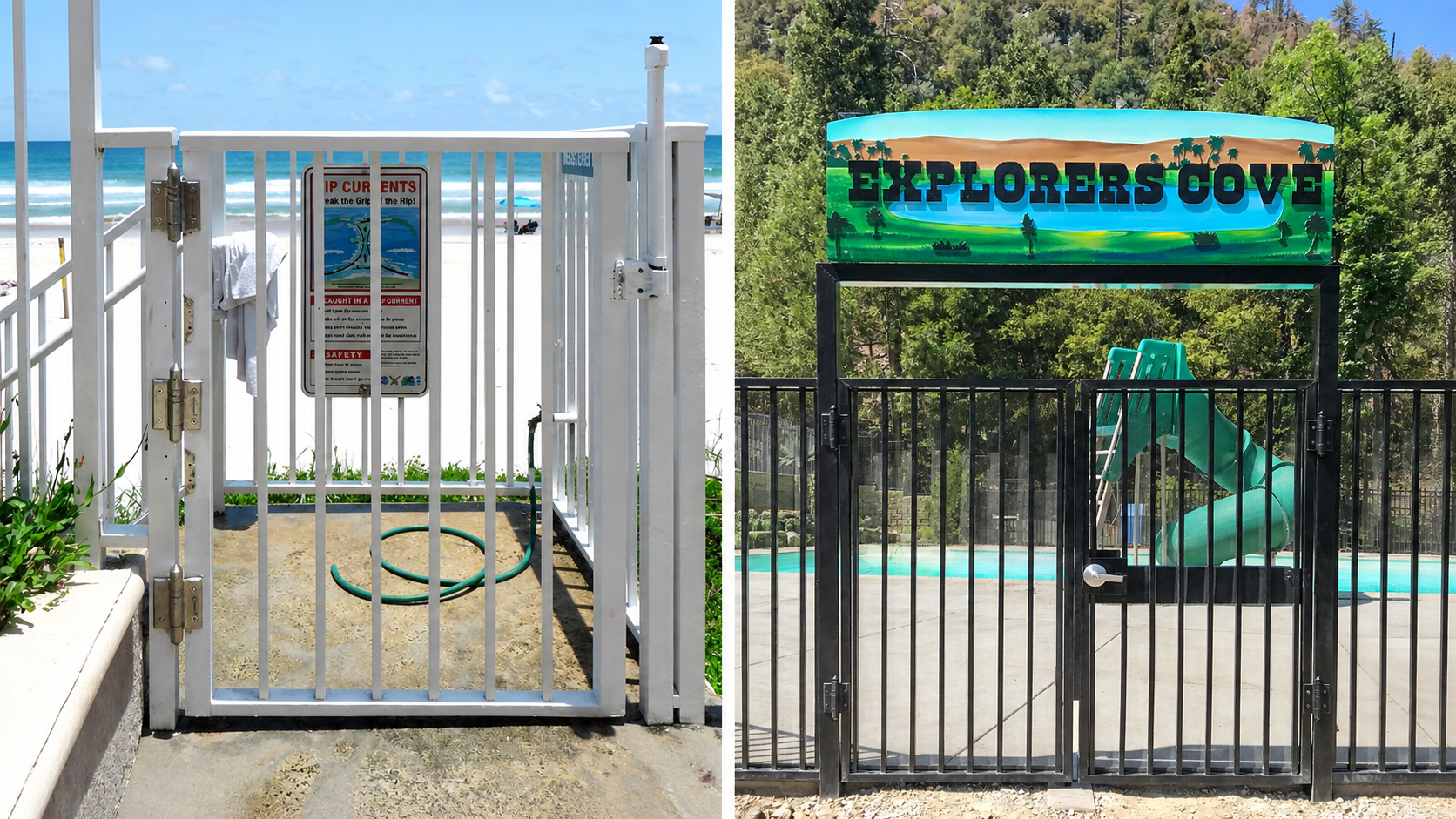
What Are the 4 Common Problems Coastal Environments Cause to Your Gate Hinges?
1. Salt Fog Causes Pitting Corrosion
Living near the coast means your gate hinges are constantly surrounded by salt-filled air. That salt sticks to any metal surface, pulls in moisture, and never really dries out. Over time, it creates tiny holes that eat through the metal from the outside in, and once that starts, there is no fixing it. Your hinge looks fine until it suddenly does not.
The only way to stop this is to use a material that salt cannot penetrate as easily. That is where 316 stainless steel comes in. Unlike standard 304 SS, 316 contains molybdenum, which makes it dramatically more resistant to this exact type of damage, even after years of direct coastal exposure.
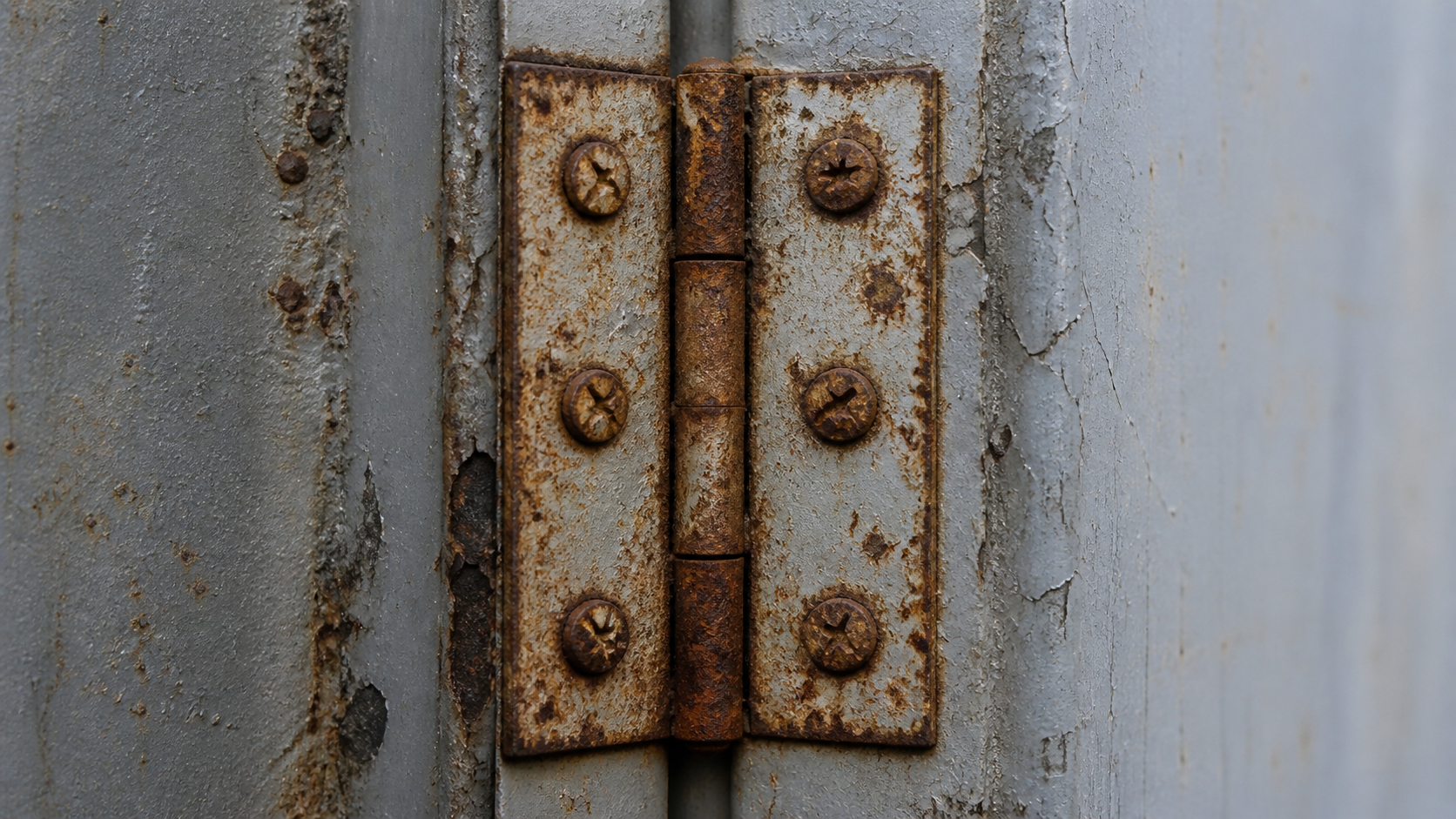
2. Tight Spaces Trap Chlorides and Drive Corrosion
Hinges have a lot of small gaps, under screw heads, between plates, and inside the barrel. Salt and moisture get into those spaces but cannot get back out, so they build up over time and corrode from the inside out. In these coastal areas, salt accumulates faster than the metal can recover, and structurally, the hinge barrel is almost an ideal environment for that to happen.
The problem is that you cannot see it while it is happening. The outside of the hinge still looks fine, but inside, the spring, pin, and bearing surfaces have already been compromised. To hold up against this, a hinge needs a fully concealed internal mechanism that gives salt and moisture no opportunity to accumulate in any gap.
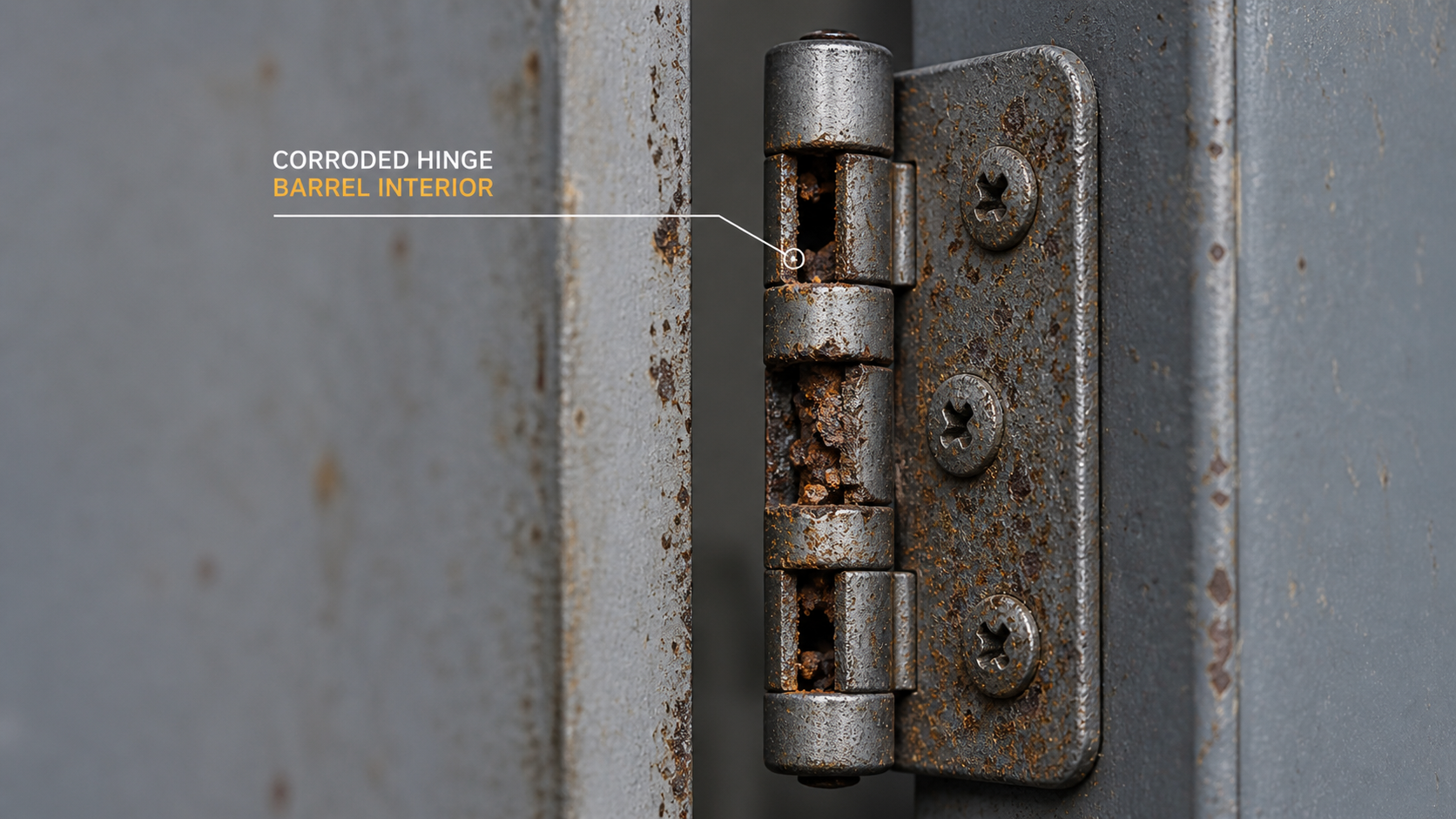
3. Dissimilar Metals Accelerate Everything
When two different metals contact each other in the presence of saltwater (one of the most efficient electrolytes available), the less noble metal corrodes at an accelerated rate. Common examples in standard hinge assemblies:
- Zinc-plated springs inside a stainless housing: zinc coating is attacked within one season, exposed steel corrodes underneath
- Aluminum closer arms with steel fasteners: galvanic reaction degrades the aluminum at every contact point
- Brass bushings against stainless barrels: accelerated corrosion at every bearing surface
The only reliable prevention is eliminating dissimilar metals from the assembly entirely, meaning all-stainless construction with no aluminum, no plastic, no zinc-plated internals.
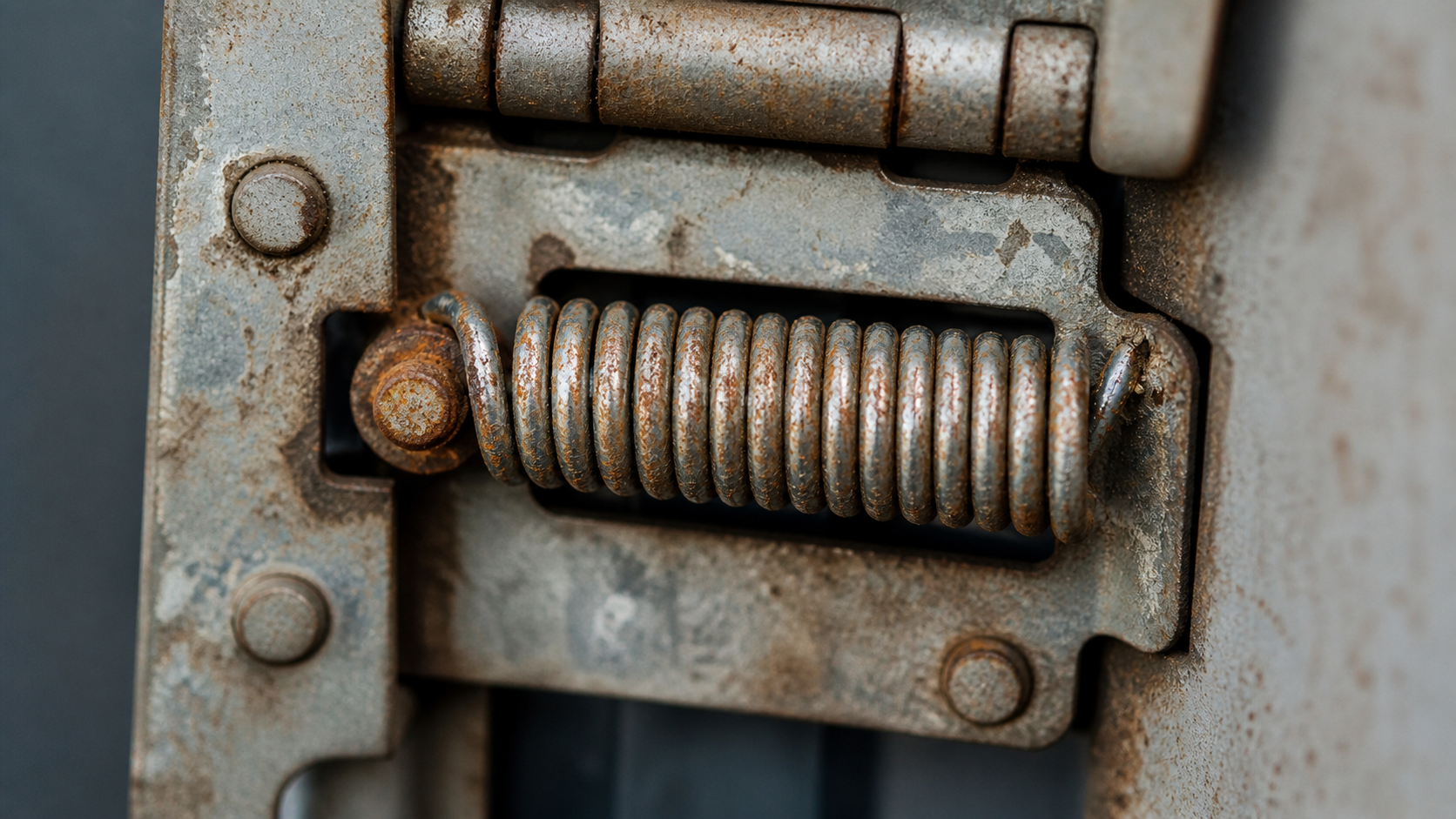
4. Coastal Wind Causes Structural Damage Without Speed Control
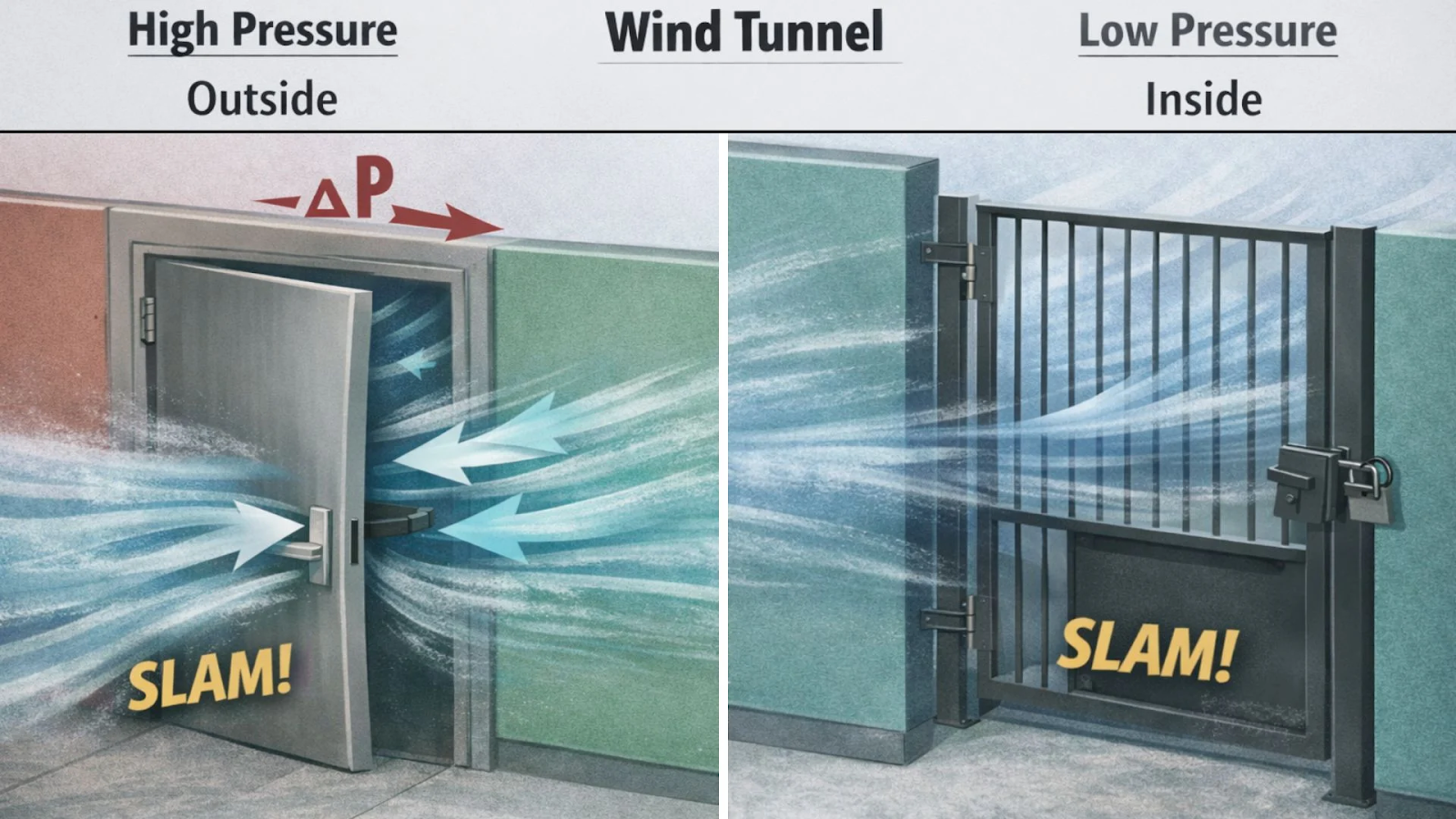
A gate without speed control in a coastal wind environment is a gate that slams. Sustained winds of 15-25 mph with gusts above 40 mph are routine in oceanside applications. Every uncontrolled slam transfers force directly into the frame, latch hardware, and hinge fasteners.
Standard spring hinges offer no wind resistance. They apply spring tension only, with no damping to resist wind-assisted acceleration. Over time, repeated slamming shears fasteners, distorts frames, and damages latch assemblies.
Is Your Coastal Pool Gate Actually Code-Compliant?
If the marine stainless hinge application is a pool gate, the International Swimming Pool and Spa Code (ISPSC) Section 305.3.3 mandates specific hardware performance, not just material:
- Self-closing from any open position, without human assistance
- Self-latching without manual engagement
- Outward-opening (away from the pool area)
- Latch release on the pool side, positioned at least 3 inches below the top of the gate
The compliance gap in coastal environments is timing. A gate can pass initial inspection with compliant hardware and fail to maintain that compliance after 12-18 months of salt air exposure. Corroded springs lose tension. Seized bearings prevent full closure. A gate that technically had a self-closing hinge stops functioning as one.
Code compliance in a marine environment requires hardware that maintains its performance over time, not just on installation day.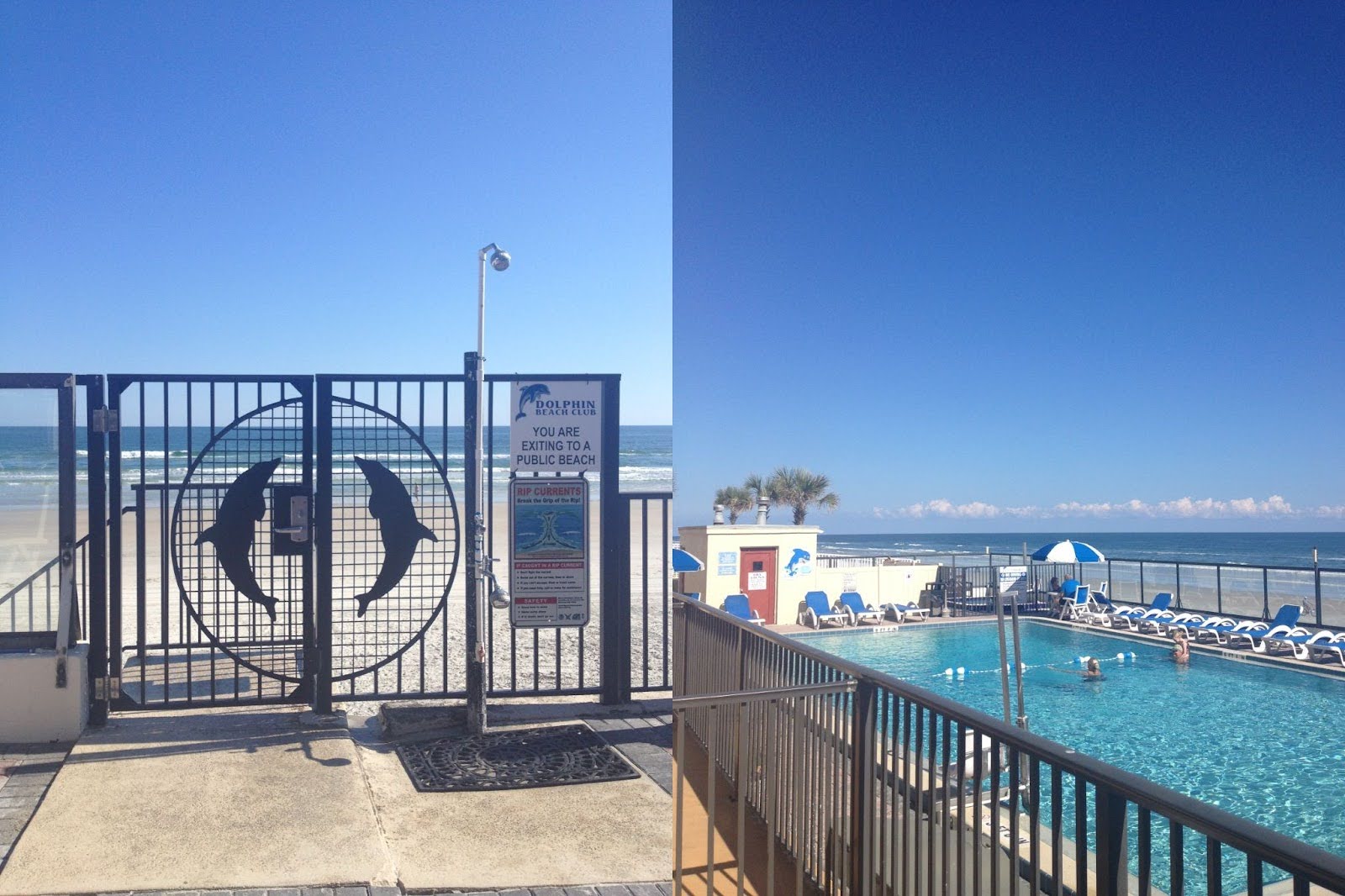
What to Require in a Marine Stainless Hinge Specification?
Before evaluating any product, confirm it meets these criteria:
| Criteria | Minimum Requirement |
|---|---|
| Material grade | 316 SS throughout (body, pin, internals) |
| Fastener material | 316 SS to match hinge metal |
| Salt spray rating | ASTM B117 200+ hours |
| Cycle certification | ANSI/BHMA A156.17 Grade 1 (1,000,000 cycles) |
| Speed control | Required for coastal wind |
| Self-closing function | Required for pool gates (ISPSC 305.3.3) |
| Dissimilar metals | None |
| Plastic components | None |
Why You Should Not Choose 304 Stainless Steel for Coastal Areas?
The most common failure point in this checklist is material grade. 316 stainless steel contains 2-3% molybdenum, which 304 lacks entirely. Molybdenum accelerates re-passivation at vulnerable surfaces, dramatically improving resistance to both pitting and crevice corrosion. In ASTM B117 accelerated salt spray testing, 316 SS outperforms 304 by roughly 10x under equivalent conditions.
How Waterson 316 Marine Stainless Hinges Address Each Failure Mode
Waterson’s 316 marine stainless gate hinge was built specifically for pool and marine environments. Here is how it maps to each failure mode above:
| Failure Mode | Waterson 316 marine stainless gate hinges |
|---|---|
| #1 Salt Fog Causes Pitting Corrosion | Investment casting 316 SS with 2-3% molybdenum resists chloride-induced pitting; ASTM B117 salt spray tested 200+ hours |
| #2 Tight Spaces Trap Chlorides | Fully concealed mechanism inside the hinge barrel; no exposed springs, pins, or bearing surfaces to trap chlorides |
| #3 Galvanic corrosion from dissimilar metals | All-stainless steel construction throughout: no aluminum, no plastic, no zinc-plated internals |
| #4 Wind slamming without speed control | Patented hydraulic hybrid mechanism combines spring force with oil damping in a single barrel; closing speed is field-adjustable |
| Pool gate code compliance is degrading over time | ANSI/BHMA A156.17 Grade 1 verified to 1,000,000 cycles; maintains self-closing and self-latching function throughout rated service life |
Besides that, Waterson 316 Marine Stainless Hinges also come with the following key features:
- Load capacity: 3 hinges support up to 260 lbs, 4 hinges support up to 330-440 lbs, depending on the hinge configuration.
- ADA compliant: Opening force under 5 lbs, closing speed over 5 seconds from 90 degrees, safe and accessible for all users.
- Adjustable tension: Swing speed and latch speed are controlled independently, both field-adjustable without removing the hinge.
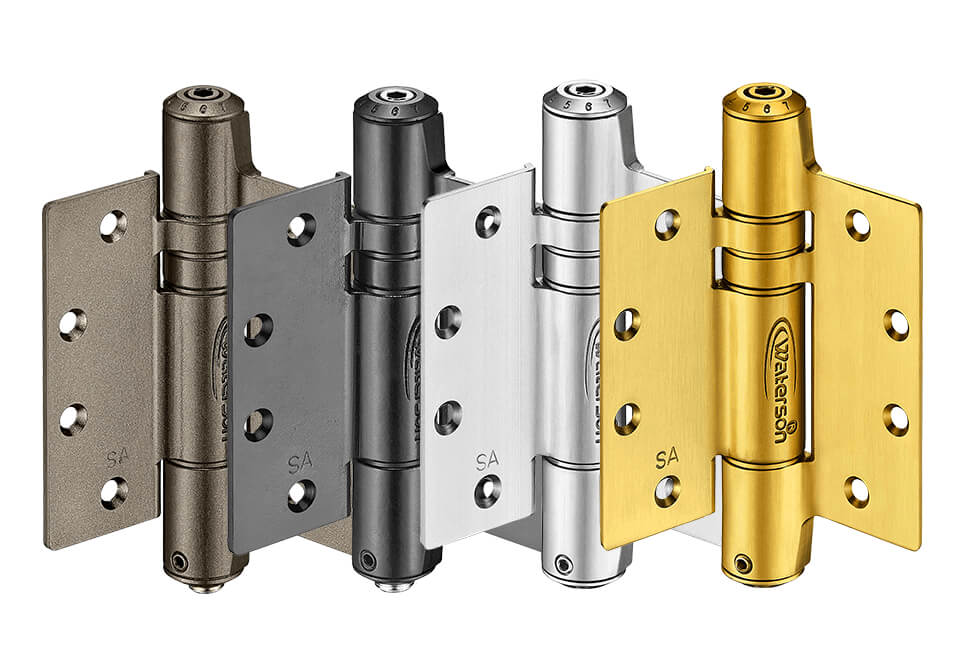
- Finish options: Available in 4 finishes: Satin, Black, Brass, and Bronze, all applied at the factory through a PVD process for additional protection against coastal exposure.
- Warranty: 10 years for mechanical models, 3 years for hydraulic models.
What Types of Marine Stainless Steel Gate Hinges does Waterson offer?
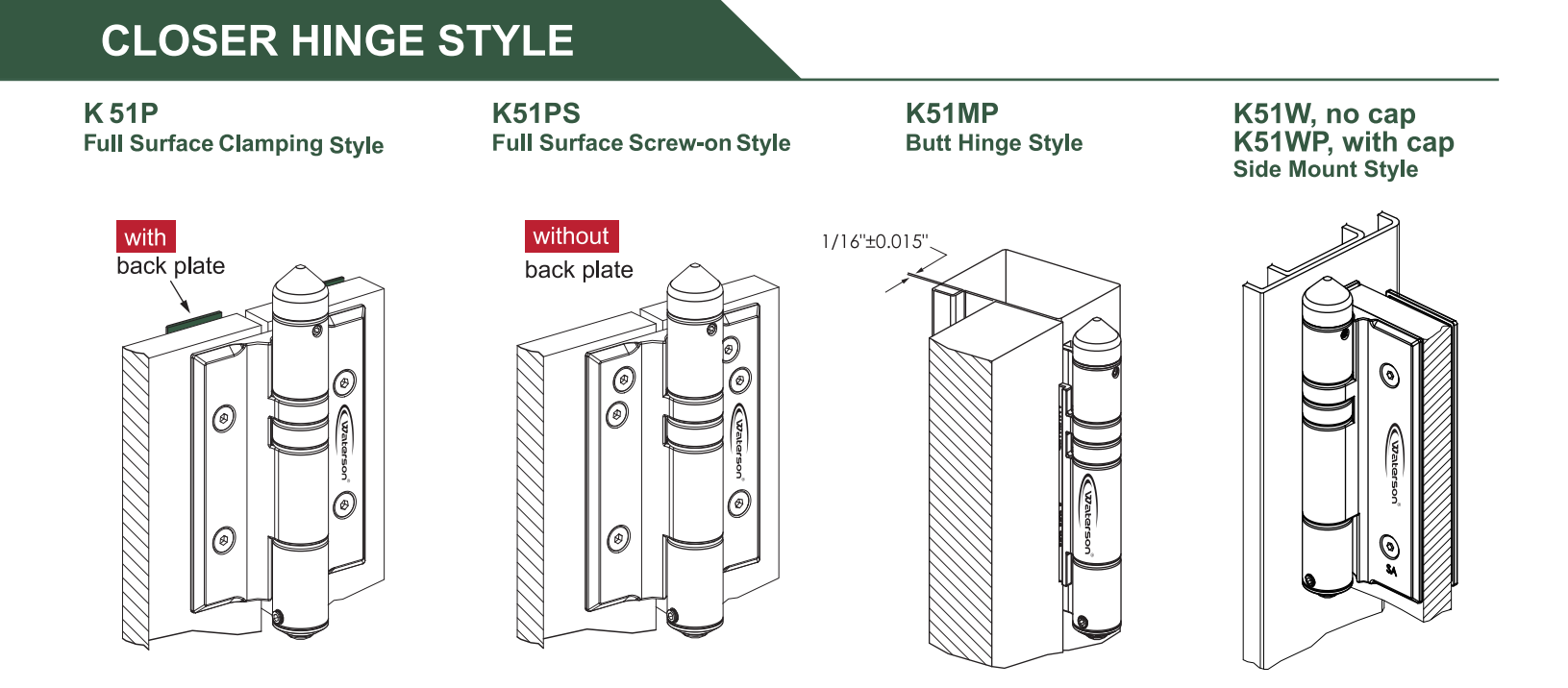
Waterson heavy duty marine stainless steel hinges are available in 4 mounting styles to fit different gate configurations, from surface-mounted posts to uneven planes. Whether you are specifying for a beachfront pool gate, a marina dock entry, or a coastal commercial building, there is a mounting style that fits without additional modification.
All styles are available in 316 stainless steel and can be custom-ordered to match specific project requirements.
How Many Marine Stainless Hinges Do I Need?
Start with gate height, then confirm by weight:
- Up to 60 inches: 2 hinges
- 60 to 90 inches: 3 hinges (supports up to 260 lbs)
- 90 inches and above: 4 hinges (supports up to 440 lbs)
Always use a matched set of the same hinge model. Mixing Waterson with commodity hinges creates alignment inconsistencies and negates the speed control calibration.
Two speed control configurations are available:
- Hydraulic (B/D sets): Oil-damped closing for high-wind coastal gates where wind-assisted acceleration is the primary concern
- Mechanical friction (A/C sets): Consistent tension-based control for applications requiring predictable closing force without fluid mechanisms
304 SS forms a chromium-oxide passive layer that resists general corrosion well in dry environments. In chloride-rich salt air, that layer is continuously attacked and cannot repair itself fast enough. Without molybdenum, pitting begins within months of exposure to coastal conditions.
Hydraulic speed control uses oil damping to resist closing acceleration, which is most effective against high wind gusts. Mechanical friction uses consistent spring-based tension. Both prevent slamming. Hydraulic is the preferred choice for gates exposed to sustained coastal wind.
Yes. A stainless hinge installed with zinc-plated or carbon steel screws creates a galvanic cell at every fastener point. Waterson includes 316 SS fasteners as standard. If you are specifying for an existing frame with mixed hardware, request a full 316 SS fastener set.
Waterson 316 Marine Grade Stainless Steel Gate Hinges
Waterson 316 marine stainless hinges combine the function of an overhead closer and a hinge into a single, sleek component—complete with optional hold-open and door-stop features. Designed for commercial openings, gates, and glass doors, these hinges are easy to install and adjust to meet ADA and ICC A117.1 standards for opening force, while ensuring quiet and secure closure. Crafted from durable stainless steel, they are NFPA 80 compliant, UL 3-hour fire-rated, and built to perform reliably in both interior and all-weather exterior environments. See all our features.
In addition to these performance advantages, Waterson offers custom hinge services. As a direct manufacturer, we can tailor hinge sizes, finishes, and especially hinge leaf designs to meet the specific structural needs of your doors. This makes our hinges an ideal solution for door manufacturers seeking custom options that integrate seamlessly with their existing frames.
Request For Quote
Please note that Waterson Closer Hinges start from a size of 4″x4″. If you’re in need of smaller self-closing hinges, we’d recommend checking out some other resources! Also, we only provide single acting closer hinges. Thank you.
Recent Post
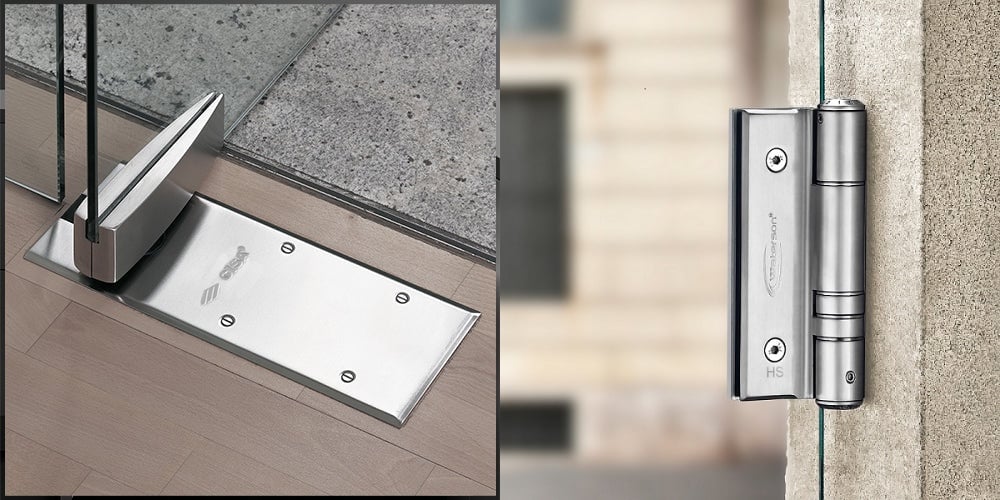
Glass Door Hinges: Floor Spring vs Spring Hinge Compared
Quick Answer Floor hinges (also called floor springs) are hydraulic closers set into the floor slab for center-hung or double-acting glass doors with fully concealed [...]
Stainless Steel Spring Hinges: Self-Closing Hinges for Interior and Exterior Doors
Quick Answer A stainless steel spring hinge is a self-closing hinge with a torsion spring inside the barrel, so it swings the door and closes [...]
Cold Weather Gate Hinges: How Waterson Performs in Winter
When winter comes, temperatures drop, and outdoor fence gates start to behave differently. Wood absorbs moisture and swells, metal contracts slightly, and hardware components shift [...]