
Picture this: a wheelchair user trying to enter a public restroom on their own. One hand is on the wheel, the other has to pull the door. If the door is too heavy, they cannot pull it open. If it closes too fast, it hits the wheelchair before they can get through. If the opening is not wide enough, the wheelchair simply does not fit.
This is not a rare situation. And this is exactly why a public restroom door is not an ordinary door. It has to meet a specific set of technical requirements, not to look good or make things easier for the designer, but to actually be usable by everyone, at every age and every level of physical ability.
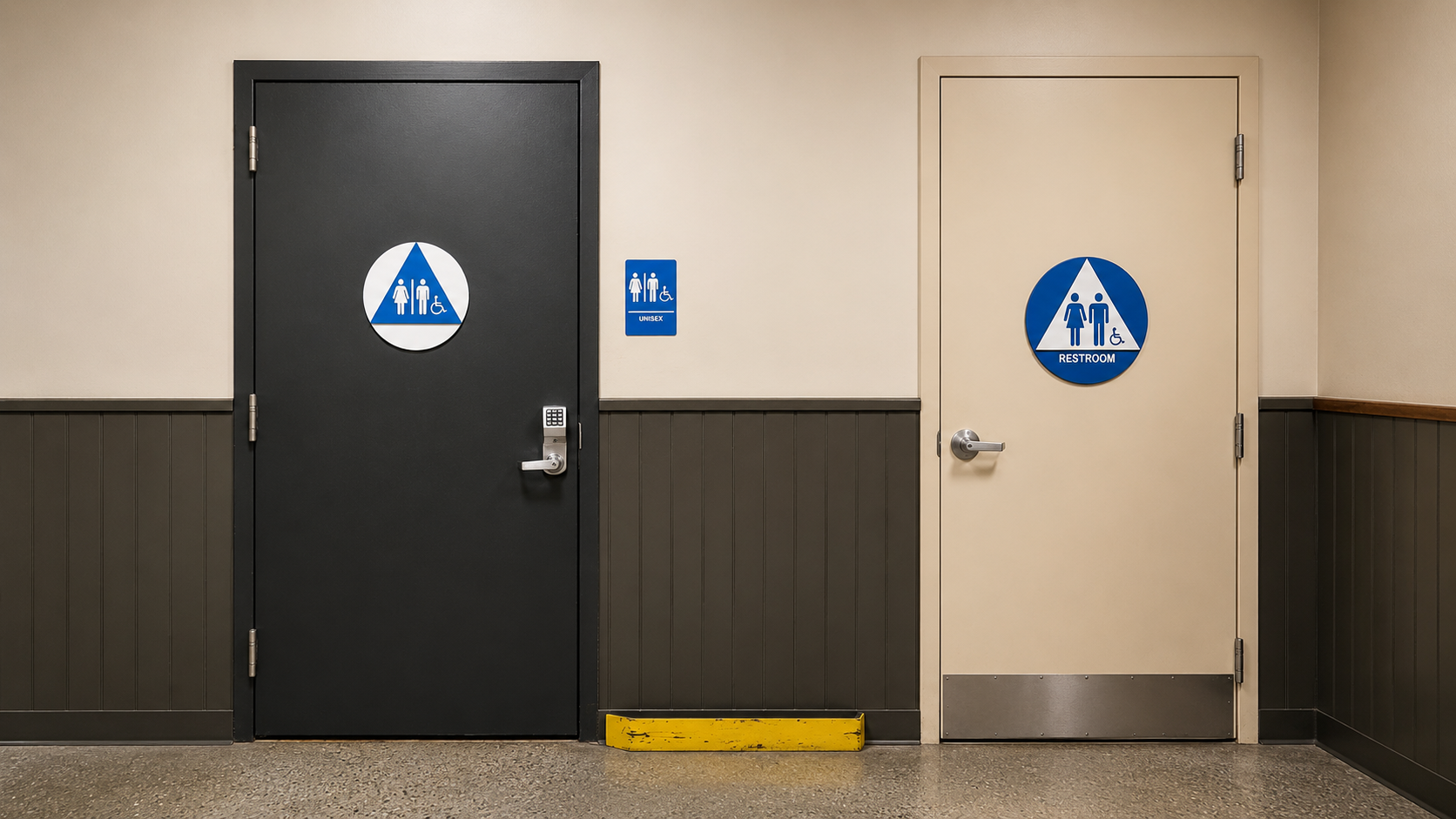
Why Does ADA Compliance Matter So Much for Restroom Doors?
“We’re upgrading the restroom at our center. Door is 1″ solid wood, pilasters are black powder coated metal at 1-1/4″ thick. We need the door to close slowly, you know, we have elderly visitors and wheelchair users coming in, so I guess we need ADA compliance too. Do you support this?”
This is one of the most practical questions facility managers and contractors ask when starting an ADA upgrade, and the answer goes beyond a simple yes or no. Before any spec decision gets made, ADA Section 404.2.9 combined with ICC A117.1 sets out three numbers everyone on a restroom project needs to know:
- Maximum opening force: 5 lbs (22 N) for interior doors (ADA 309.4).
- Minimum closing speed: At least 5 seconds from the 90-degree open position to 12 degrees from the latch (ICC A117.1, Section 404.2.9).
- Minimum clear opening width: 32 inches when the door is open at 90 degrees (ADA 404.2.3).
Three numbers that sound straightforward. The challenge is that all three have to be met at the same time, by the same hinge configuration.
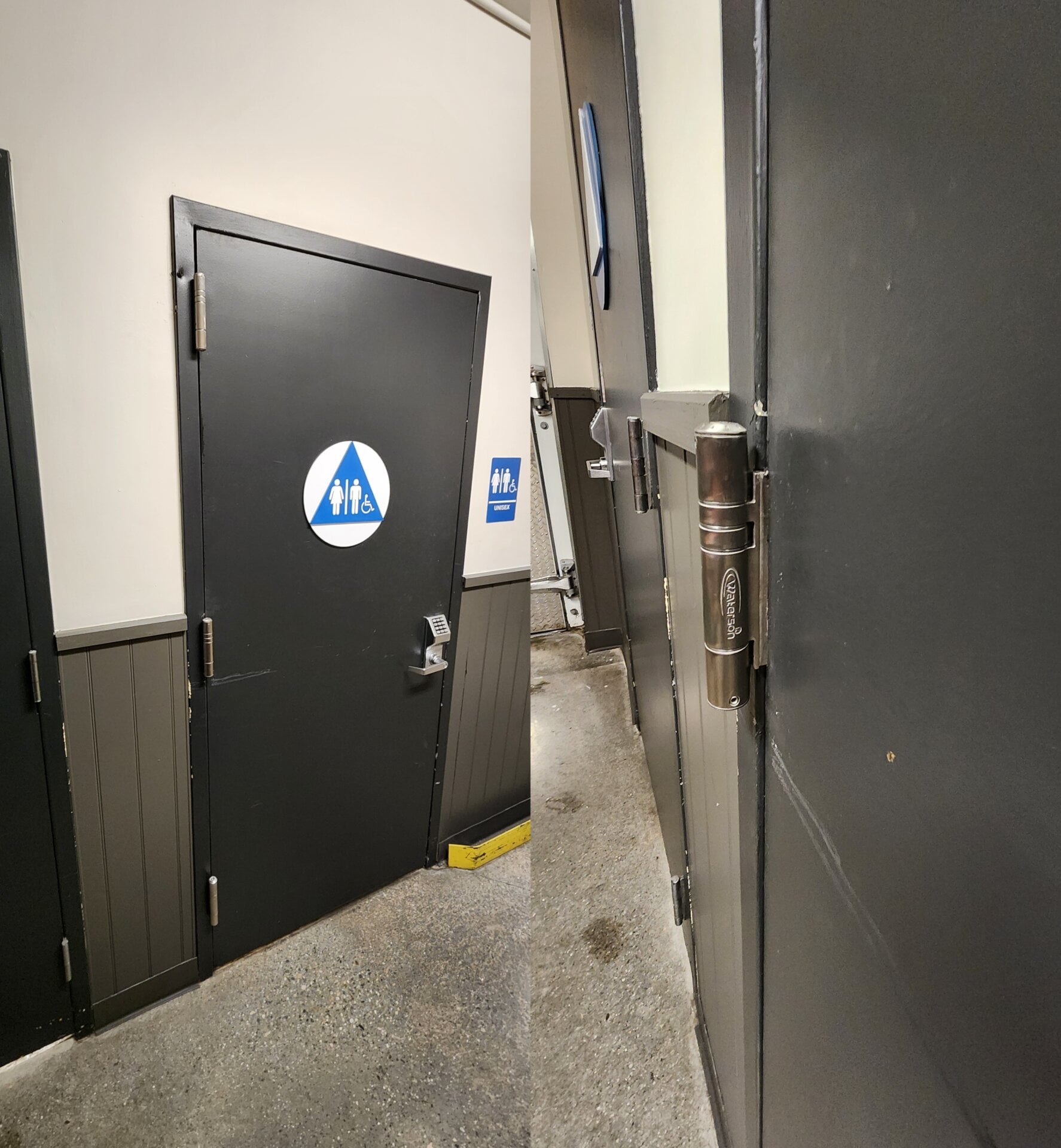
So, What Is the Problem with Traditional Hinges?
The traditional spring hinge was the go-to choice for restroom projects for years, cheap, easy to install, and self-closing. But its mechanism creates one internal contradiction that is hard to get around: a spring creates a single tension force that both pulls the door shut and resists someone trying to open it. Make it stiff enough to latch reliably, and the opening force already exceeds 5 lbs, which fails ADA.
And with no speed control whatsoever, the door almost always closes faster than 5 seconds, which fails ADA on closing time, too. Not to mention the slamming, hundreds of times a day in any busy facility.
What Is the Difference Between Self Closing and Soft Closing?
Self-closing means the door returns to the closed position on its own after being opened, without the user having to pull or push it again. This is a mandatory requirement under ADA 604.8.2 for public restroom doors. Traditional spring hinges do this, but with no control over speed.
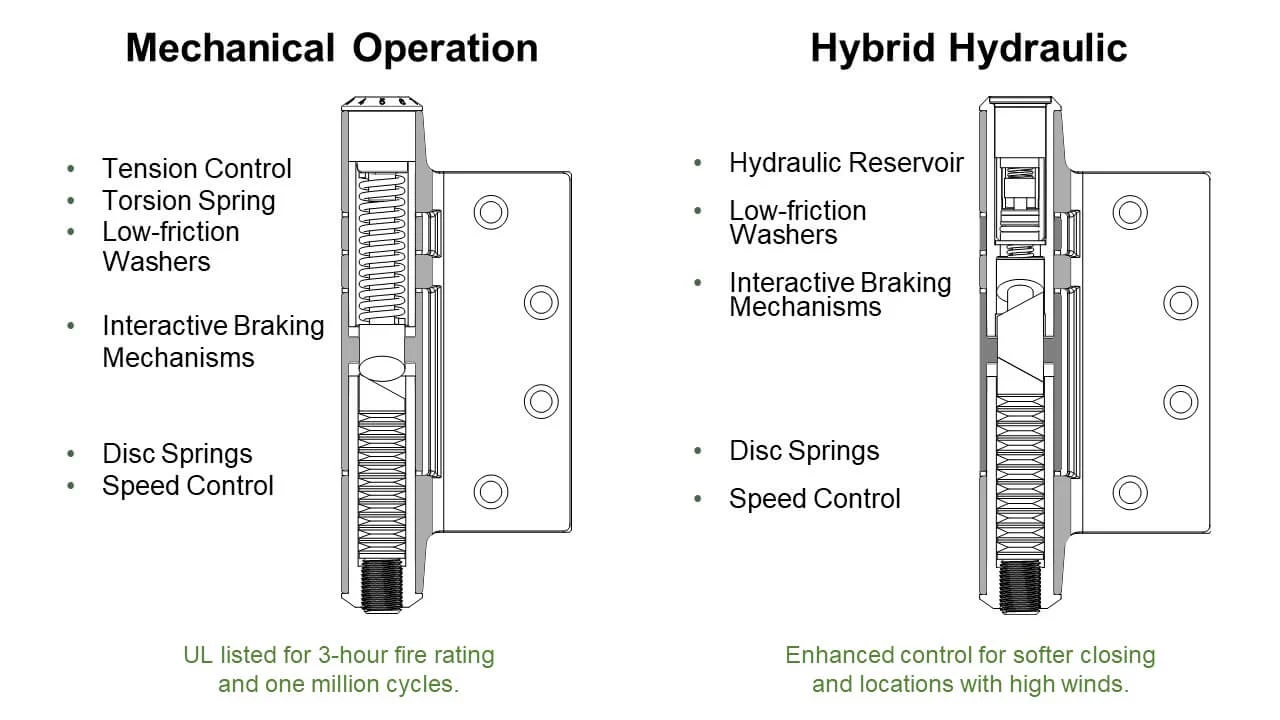
Soft closing means the door self-closes at a controlled speed, through a hydraulic or mechanical-hydraulic hybrid mechanism. This is what allows the door to meet the 5-second closing time required by ADA without needing excessive opening force.
This difference is very important for any ADA project because ADA does not just require the door to self-close. It also sets a specific minimum for how slowly it must close. With traditional hinges, they close too fast and cannot meet this requirement. This is why a new-generation slow-closing hinge is the right choice for any restroom project with ADA compliance requirements.
Beyond Speed and Opening Force, Are There Other Requirements?
Under ADA 404.2.3, the door must provide at least 32 inches clear opening at 90 degrees. A standard butt hinge eats into that clearance, and a 34-inch door that theoretically gives 32.25 inches can easily drop below 32 inches once hinge leaf and installation tolerances are factored in. An ADA compliant hinge solves this by pushing the door entirely outside the frame footprint when opened.
Beyond the hinge itself, two more requirements directly affect how the door gets installed:
- Wheelchair turning space (ADA 603.2.1): Minimum 60-inch diameter circle, or a 60 x 60-inch T-shaped space. The door can swing into this area but not into fixture clearance zones, which affects swing direction and hinge placement.
- Door hardware (ADA 309.3 and ADA 308): Operable with one hand, no tight grasping or wrist twisting, mounted no higher than 48 inches from the finished floor. Lever handles are the standard choice here.
Why Does Hinge Material Also Affect Long Term Compliance?
ADA compliance is not something you achieve on inspection day and then forget about. High humidity, daily cleaning chemicals, and heavy traffic will wear down a lower-quality hinge over time, and when the mechanism shifts, closing speed shifts with it. The door may no longer meet ADA standards even if it was installed correctly from day one.
Going back to the 1-inch solid wood door and 1-1/4-inch black: both are common materials and fully compatible with a self-closing ADA compliant setup, as long as the hinge has the right leaf size, the right mounting configuration for each material, and enough adjustability to fine-tune force and speed after installation.
When Should a Restroom Project Reconsider All Its Door Hardware?
Most renovation or ADA upgrade projects need a second look, because most buildings built before 2010 were fitted with hardware that does not fully meet current requirements. Therefore, the clearest signs you need a retrofit are:
- The door requires more than 5 lbs to open
- The door closes in under 5 seconds
- Actual clear opening measures below 32 inches
- The handle is a round knob
- Hinges are showing rust, and the closing speed has shifted over time
If a restroom upgrade project has any of those issues, replacing the hinges is a step that cannot be skipped and must occur before any decisions about finishes or aesthetics are made.
When an ADA Public Restroom Door Hinges Work Right, There Is No Compromise
“The hinges kind of look intimidating, but actually, they were rather easy to install. Instructions were clear and easy to follow, especially for someone who’s never installed hinges before.
…
Since we started doing ADA upgrades, these self-closing hinges have been a game-changer.”
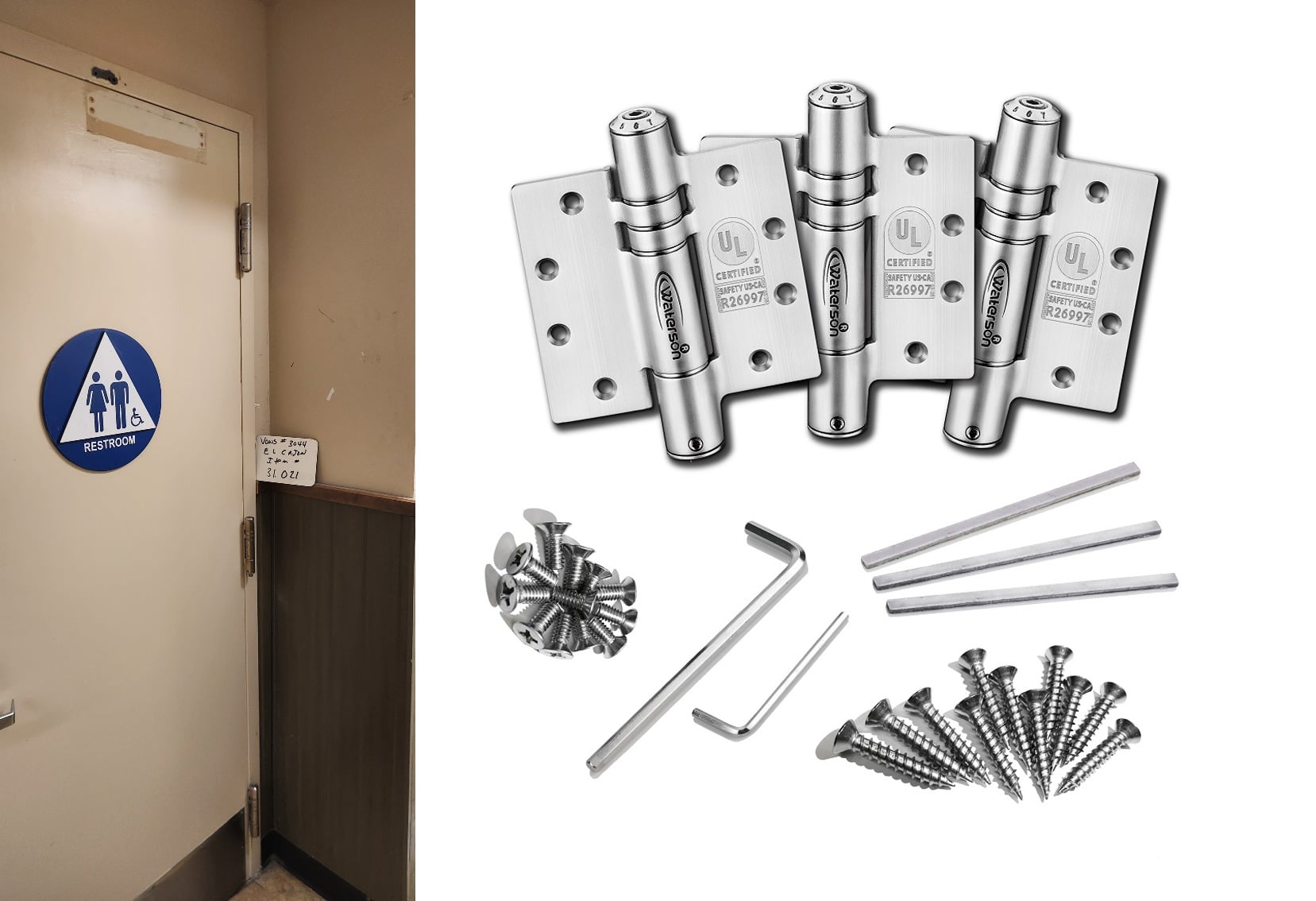
Waterson ADA compliant public restroom door hinges combine the reliability of a door closer with the simplicity of a standard hinge, making ADA compliance easier to design for and smoother to operate in practice. The features most directly relevant to restroom applications:
- ADA Compliance: Opening force under 5 lbs, closing time over 5 seconds, and 33 inches ADA clearance guaranteed with swing-clear configuration.
- Soft Close / Self Closing: Eliminates door slamming entirely, protecting both the frame and users in a tight space.
- 90° Hold Open: Gives users enough time to enter and get settled without the door closing in on them.
- Stainless Steel 304/316: Resistant to moisture and cleaning chemicals, maintaining consistent performance over time without compliance drift after the first few years.
- Adjustable Tension: Fine-tunable for force and speed after installation, compatible with both 1-inch solid wood doors and 1-1/4-inch metal pilasters.
- Concealed Design: No bulky arms or brackets, suitable for spaces with high aesthetic requirements.
- Custom Finish: Satin, Black, Brass, Bronze, matching any interior scheme.
- ANSI/BHMA A156.1: Tested to 1,000,000 cycles, built for high-traffic facilities.
- Easy Install: No overhead installation required, fits like a standard hinge.
- Warranty: 10 years for mechanical self-closing, 3 years for hydraulic soft-closing.
Waterson Self Closing ADA Public Restroom Door Hinges
Waterson self closing ADA door hinges combine the function of an overhead closer and a hinge into a single, sleek component—complete with optional hold-open and door-stop features. Designed for commercial openings, gates, and glass doors, these hinges are easy to install and adjust to meet ADA and ICC A117.1 standards for opening force, while ensuring quiet and secure closure. Crafted from durable stainless steel, they are NFPA 80 compliant, UL 3-hour fire-rated, and built to perform reliably in both interior and all-weather exterior environments. See all our features.
In addition to these performance advantages, Waterson offers flexible custom hinge services. As a direct manufacturer, we can tailor hinge sizes, finishes, and especially hinge leaf designs to meet the specific structural needs of your doors. This makes our hinges an ideal solution for door manufacturers seeking custom options that integrate seamlessly with their existing frames.
Request For Quote
Please note that Waterson closer hinges start from a size of 4″x4″. If you’re in need of smaller self-closing hinges, we’d recommend checking out some other resources! Also, we only provide single acting closer hinges. Thank you.
Recent Post
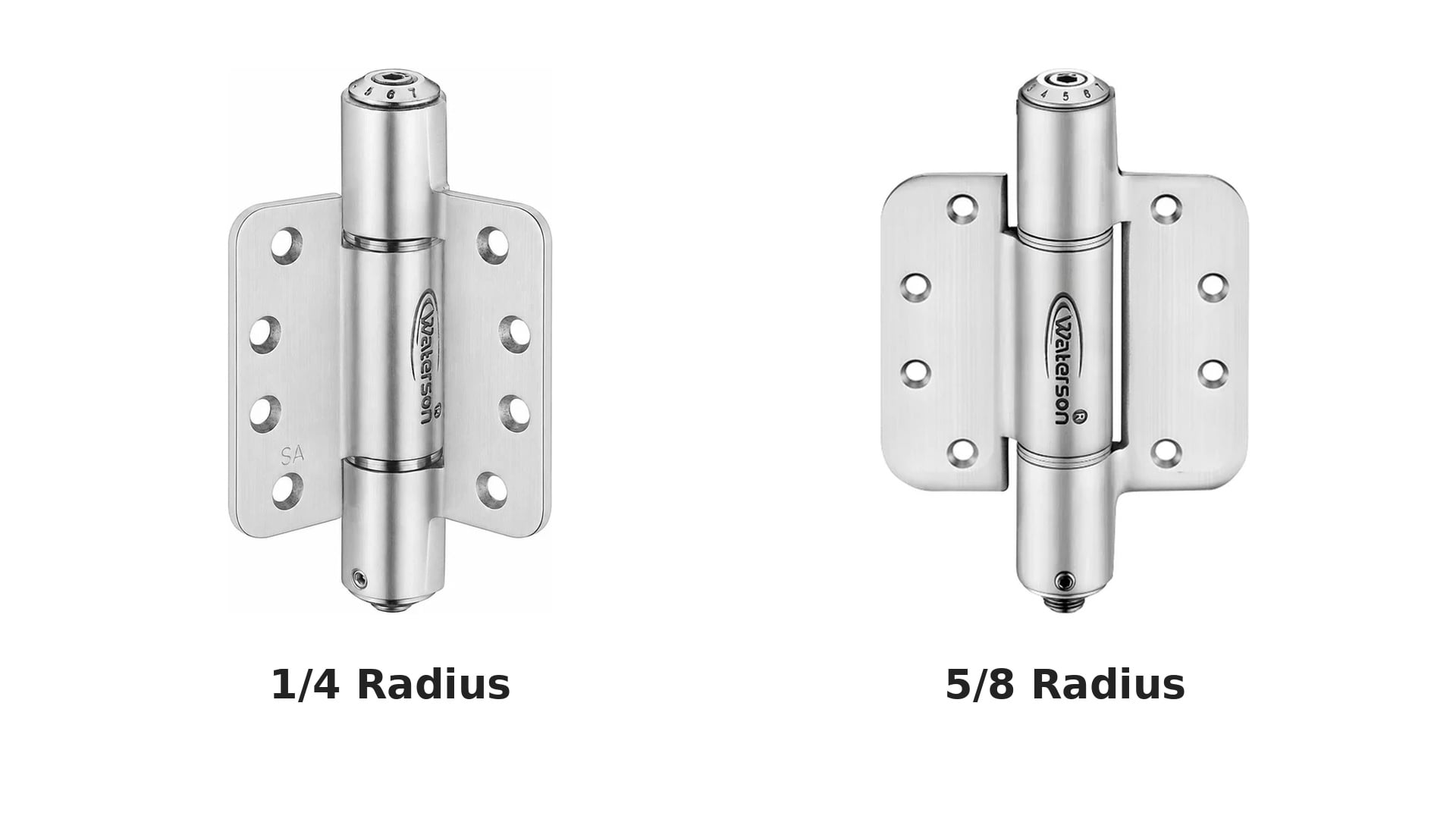
Replacing Door Hinges: 1/4 vs 5/8 Radius vs Square Corners
Quick Answer Most 4 inch residential door hinges have one of three corners: square, 1/4" radius, or 5/8" radius. A rounder hinge fits a mortise [...]
Why Won’t My Self Closing Door Hinges Close in Cold Weather
Quick Answer An exterior door that closes fine in summer but won't latch in winter is usually affected by two things: weather stripping that stiffens [...]

Soft Closing Hinges: 9 Most Frequently Asked Questions
Since the AIA in 2018, there has been an increased interest in Waterson hinges for many different projects. We have been inundated with questions by [...]