
Project Description
Quick Answer
Aluminum doors do not self-close on their own, and the usual fixes (an overhead closer arm or an offset pivot with a floor closer) need room or floor work a tight opening may not allow. A self-closing aluminum door hinge builds the closing action into the hinge itself, so the door closes on its own with no overhead arm and no floor cutting. The National Architect Association used Waterson self-closing hinges on their aluminum double doors: three hinges, self-closing plus hydraulic buffer plus hold-open in one unit, UL certified and tested to 1 million cycles.
“We have aluminum double doors in a low-ceiling entry. They need to self-close, but there is no room for an overhead closer arm, and we would rather not cut the floor for a floor closer. What are our options?”
That question comes up on almost every aluminum door project, because the door material is the easy part and the closing hardware is where openings get stuck. Below is how aluminum doors normally close, where each method runs out of room, and how the right aluminum door hinges solve it in a single component.

Why Is Self-Closing So Hard to Add to an Aluminum Door?
An aluminum door will not return and latch on its own. Something has to pull it closed, and on aluminum storefront and double doors that something is almost always a separate device: an overhead closer, a surface top-jamb closer, or a floor closer working with offset pivots. Each one needs space or structure that a constrained opening may not have.
A low ceiling or a deep transom leaves no clean line for an overhead closer arm. A tight corner or a back-to-back pair of doors leaves the arm swinging into something. And a floor closer means cutting the slab, which is costly on a retrofit and off the table entirely on a finished floor. So the door is simple, but making it self-close without one of those trade-offs is the real problem.

What Hardware Do Aluminum Doors Normally Use, and Where Does Each One Fall Short?
Most aluminum doors hang on one of four systems. The difference that matters is not how they carry the door, it is how they handle the closing, because that is the part that fails or does not fit.
| Hardware | How it self-closes | Where it falls short |
|---|---|---|
| Offset pivots + floor closer | Floor-mounted closer returns the door | Slab cutting to install; the floor unit corrodes in salt and weather and is expensive to replace |
| Overhead closer (OHC or top-jamb) | Surface arm returns the door | The arm needs headroom and swing clearance a low ceiling or tight corner does not give |
| Geared continuous hinge | Does not self-close on its own; still needs a closer | Solves sag, not closing; the face must be at least 7/8″ wide to mount |
| Self-closing hinge | Closing is built into the hinge barrel | Needs a stile that can take a full mortise hinge; confirm stile width first |
The pattern is clear: with the first three, the closing job is handed to a separate part that either eats space, cuts the floor, or rusts out. The fourth removes that part entirely.

How Did the National Architect Association Solve Their Aluminum Door Closing Problem?
The National Architect Association needed a durable, small-footprint way to self-close their aluminum double doors, in a space where a traditional overhead closer did not fit the low-ceiling, tight-corner layout. After reviewing the constraint, the Waterson team specified the K51M aluminum door hinge, three per door, delivering self-closing, hydraulic buffering, and hold-open in one compact unit with no overhead arm. [CONFIRM MODEL WITH YOUR TEAM before publishing.]
Two things closed the decision. First, the install: the complete hinge goes in with a single screwdriver, with no need to rework the floor or the door and no arm hanging overhead. Second, the durability: the hinge is UL certified and passed a 1 million cycle test. For a professional body specifying hardware others would copy, both mattered, and the chief officers chose Waterson.

Which Waterson Features Matter Most for Aluminum Doors?
Not every hinge feature is relevant to an aluminum opening. These are the ones that decide the job:
- Closing built into the hinge, so there is no overhead arm to fit under a low ceiling and no floor closer to cut in.
- Single-screwdriver install with no floor or door rework, which is what makes it viable on a retrofit or a finished space.
- Self-closing plus hydraulic buffer plus hold-open in one unit, so the door closes controlled, does not slam, and can stay open when needed.
- UL certified, tested to 1 million cycles, rated for the daily traffic a commercial aluminum entry sees.
- Stainless steel construction, so it holds up in exterior and coastal aluminum door applications where floor closers corrode.
- ADA and ICC A117.1 opening force compliance, adjustable so the door meets the 5 lb opening-force target where required.
One honest note for spec accuracy: Waterson closer hinges start at 4″ x 4″ and are full mortise, so they suit medium and wide stile aluminum doors, or aluminum doors that can accept a mortised hinge. On a narrow-stile storefront door, confirm the stile width first, or ask about the aluminum mortise line.
Waterson Stainless Steel Aluminum Door Hinges
Waterson Aluminum Door Hinges combine an overhead closer and hinge into one attractive component with optional hold-open and door stop features. These hinges are ideal for commercial openings, gates, and glass doors. The hinges are easily installed and adjusted to comply with ADA & ICC A117.1 requirements for opening force and to assure quiet, secure closing. Made with stainless steel, Waterson closer hinges meet NFPA 80 and are UL 3-hour fire-rated, as well as being suitable for both interior and all-weather exterior openings. See all our features.
In addition to these performance advantages, Waterson offers custom hinge services. As a direct manufacturer, we can tailor hinge sizes, finishes, and especially hinge leaf designs to meet the specific structural needs of your doors. This makes our hinges an ideal solution for door manufacturers seeking custom options that integrate seamlessly with their existing frames.
Request For Information
Recent Post
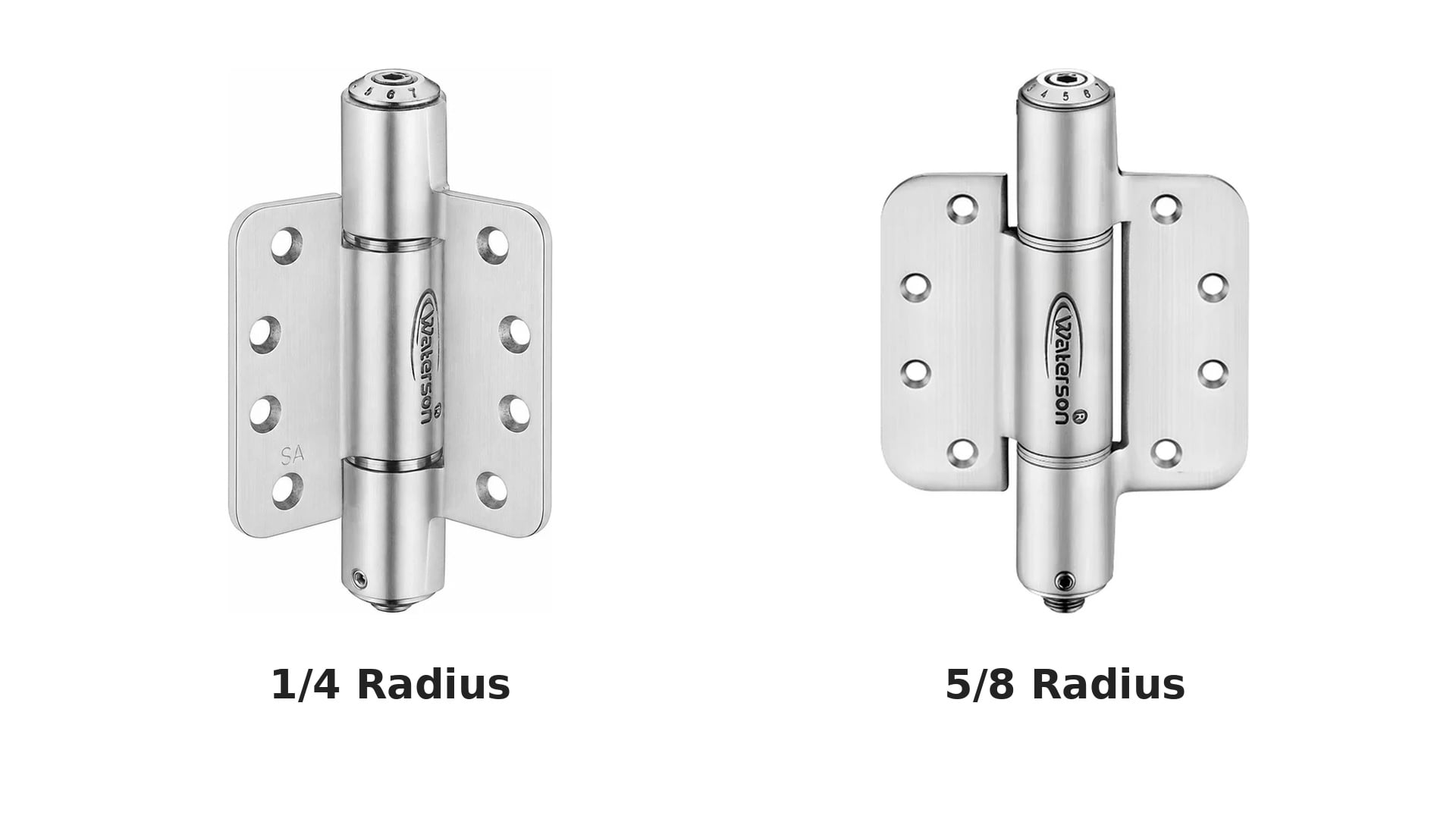
Replacing Door Hinges: 1/4 vs 5/8 Radius vs Square Corners
Quick Answer Most 4 inch residential door hinges have one of three corners: square, 1/4" radius, or 5/8" radius. A rounder hinge fits a mortise [...]
Why Won’t My Self Closing Door Hinges Close in Cold Weather
Quick Answer An exterior door that closes fine in summer but won't latch in winter is usually affected by two things: weather stripping that stiffens [...]

Soft Closing Hinges: 9 Most Frequently Asked Questions
Since the AIA in 2018, there has been an increased interest in Waterson hinges for many different projects. We have been inundated with questions by [...]