
Quick Answer
Yes, in most U.S. jurisdictions. The 2021 IRC (R302.5.1) requires the door between an attached garage and the house to be self-latching and equipped with a self-closing or automatic-closing device. Self-closing only meets the minimum. Adjustable swing and latch speed control stops airflow slamming without losing positive latching.
“Hello. It’s just a standard residential house entry door from the garage. We have little ones. And the airflow constantly slams the door. Just waiting for the fingers to be in the wrong spot…
…They are self closing currently. But do not provide enough reactance at times.”

Do Garage Doors Need to Be Self Closing?
Yes. Self-closing is required by the building code. For attached garages, the door leading into the house must be self-closing to maintain a fire and CO barrier between the garage and living space.
The garage is one of the most common sources of residential fires. Garages typically contain flammable materials: gasoline, paint thinners, propane, and cars that produce carbon monoxide.
The self-closing requirement exists because people forget to close doors. In a fire, even a small gap allows flames and toxic smoke to spread into the living space within minutes. A self-closing door removes human error from the equation.
There’s also the CO risk: if a vehicle is left running in the garage, carbon monoxide can silently seep into the home through any gap in an open door.
What Does the Building Code Actually Say?
The International Residential Code (IRC) is the most widely adopted residential building code in the U.S. Section R302.5.1 governs the door between your garage and your home.
According to the 2021 IRC (R302.5.1), the garage entry door must meet all three of the following requirements:
- Door material: Must be a solid wood door (min. 1-3/8″ thick), a solid or honeycomb-core steel door (min. 1-3/8″ thick), or a 20-minute fire-rated door
- Self-latching: Must latch automatically when closed
- Self-closing or automatic-closing device: Must close on its own every time
Beyond the self-closing device, the door itself must meet a minimum fire resistance standard. A 20-minute fire rating means the door can withstand fire for at least 20 minutes. This rating gives the occupants critical time to escape. This is also why door hardware, including hinges, must be NFPA 80 compliant to maintain the integrity of the full fire door assembly.
The self-closing requirement was formally added to the IRC in 2012. Homes built before 2012 may not have been required to comply at the time of construction, but local amendments vary. Always check with your local Authority Having Jurisdiction (AHJ).
Why Self Closing Alone May Not Be Enough
Meeting code is the floor, not the ceiling. A basic spring hinge pulls simply automatically pulls the door shut. But they don’t:
- Control door speed to the very best
- Prevent slamming from airflow or careless closing
- Reduce noise or impact
- Protect fingers—especially little ones
If your garage entry door slams, you need adjustable speed control, not just spring force. You need a soft closing mechanism.
That is When Our Client Switching to Soft-Close Garage Door Hinges
Our client’s concern was simple but urgent: their garage entry door was slamming shut from air pressure, and with young kids around, finger injuries were a real risk. Even though the door had a basic self-closing hinge, it lacked control.
That’s when they made the switch to Waterson Soft Close Garage Door Hinges: a smart, heavy-duty upgrade designed for both safety and comfort.
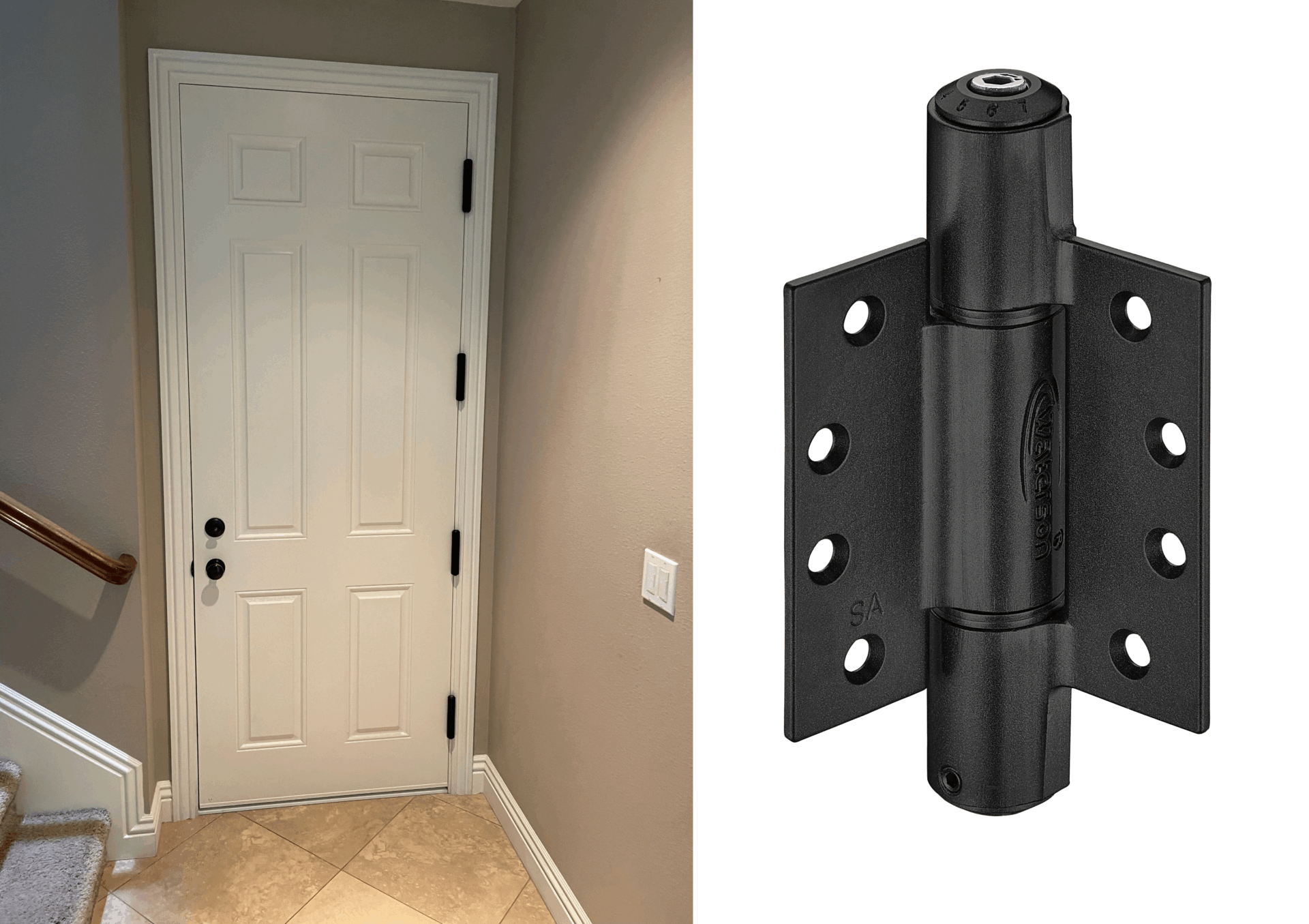
When Your Garage Door Needs More Than Just a Spring Hinge
For homes that need reliable code compliance and real-world safety, Waterson self close and soft-close garage door hinges combine both self-closing and anti-slam technology in a single, sleek hinge: no bulky overhead closer required.
Whether you choose self-close or soft-close, both hinge types are built for reliability in demanding settings.
-
- High-Frequency Use: Meet ASNI/BHMA A156.17 Grade 1 Standard. Tested up to 1 million cycles.
- Fire Rated: Certified for fire door compliance
- Hold-Open: Available for both—see Waterson Catalog for the right setup.
While both offer reliable performance, the key differences come down to how they control speed, absorb impact, and handle latch resistance as follows.
| Feature / Application | Mechanical Self Close | Hydraulic Hybrid Soft Close |
|---|---|---|
| Operation Mechanism | Torsion spring + disc springs + tension control | Torsion spring + hydraulic reservoir + fluid damping |
| Closing Style | Firm, consistent closing | Smooth, gradual, and quiet |
| Door Sizes & Weight | Up to 4×8 ft / 330 lbs, and more | Up to 4×8 ft / 260 lbs, and more |
| Noise Control | Moderate. Audible snap in final close | Excellent. Whisper-quiet, ideal for quiet spaces |
| Wind Resistance | Strong. Performs well even in gusts | Adaptive. Absorbs wind shocks and sudden pressure changes |
| Anti Slam | Spring-controlled (may slam if airflow is strong) | Hydraulic damping absorbs force to prevent slamming |
| Durability & Warranty | 10-year warranty | 3-year warranty |
| Ideal Applications | Fire doors, hotel rooms, arch tops, courtyard doors | Offices, courtroom gates, French/glass frameless doors |
| Latch Resistance | Excellent. Supports heavy-latch systems | Not ideal for heavy-latch resistance |
| Quiet Room Compatibility | Good. May produce impact noise | Better. Extremely low noise, even in tight rooms |
| Exterior Usage | Fully exterior (opening range up to 180 degrees, all harsh environments) | Suitable for exterior use (opening range up to 120 degrees, temperature above 32°F) |
| Swing Angle Limitations | Handles wide openings well (180°+) | Risk of internal damage beyond 120° |
Best Soft Close & Self Close Garage Door Hinges Explained
Waterson heavy-duty stainless steel soft closing garage door hinges combine both self-closing action and anti-slam technology—making them ideal for residential garage doors where safety, performance, and aesthetics matter.
- Self Closing: Built-in mechanical spring to auto-close the door
- Soft Closing: Hydraulic damper prevents slamming, closes gently. Minimizes injury risk from slamming door
- ADA Compliant: Easy to open (<5 lbs of force), closes in ≥5 sec
- Fire Rated: Certified up to 3 hours to meet UL-list and NFPA 80 standards
- Heavy Duty: Built for high-traffic and demanding applications
- Non Handed Design: Suitable for both left- and right-swing doors
- Modern Look: Available in black, satin, gold, bronze finishes and more with custom hinges.
Code Minimum vs. a Door That Works
Code sets the minimum: the door must self-close and self-latch. A closer hinge with adjustable swing and latch speed goes further, so the door closes quietly, latches every time, and stops wearing down the frame. For most garages, choose a mechanical set.
If your garage is climate-controlled and you want the quietest close, our soft close door hinges add hydraulic damping. Building or supplying multiple homes? Request a quote, download spec sheets and CAD files, or talk to a Waterson product specialist.
California adopts the IRC with state amendments. The self-closing requirement for the garage-to-home door applies in California. Check with your local building department for any county or city amendments.
Request For Information
Please note that Waterson Closer Hinges start from a size of 4″x4″. If you’re in need of smaller self-closing hinges, we’d recommend checking out some other resources! Also, we only provide single acting closer hinges. Thank you.
Recent Post
Healthcare Door Hinges: How to Choose from Patient Rooms to Labs
Quick Answer Healthcare door hinges are not one product. Patient rooms need hydraulic self-closing hinges that close heavy doors softly, often in a swing clear [...]
How to Provide Your Door Information to Waterson to Get Product Recommendations
If you're new to Waterson Hinges and not sure how to get started, this page is for you. We get a lot of inquiries every [...]
Self Close vs Soft Close Hinges: Two Different Needs, Explained
Self close hinges shut the door on their own. Soft close hinges only slow the door so it won’t slam. Learn how to choose.