
Spring hinges are specified for stairwell corridors, high-traffic commercial openings, and applications where an overhead closer is not an option for clearance, aesthetics, or installation constraints. The choice comes with one assumption: the door closes every time. That assumption depends on one thing: sustained closing force across the life of the installation.
The question is whether the industry standard that governs spring hinge performance actually verifies that.
What is ANSI/BHMA A156.17, and What Does It Actually Test
ANSI/BHMA A156.17, “Standard for Self Closing Hinges and Pivots,” covers more than just cycle count. The standard evaluates five areas: closing force, durability, strength, corrosion resistance, and accessibility compliance.
Each one measures something real. Closing force confirms the hinge generates enough torque to close the door across its range of travel. The static load test checks that the hinge resists lateral shift under load. The salt spray test verifies corrosion resistance to ASTM B117. Accessibility requirements confirm opening force meets ADA and A117.1 thresholds.
Grade 1 is the highest commercial classification. On durability, it requires 1,000,000 cycles.
| Grade | Single Acting Hinges (Cycles) |
|---|---|
| Grade 1 | 1,000,000 |
| Grade 2 | 500,000 |
| Grade 3 | 250,000 |
Cycle requirement on BHMA A156.17 Standard
At the end of the specified cycle count, the hinge must still open and close. The standard does not require manufacturers to measure or report the residual closing torque after cycling, only that functional operation continues. As one industry professional put it: “Grade 1 means it works for a million cycles. But the test doesn’t measure how much force remains at cycle 500,000.”
What are the Three Reasons in Service
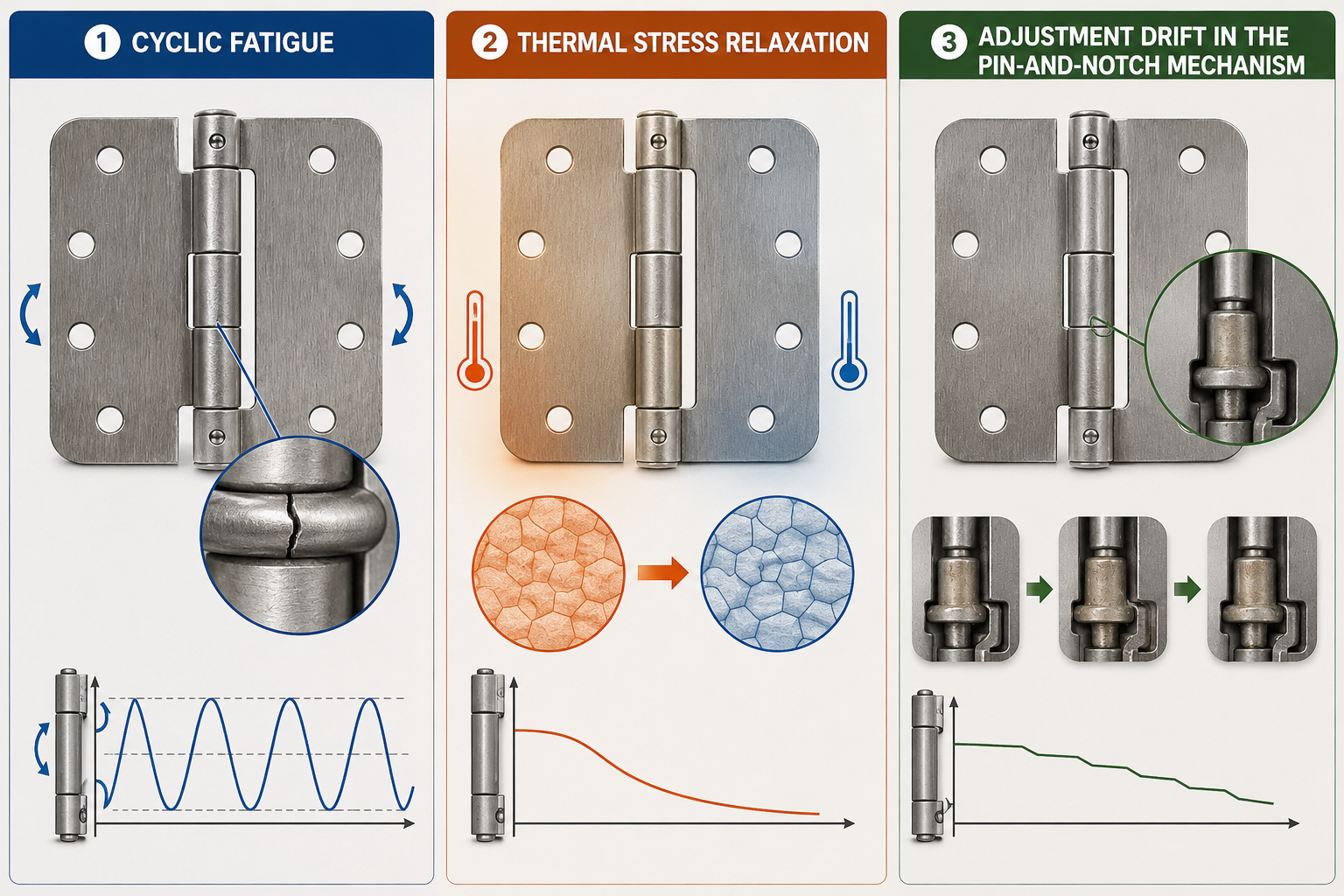
Spring hinge closing force does not disappear all at once. It erodes through three overlapping mechanisms, each documented in engineering literature and field practice.
1. Cyclic Fatigue of the Torsion Spring
The spring inside a hinge barrel is a torsion spring, a coiled metal element that stores and releases energy with each rotation. As cycle count accumulates, the spring’s stiffness gradually declines. The spring does not need to break to become a problem. It just needs to weaken enough that the door no longer latches reliably.
2. Thermal Stress Relaxation
Metal springs under sustained or cyclic load are subject to stress relaxation, a process in which internal stress redistributes over time and temperature, reducing net closing force. Force loss accelerates in high-temperature environments and with longer loading durations. Stairwell doors, exterior vestibule doors, and doors near mechanical rooms or loading docks are especially vulnerable because of seasonal temperature swings.
3. Adjustment Drift in the Pin-and-Notch Mechanism
Standard spring hinges set closing tension through a barrel rotation mechanism locked by a pin and notch. In theory, a facility technician can restore tension by rotating the barrel to a higher notch setting. In practice, this rarely happens after initial installation. The adjustment exists. It just does not get made.
In Summary, What Does a Spring Hinge Actually Need to Maintain Closing Force?
Three mechanisms cause force loss. Each one points to a specific requirement:
- Fatigue-resistant construction: the spring material and manufacturing method must resist stiffness loss over hundreds of thousands of cycles, not just survive to the end of the cycle test
- Field-adjustable tension: closing force must be measurable and restorable without removing the hinge from the door, so retensioning actually happens in practice
- Controlled closing speed: consistent force delivery across the full arc of travel, including the final degrees where latching occurs
Most standard spring hinges address none of these. The spring is stamped steel, tension is set once at installation, and the pin-and-notch adjustment goes untouched for the life of the opening. And that is the gap Waterson spring loaded door hinges are built to close.
When Waterson Spring Loaded Door Hinges Provide More Consistent Closing Force on Commercial Doors
Waterson spring-loaded door hinges are built from investment-cast Type 304 stainless steel, combining a mechanical spring with an optional hydraulic damping cylinder in a single barrel.
| Force Loss Mechanism | Root Cause | Waterson K51M Solution |
|---|---|---|
| Cyclic Fatigue | Stamped steel spring loses stiffness over cycles | Investment casting stainless steel resists stiffness degradation over thousands of cycles |
| Thermal Stress Relaxation | Internal stress redistributes under heat and load | Stainless steel 304 / 316 maintains spring integrity across temperature swings |
| Adjustment Drift | Pin-and-notch tension never gets restored after installation | Numerical tension panel lets installers measure and restore closing force in the field without removing the hinge |
Waterson Hinges Are UL Tested for up to 8 ft Doors
The ANSI/BHMA A156.17 standard specifies testing with three hinges on doors up to 7 ft. Most manufacturers stop there. Waterson went further and engaged UL Solutions to conduct a separate verification for 4-hinge configurations on 8-foot fire-rated doors.
| Certification | Details |
|---|---|
| ANSI/BHMA A156.17 Grade 1 Standard 3-hinge, up to 7 ft | Verified through 1,000,000-cycle endurance testing |
| Waterson 4 hinges; 8ft K51M-450 BHMA A156.17 | UL Solutions verified, 260 lb, 1,000,000-cycle. All Compliant |
| ANSI/BHMA A156.7 | Standard hinge template compliance |
| UL Listed | View certificate |
Waterson Grade 1 Self Closing Spring Hinges also come with the following key features:
- Self-Closing Mechanism: Spring-loaded (mechanical) at installation via numerical adjustment panel
- Soft Closing: Hydraulic damping cylinder, adjustable deceleration in final degrees of travel
- Fire Rated: UL Listed, 3-hour fire-rated
- Closing Speed Control: 3 adjustable speed zones: swing, latch, and backcheck
- Opening Force: 5 lbs or less, ADA compliant
- Hold Open: Optional, holds at 90°; door self-closes once moved past perpendicular
- Available Sizes: 4″, 4.5″, 5″, and 6″
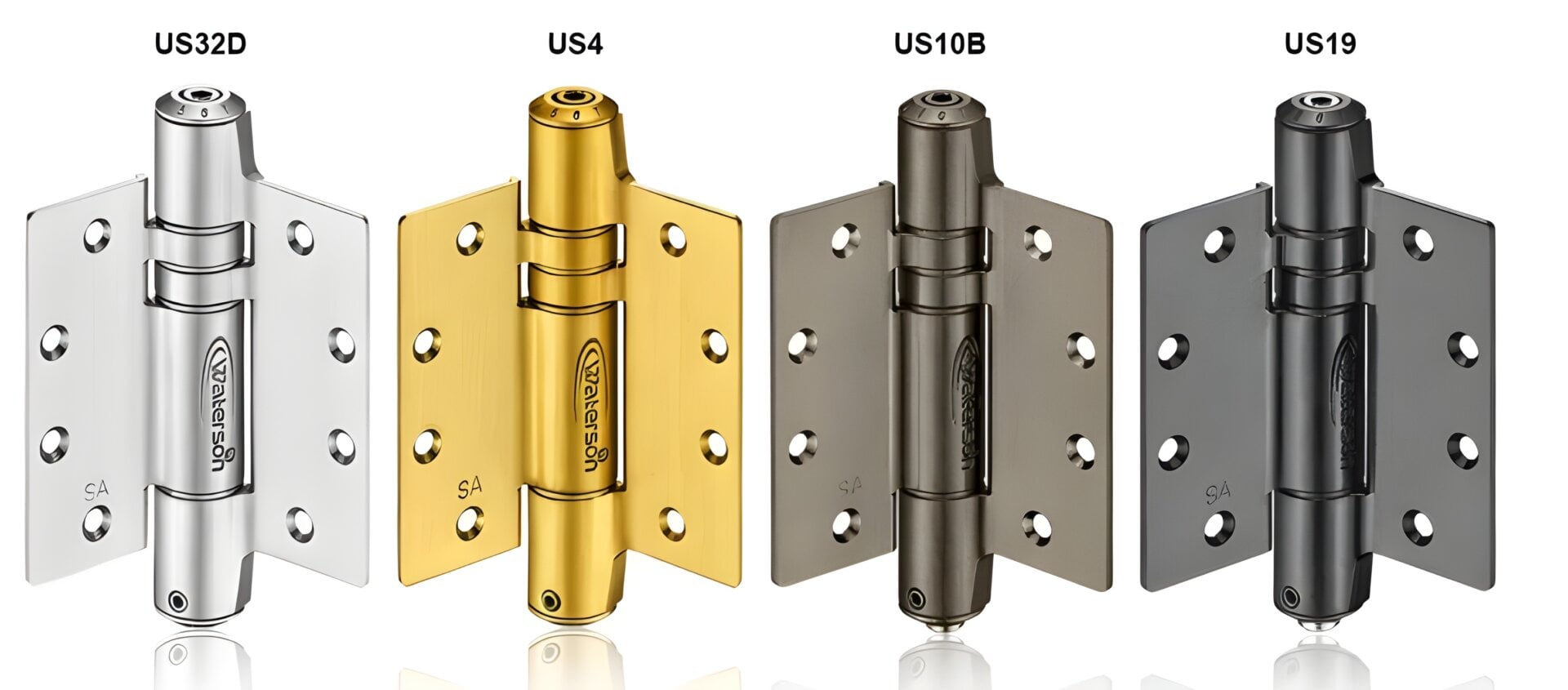
- Finishes: Satin, flat black, bronze, brass, and custom orders
- Warranty: 10-year mechanical / 3-year hydraulic
Frequent Asked Questions
No. Grade 1 certifies that the hinge passes a closing force measurement at the beginning of testing and that the hinge still functions after 1,000,000 cycles. The standard does not require manufacturers to measure or report residual closing torque at intermediate cycle counts. A hinge can pass Grade 1 while losing meaningful closing force well before the end of its rated cycle life.
Yes, in theory. Standard spring hinges use a pin-and-notch barrel that can be rotated to a higher tension setting. In practice, this adjustment is almost never performed after initial installation. Waterson’s numerical tension panel makes re-tensioning straightforward: the installer rotates the panel to a higher number and re-engages the locking mechanism, without removing the hinge from the door.
Yes. Waterson submitted the K51M-450 series for a separate UL Solutions verification for 4-hinge configurations on 8-foot doors weighing up to 264.6 lbs. That test covered all five ANSI/BHMA A156.17 Grade 1 performance categories and returned compliant results across all of them. The full letter report is publicly available on the Waterson website.
Waterson ANSI/BHMA A156.17 Grade 1 Self Closing Spring Hinges
Waterson self closing door spring hinges combine the function of an overhead closer and a hinge into a single, sleek component—complete with optional hold-open and door-stop features. Designed for commercial openings, gates, and glass doors, these hinges are easy to install and adjust to meet ADA and ICC A117.1 standards for opening force, while ensuring quiet and secure closure. Crafted from durable stainless steel, they are NFPA 80 compliant, UL 3-hour fire-rated, and built to perform reliably in both interior and all-weather exterior environments. See all our features.
In addition to these performance advantages, Waterson offers custom hinge services. As a direct manufacturer, we can tailor hinge sizes, finishes, and especially hinge leaf designs to meet the specific structural needs of your doors. This makes our hinges an ideal solution for door manufacturers seeking custom options that integrate seamlessly with their existing frames.
Request For Quote
Please note that Waterson Closer Hinges start from a size of 4″x4″. If you’re in need of smaller self-closing hinges, we’d recommend checking out some other resources! Also, we only provide single acting closer hinges. Thank you.
Recent Post
Which Gate Hinges Do Commercial Specifiers in Canada Use for Exterior Gates?
Most commercial self-closing hinges still adopt either spring or hydraulic damper for [...]
Which Steam Room Door Hinges Survive Commercial Heat: Mechanical or Hydraulic?
"Door size is 84" x 36" x 1.5" thick. Solid cedar with a 3.5" hinge stile and glass insert. It is for a commercial steam [...]
Patio Door Hinges: How to Stop Your Door from Slamming in the Wind?
"I'd like to order a set of these for my patio door hinges. Our discussion is below. Winds are getting heavy and I need something [...]