
“We manage a 40-unit assisted living community. The fire marshal wants every unit entry door to close and latch on its own, but several of our residents already struggle to open their doors. Is there hardware that satisfies both?”
This question, in one form or another, comes up in nearly every senior living project we work on. And honestly, it is a fair one. Assisted living doors sit at the intersection of two goals that often pull in opposite directions: they must protect residents during a fire, yet remain light and forgiving enough for someone with limited strength to use every single day.
The good news is that the codes are clearer than they first appear, and the right hardware can satisfy both sides. Let’s walk through the requirements step by step.
Assisted Living vs. Nursing Home: Why the Door Rules Are Different
Under the International Building Code (IBC), assisted living facilities are typically classified as Group I-1 or, for smaller communities, Group R-4. Nursing homes, on the other hand, are usually Group I-2 healthcare occupancies under the IBC and NFPA 101. That single classification changes what your resident room doors must do.
| Assisted Living (I-1 / R-4) | Nursing Home (I-2 Healthcare) | |
|---|---|---|
| Resident capability assumption | Residents can evacuate with limited assistance | Residents may be incapable of self-evacuation |
| Unit / room entry doors | Fire-rated assemblies, generally self-closing and self-latching | Corridor doors must resist smoke and positively latch; self-closing not always required |
| Typical door rating | 20-minute fire protection rating is common | 20-minute rating or 1-3/4″ solid bonded core wood in many existing facilities |
| Hold-open option | Permitted if released by the fire alarm (automatic-closing) | Permitted if released by the fire alarm (automatic-closing) |
In short, if you operate an assisted living community, plan on unit entry doors that close and latch by themselves. If you operate a nursing home, the emphasis shifts toward smoke resistance and positive latching. Either way, always confirm the details with your local Authority Having Jurisdiction (AHJ), since state licensing rules can add their own layers on top of the model codes.
Fire Rating Requirements: Self-Closing and Self-Latching Doors
Now, why do the codes insist that these doors close on their own? The logic is simple and, unfortunately, proven by real tragedies: a fire door only works when it is closed. An open door lets smoke and flames travel down the corridor, which is exactly where residents and staff will be during an evacuation.
That is why the IBC requires doors serving residential sleeping and dwelling units, including assisted living units, to be part of self-closing, self-latching fire door assemblies. In practice, that means three things must happen without anyone touching the door:
- The door returns to the closed position after every use, whether it was opened two inches or ninety degrees.
- The latch engages fully, because a door that closes but does not latch can be pushed open by fire pressure.
- Every component of the assembly, including the hinges, carries a listing appropriate for the door’s rating, per NFPA 80.
What if residents prefer their doors open during the day? The codes anticipated that too. A hold-open device is allowed, provided the door becomes automatic-closing, meaning the hold-open releases when the fire alarm activates and the door closes and latches on its own. Propping a fire door with a wedge or a decorative doorstop, however, remains a violation in any occupancy.
Just remember that: Under NFPA 101 and NFPA 80, fire door assemblies in assisted living buildings must be inspected annually. If a door has stopped latching because the spring hinges have worn out, that is a finding on your inspection report.

ADA Requirements: Opening Force, Closing Speed, and Hardware Height
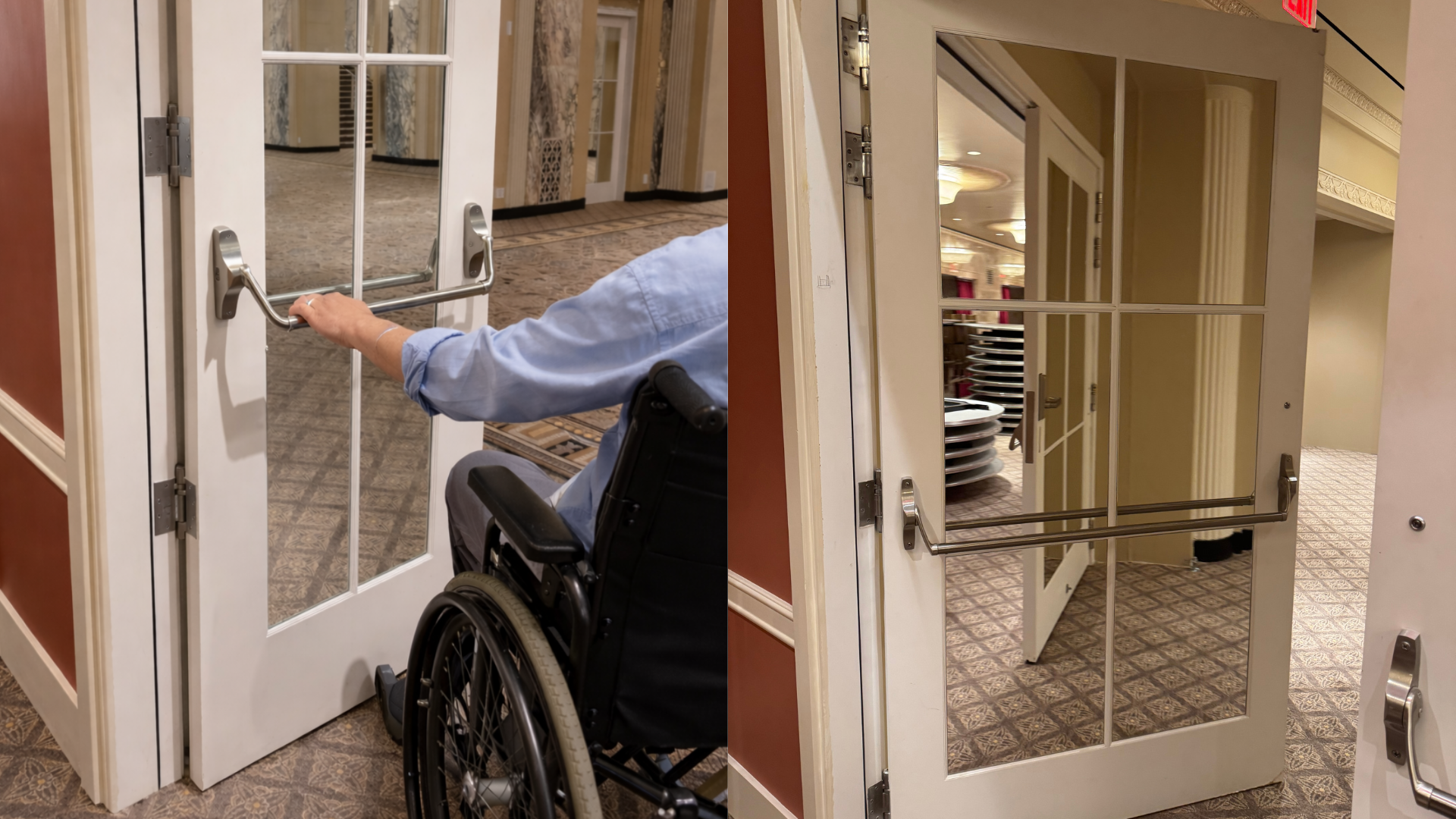
So far, so good for fire safety. Here is where it gets tricky. The same door that must reliably slam… sorry, close and latch on its own also has to be usable by a resident with arthritis, a walker, or one free hand. The ADA Standards for Accessible Design set specific, measurable numbers for that:
| Requirement | ADA Threshold |
|---|---|
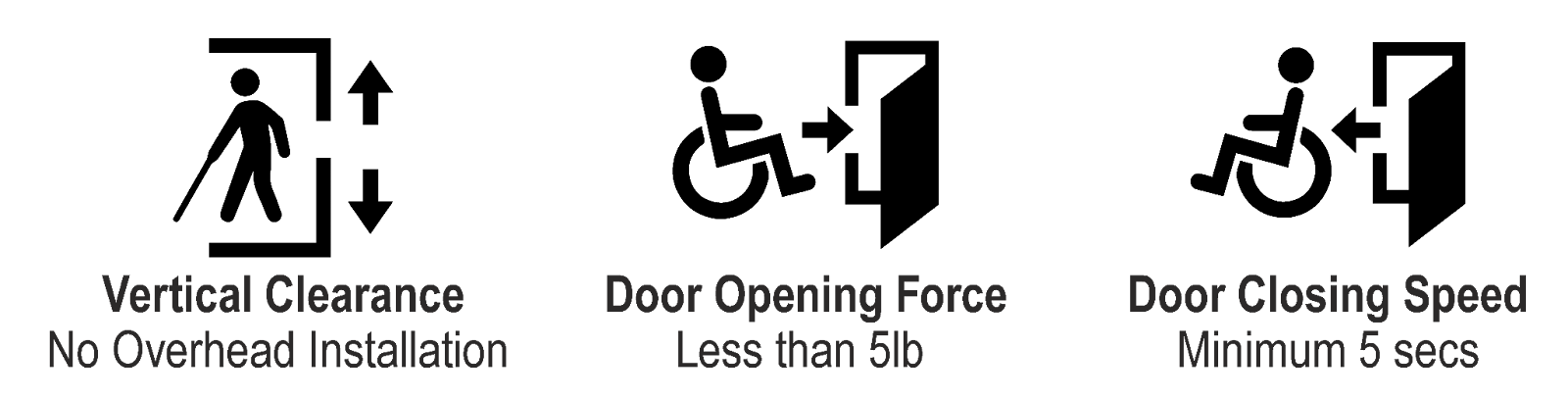
| Opening force, interior doors | 5 lbs maximum |
| Closing speed with a door closer | At least 5 seconds from 90 degrees open to 12 degrees from the latch |
| Closing speed with spring hinges | At least 1.5 seconds from 70 degrees open to closed |
| Hardware operating height | Between 34 and 48 inches above the floor |
| Hardware operation | One hand, no tight grasping, pinching, or twisting of the wrist |
Two of these deserve special attention in senior living. First, the 5 lb opening force: this does not apply to the fire-rated exterior or stairwell doors in every case, but for interior doors along accessible routes, 5 lbs is the ceiling, and many spring-hinged doors fail it. If you want to see how your doors measure up, a simple door pressure gauge will tell you in seconds. We cover the full testing procedure in our guide to ADA compliant doors.
Second, the closing speed. A door that snaps shut in under two seconds is not just non-compliant, it is a genuine hazard for someone moving at the pace of a walker. Which brings us to the next point.
Solving the Conflict: Light Opening Force vs. Reliable Latching
A door needs enough spring force to latch at the end of its swing, yet ADA limits opening force to 5 lbs. With single-tension spring hinges, you cannot have both: more tension latches the door but makes it heavy, less tension makes it easy to open but stops latching. We break down this trade-off in our article on ADA opening force vs. fire door latching.
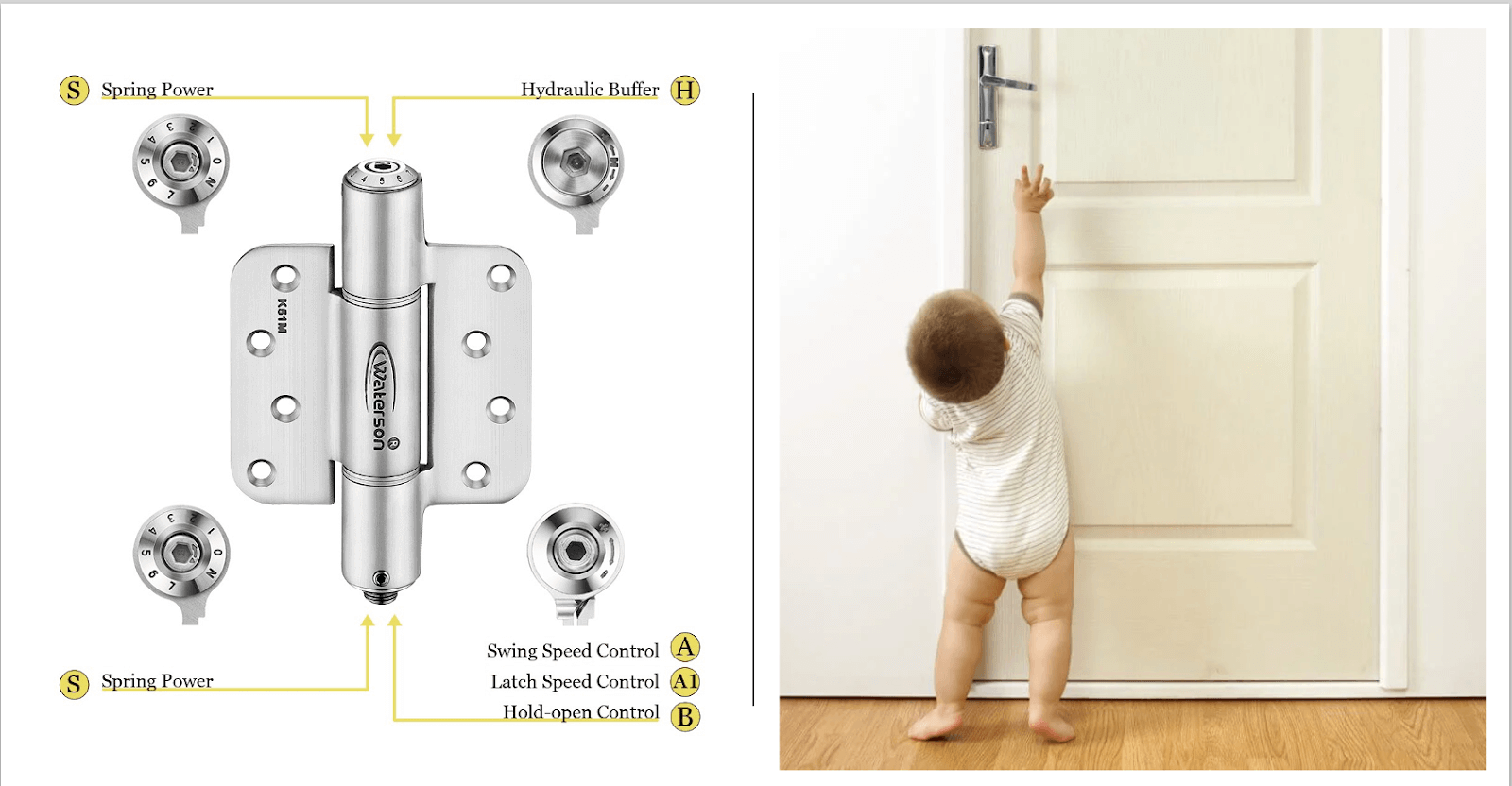
Closer hinges solve this by adjusting closing force and closing speed independently. The door swings closed at a steady pace, then a gentle final push engages the latch. A resident with arthritis can open it with two fingers, and it still closes and latches on its own, every time.
For residents using wheelchairs or walkers, swing clear hinges add one more fix: they move the door leaf completely out of the opening, often recovering the clear width needed for wheelchair access without widening the frame.
Waterson ADA Self-Closing Door Hinges for Assisted Living
Waterson ADA compliance self closing door hinges were built for exactly this kind of opening: doors that must satisfy the fire code, the ADA, and the resident, all at once. Each hinge combines a door closer mechanism, a spring hinge, and an optional hold-open into one clean component, with no overhead arm above the resident’s head and nothing to detract from a homelike interior.
Key features for senior living facilities include:
- Self-closing and self-latching: the built-in spring mechanism returns the door to the fully latched position after every use, keeping unit entry doors compliant without staff intervention.
- UL listed, 3-hour fire rated: certified for fire door assemblies and compliant with NFPA 80, suitable for 20-minute rated unit entry doors and beyond.
- ADA compliant operation: independently adjustable closing force and closing speed make it practical to meet the 5 lb opening force and the required closing time on the same door. Review our ADA testing documentation for details.
- Soft, quiet closing: the hydraulic damper eliminates slamming, protecting residents from contact injuries and keeping corridors calm.
- Optional hold-open and door stop: allows doors to rest open for housekeeping and social hours while remaining code-conscious when paired with the appropriate release arrangement.
- ANSI/BHMA A156.17 Grade 1: proven through 1,000,000 cycles, built for doors that open dozens of times a day, every day.
- Durable stainless steel: 304 and 316 stainless construction stands up to high-traffic corridors, humidity, and frequent cleaning protocols.
- Concealed, resident-friendly design: no protruding closer arm, no exposed cords, and finish options that blend with residential-style interiors.
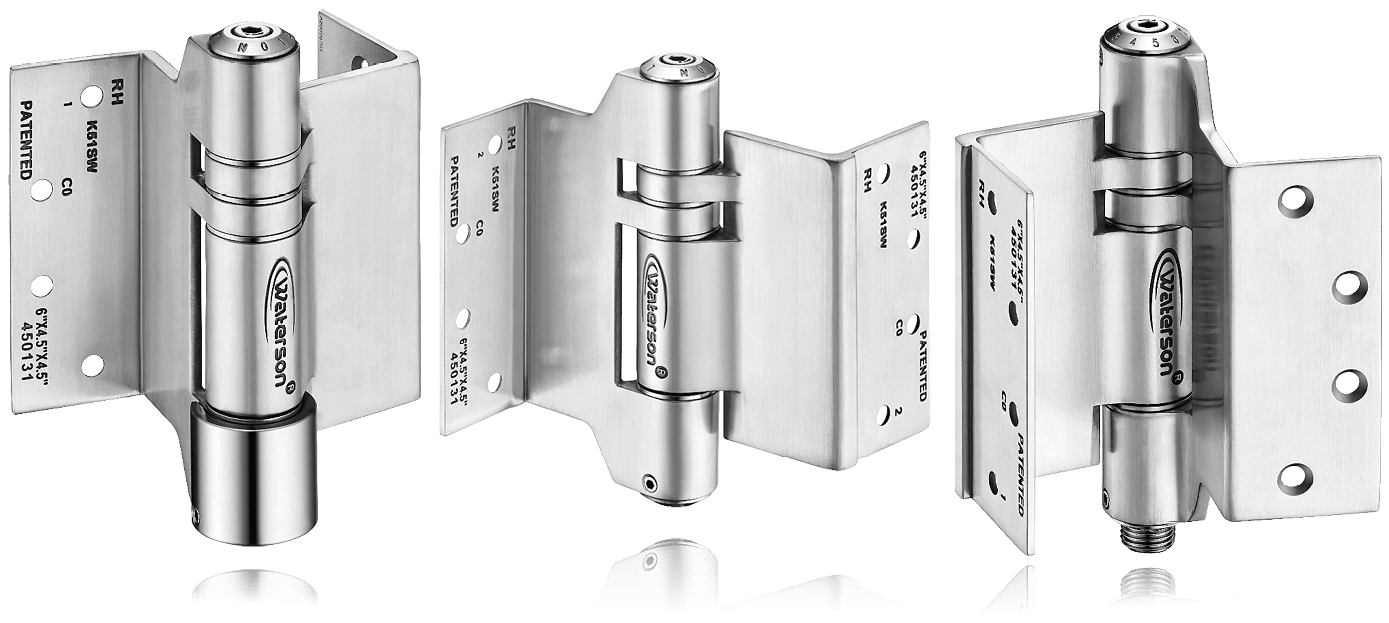
Waterson ADA Self Closing Swing Clear Hinges for Assisted Living Door
Waterson ADA self closing swing clear hinges stainless steels combine the function of an overhead closer and a hinge into a single, sleek component—complete with optional hold-open and door-stop features. Designed for commercial openings, gates, and glass doors, these hinges are easy to install and adjust to meet ADA and ICC A117.1 standards for opening force, while ensuring quiet and secure closure. Crafted from durable stainless steel, they are NFPA 80 compliant, UL 3-hour fire-rated, and built to perform reliably in both interior and all-weather exterior environments. See all our features.
In addition to these performance advantages, Waterson offers flexible custom hinge services. As a direct manufacturer, we can tailor hinge sizes, finishes, and especially hinge leaf designs to meet the specific structural needs of your doors. This makes our hinges an ideal solution for door manufacturers seeking custom options that integrate seamlessly with their existing frames.
Request For Quote
Please note that Waterson closer hinges start from a size of 4″x4″. If you’re in need of smaller self-closing hinges, we’d recommend checking out some other resources! Also, we only provide single acting closer hinges. Thank you.
Recent Post
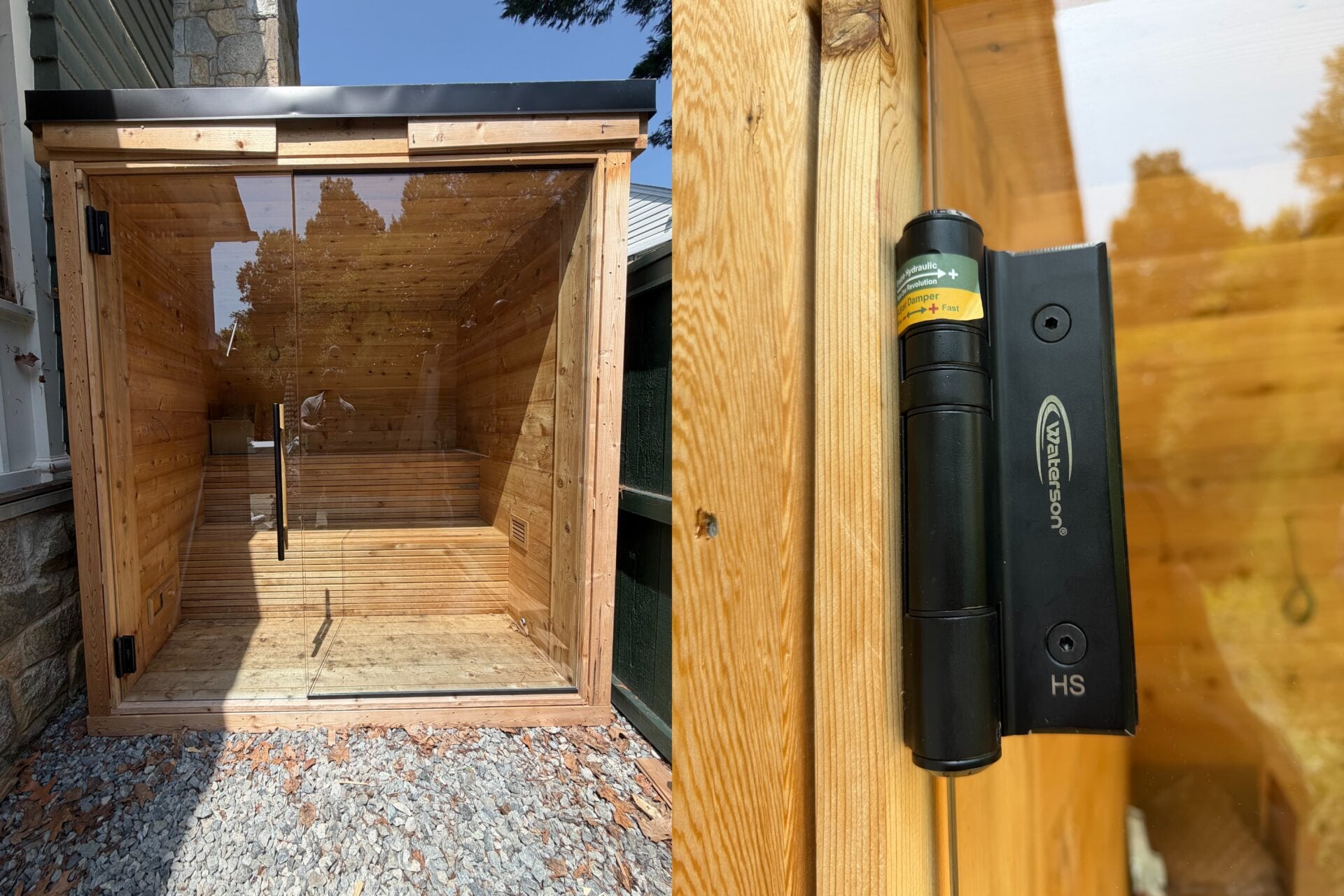
Frameless Glass Sauna Door Hinges: ADA Self Closing Solution for Commercial Saunas
Quick Answer For a frameless tempered glass sauna door that swings from a wall, use the Waterson K51GWL glass-to-wall hinge in the hydraulic hybrid version. [...]

Self Close vs Soft Close Hinges: Two Different Needs, Explained
Most commercial self-closing hinges still adopt either spring or hydraulic damper for [...]
4 Inch Self Closing Door Hinges for Residential & Commercial Doors
Quick Answer Waterson 4-inch self-closing hinges (K51M-400) fit standard 4" x 4" templates on 1-3/8" or 1-3/4" residential doors, in mechanical or hydraulic versions with [...]