
Quick Answer
Yes, many spring hinge problems like slamming and vibration can be fixed by lubricating, adjusting tension, or re-aligning the door, but traditional spring hinges only control closing force, not speed, so slamming can return. Waterson spring hinge self closing models are a direct replacement using the same ANSI A156.17 sizing, adding speed control, soft close, and numerical tension adjustment that regular spring hinges lack. If adjustment alone no longer solves the problem, swapping to a Waterson self closing hinge is the more permanent fix.
I have currently used some common spring hinges on my office doors, which now cause terrible slamming and vibration. Can Waterson fix the problem? Also, is it possible to replace traditional spring hinges with Waterson spring hinge self closing?
The good news is that many spring hinge issues are fixable with a few simple tools and the right technique. This guide walks you through the most common causes, what tools you’ll need, and exactly how to fix your spring hinges step by step. We’ll also cover when a fix is no longer enough, and what a proper upgrade looks like.
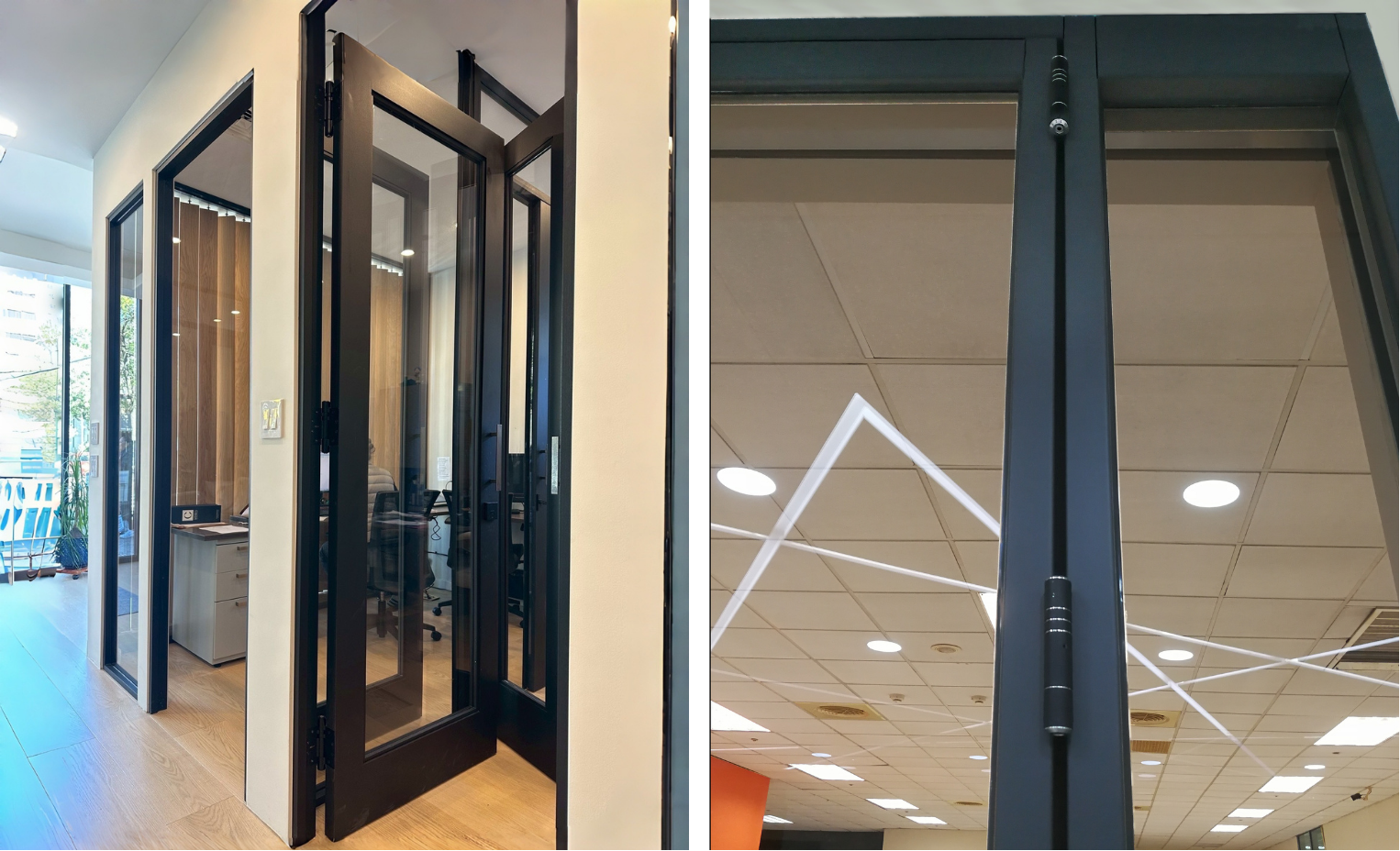
Why Do Spring Hinges Stop Working?
Most spring hinge problems fall into one of four categories:
- Loss of Spring Tension: Springs lose elasticity over time. Door drifts toward closed but won’t latch, or stops mid-swing.
- Wear and Tear: Pins, knuckles, and bearing surfaces wear down on high-traffic doors, causing wobble, grinding, or misalignment.
- Corrosion and Rust: Moisture and salt air degrade metal, causing stiffness, squeaking, and eventual failure: especially on exterior doors and gates.
- Misalignment: A shifted frame or improper installation works against the door’s geometry. Tension adjustment alone won’t fix this.

So What You’ll Need Before You Start Fixing Spring Hinges?
Gather these tools before beginning. Working with tensioned spring mechanisms requires care; having everything on hand means you won’t be tempted to improvise mid-adjustment.
| Tool | Why You Need It |
|---|---|
| 3mm & 5mm Hex Wrenches | For adjusting tension and speed (included with Waterson hinges) |
| Phillips Screwdriver | Removing/installing hinge screws on door and frame |
| Spreader Bar | Included with double spring (DS) hinges for installation |
| Penetrating Oil | Lubricating squeaky or stiff hinges before adjustment |
| Door Wedge / Metal Door Shim | Supporting the door safely during hinge removal |
| Safety Glasses | Protection when working with tensioned spring mechanisms |
| Masking Tape + Marker | Marking current tension positions before adjusting |
Spring hinges store significant rotational force. Never remove hinge pins without releasing tension first, or the hex key can spin violently if the spring releases unexpectedly.
How to Fix Spring Hinges: A Step-by-Step Guide
| STEP | ACTION |
|---|---|
| Step 1 | Diagnose. Observe door behavior across multiple cycles |
| Step 2 | Lubricate. Apply oil to the pin and barrel; test before adjusting |
| Step 3 | Adjust tension. Clockwise = more force, counterclockwise = less |
| Step 4 | Re-align. Check door gaps; shim if frame is off-plumb |
| Step 5 | If still failing. Consider upgrading to a hydraulic self-closing hinge |
Here Are a Few Tips Before You Finish:
- Never over-tighten. If a door requires more than 8 lbs to open, it likely violates ADA requirements (max 5 lbs for interior doors).
- Adjust one hinge at a time. On a three-hinge door, start with the middle — it bears the most load.
- Temperature affects tension. Metal contracts in cold weather. Re-check seasonal adjustments in extreme climates.
- Don’t paint over hinges. Paint seals the barrel and pin, making future adjustment extremely difficult.

Can Adjusting Fix Every Door Problem?
The Honest Truth About DIY Fixes Spring hinge adjustment can solve many door problems, but it has limits. Traditional spring hinges can only control closing force through tension. They have no speed control, no soft-close buffer, and no way to prevent slamming independently of tension. If you’ve adjusted your hinges correctly and the door still slams, squeaks, or fails to latch reliably.
And that’s where upgrading to a hydraulic self-closing spring hinge, like Waterson Hinges, makes the difference.

Ideal Spring Hinge Replacement Option: From Regular to Waterson Self-Closing
If you’ve reached the limits of DIY adjustment, or if your facility demands more reliable performance than traditional spring hinges can provide, it’s time to consider a direct replacement with Waterson self-closing spring hinges. Here’s why
Visibility
First, yes Waterson spring hinge self closing can easily fix your slamming problem. Traditional hinges typically can only adjust tension force, however, a new spring hinge replacement allows you to adjust both tension and speed control. This helps our spring hinges perform more like door closers.

Hassle-Free Replacement
Second, you can definitely replace traditional spring hinges with Waterson spring hinge self closing. Waterson also follows the same ANSI A156.17 standard: simply select the appropriate size based on your door prep needs.
- 4″ × 4″: Standard interior doors
- 4.5″ × 4.5″: Commercial doors, heavier residential
- 5″ × 5″: Heavy commercial and institutional doors
- 6″ × 6″: Extra-heavy duty applications
Go further with the Waterson Door Hinge Size Explanation here.

How Waterson Spring Hinges Outperform Traditional Spring Hinges
Here is how Waterson closer hinges compare with a traditional spring hinge, point by point:
| Feature | Traditional Spring Hinge | Waterson Spring Hinges |
|---|---|---|
| Materials | Steel, brass or stainless, varies by brand | Type 304 stainless steel standard, Type 316 optional |
| Self Closing | Yes, spring only | Torsion and disc springs ensure positive closure |
| Anti Slamming | No speed control, so doors often slam | Latch speed control slows the last 20°, plus hydraulic soft close on hybrid sets |
| Tension Adjustment | Feel-based, guesswork, or a fixed setting with no adjustment option | Numerical panel, precise |
| Adjustment Indicator | None | Visible scale / markers |
| Speed Control | Tension only | Separate swing speed (90° to 20°) and latch speed (last 20°) adjustment |
| Load Capacity | Varies by grade | Up to 260 lb with 3 hinges, or 330 lb with 4 hinges. Contact Waterson for larger doors |
| Corrosion Resistance | Varies by material and finish | Stainless steel throughout, with an optional weather-resistant cap for wet and exterior locations |
| ADA Compliant | Varies | Adjustable to 5 lbf max opening force and 5 seconds min closing (90° to 12°) |
| Fire Rating | Varies | All-mechanical models UL listed up to 3 hours, NFPA 80 compliant (without hold-open) |
| ANSI Standard | ANSI/BHMA A156.17, grade varies | ANSI/BHMA A156.17 Grade 1, all-mechanical models tested to 1,000,000 cycles |
| Warranty | Varies by brand | 10 years for mechanical hinges, 3 years for hydraulic hybrid hinges, indoors and outdoors |
Not sure which type fits your door? Compare mechanical vs hydraulic closer hinges.
What Could Be the Limitation in Waterson K51M 4inch Hinge Barrel Size
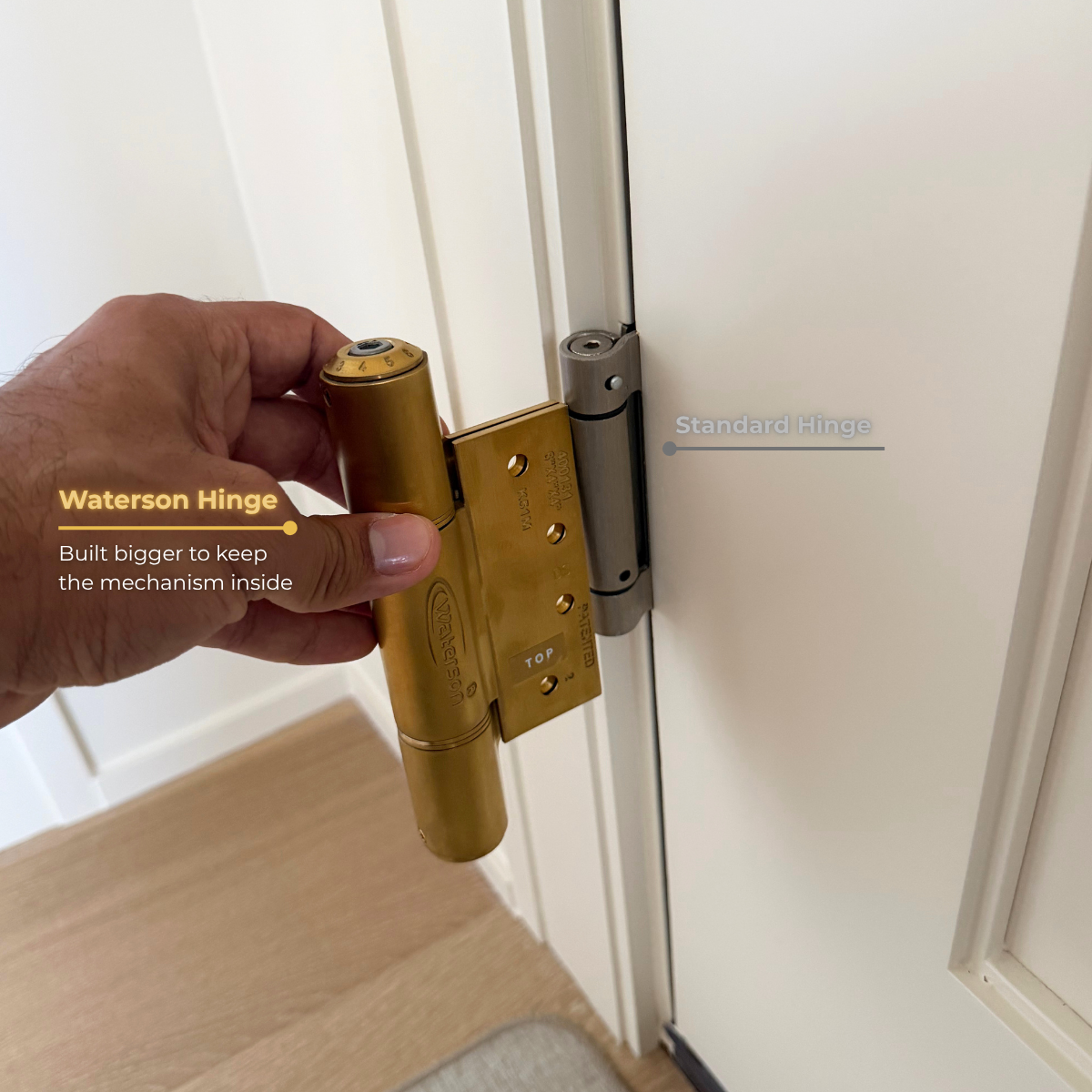
On a retrofit, the Waterson 4×4 uses the same mortise template as a standard 4×4 butt hinge, so the leaves drop into the cutout you already have. The difference is the barrel. It is built bigger to keep the hydraulic mechanism inside, and that thicker barrel moves the pivot further off the door and frame, shifting the door roughly a quarter inch toward the strike jamb.
For most doors, that shift is absorbed by the normal strike side gap, and we have not seen this issue on garage entry doors. It mainly shows up on tight custom doors, where the strike edge can end up touching the frame, and deepening the mortise only helps if there is room on the strike side to take it. If you are retrofitting, check your clearance first, because with this hinge, the barrel diameter, not the leaf size, decides whether it fits.
In short, the issue only comes up when retrofitting an interior door with an uneven or tight gap on the strike side. On new installations, or on any door with an even gap between the door and the frame, the Waterson 4-inch hinge fits and works just like a standard hinge.
Most spring hinge problems start with lost tension, worn parts, or a door that has shifted out of line, and a careful adjustment fixes many of them. But a traditional spring hinge can only change how hard the door closes, not how fast. If the door still slams after you have set the tension correctly, the hinge has reached its limit.
Waterson closer hinges drop into the same hinge prep and add what regular spring hinges are missing: separate control of closing force, swing speed and latch speed. Use all-mechanical sets on fire doors and exterior doors, and hybrid sets where you want a softer, quieter close indoors.
Frequently Asked Questions
Request For Information
Please note that Waterson Closer Hinges start from a size of 4″x4″. If you’re in need of smaller self-closing hinges, we’d recommend checking out some other resources! Also, we only provide single acting closer hinges. Thank you.
Recent Post
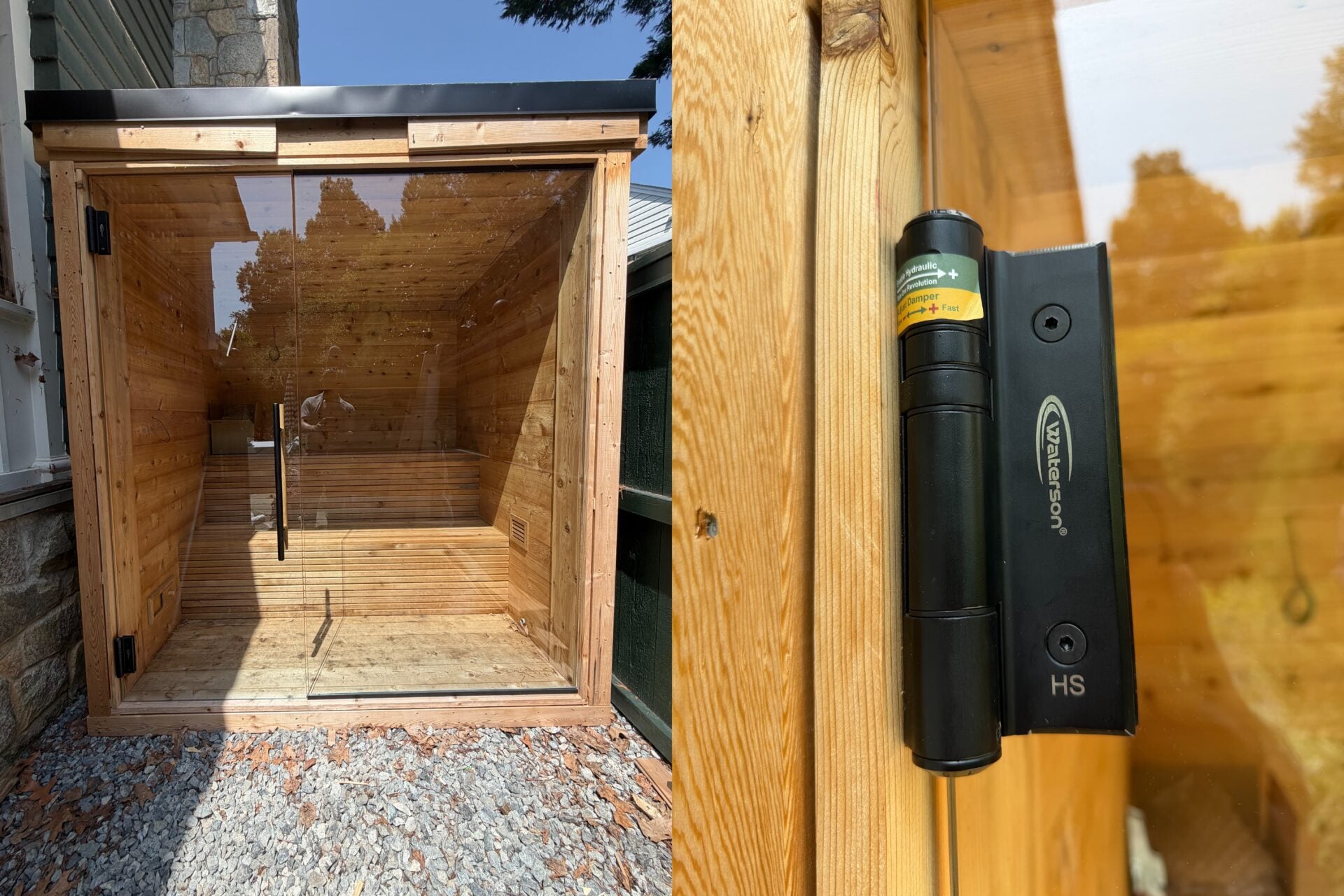
Frameless Glass Sauna Door Hinges: ADA Self Closing Solution for Commercial Saunas
Quick Answer For a frameless tempered glass sauna door that swings from a wall, use the Waterson K51GWL glass-to-wall hinge in the hydraulic hybrid version. [...]

Self Close vs Soft Close Hinges: Two Different Needs, Explained
Most commercial self-closing hinges still adopt either spring or hydraulic damper for [...]
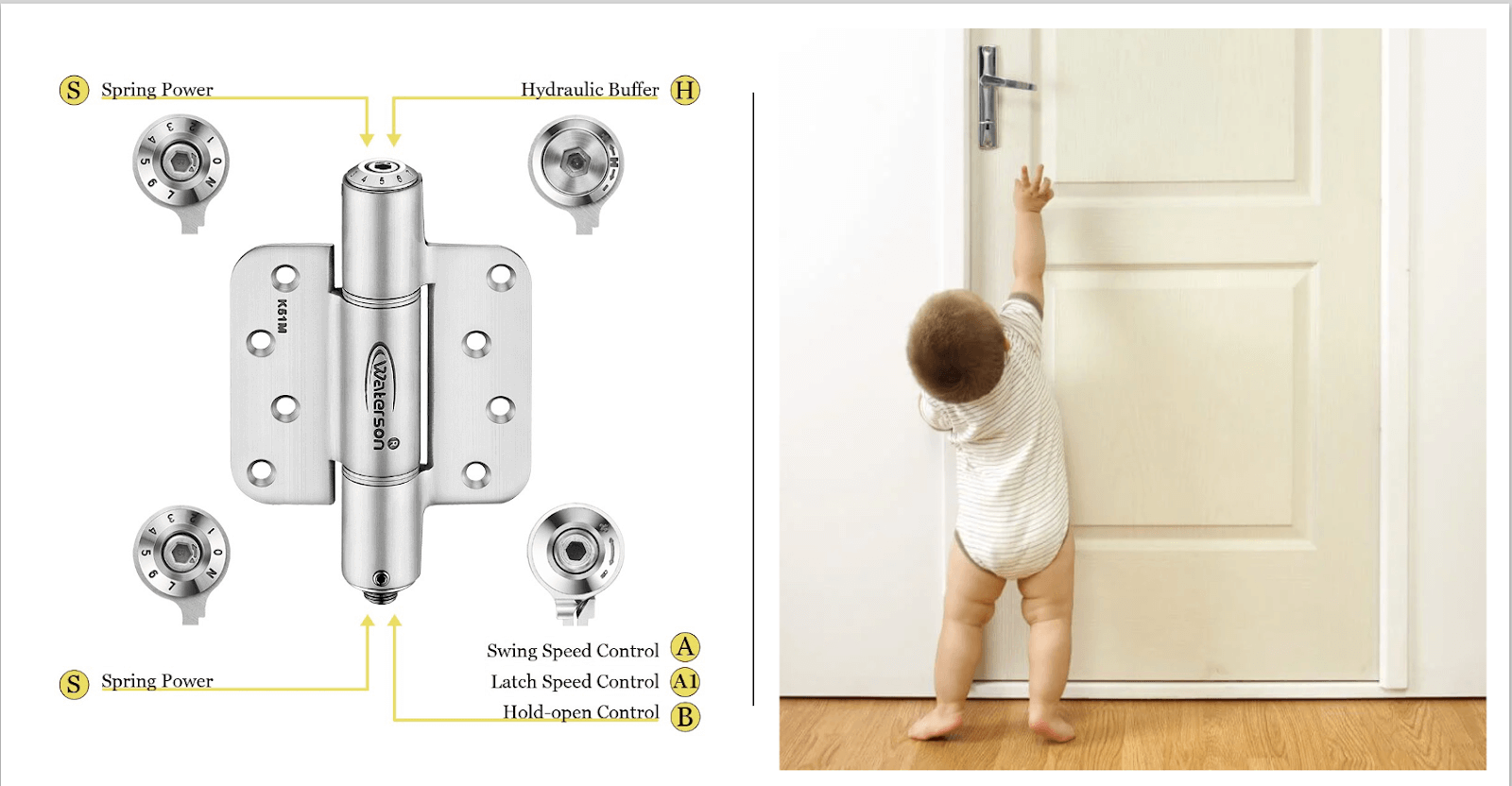
4 Inch Self Closing Door Hinges for Residential & Commercial Doors
Quick Answer Waterson 4-inch self-closing hinges (K51M-400) fit standard 4" x 4" templates on 1-3/8" or 1-3/4" residential doors, in mechanical or hydraulic versions with [...]